

Customs paperwork is part of sending an online order from the UK to Greece: a customs declaration has been required since 1 January 2021. To ship UK online orders to Greece, you’ll need to describe the contents accurately and consider whether parcel or freight transport best suits the shipment.
It’s natural to want a straightforward route from checkout to delivery, without surprises over paperwork or restricted items. This guide explains how to ship UK online orders to Greece, prepare a parcel, and understand customs declarations and item restrictions.
You’ll also learn how parcel and cargo services differ, which details shape the transport plan, and how to prepare an accurate Greek delivery address. These steps help you choose an arrangement for a single purchase or a larger shipment.
Key Takeaways
- Prepare a clear customs declaration for each parcel, with an accurate description of its contents and value.
- Choose between express and economy delivery by weighing the delivery timeframe against the needs of your order.
- Review restrictions before packing, as some goods may be prohibited or require additional checks for delivery to Greece.
- For larger or multiple shipments, consider how freight and cargo transport could suit your UK-Greece delivery needs.
Customs declarations after Brexit
Shipments from the UK to Greece require customs information. Accurate details help customs assess the goods and give the recipient clear information about the shipment.
Customs declarations and documentation
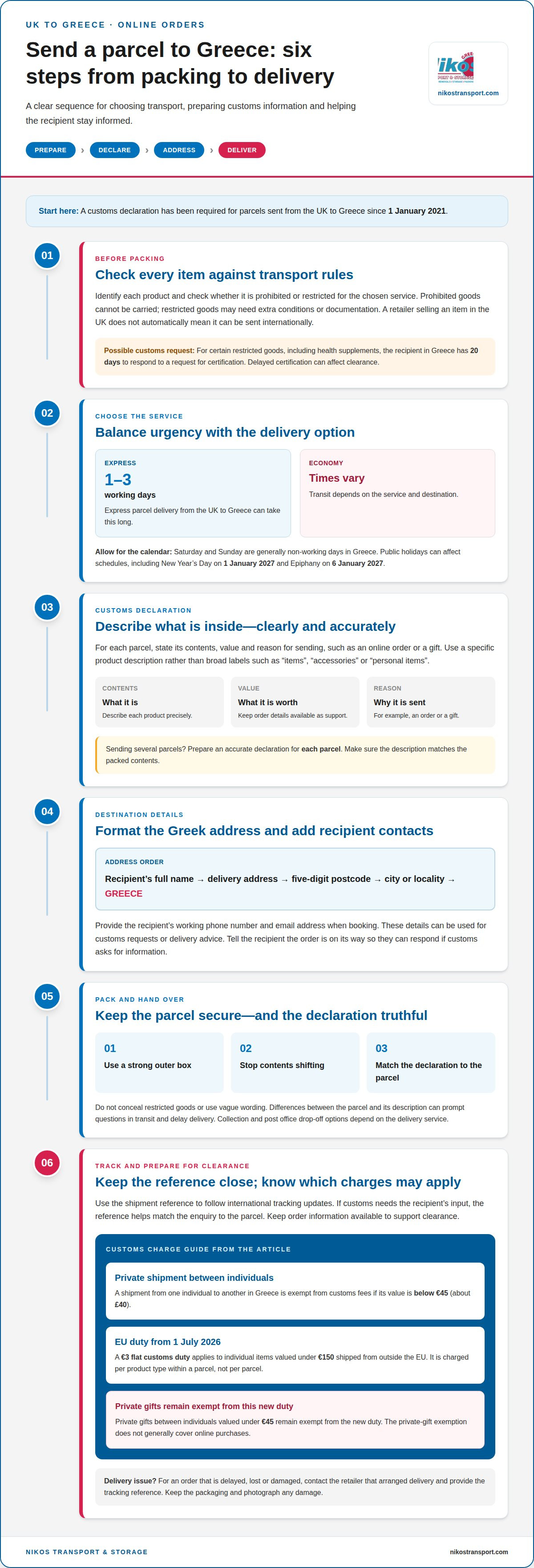
A customs declaration has been required for parcels sent from the UK to Greece since 1 January 2021. It describes the package contents, their value and the reason for sending them, such as an online order or a gift. In the booking format, enter clear descriptions rather than broad labels such as “items”.
For an order with several parcels, prepare an accurate declaration for each one. Include the recipient’s full name, delivery address and contact details so they can be reached about clearance. Keep the order information available to support the declared contents and value, and help the recipient understand any delivery instructions.
Customs, prohibited and restricted items
Check whether an item is prohibited or restricted before packing it. Restrictions can require extra documentation or action from the recipient. For example, recipients in Greece have 20 days to respond to a request for certification for certain restricted goods, including health supplements. A delay in providing requested certification can affect clearance.
Customs charges also depend on the shipment and current rules. A shipment from one individual to another in Greece is exempt from customs fees if its value is below €45 (about £40). From 1 July 2026, the EU applies a €3 flat customs duty to individual items valued under €150 shipped from outside the EU. It is charged per product type within a parcel, not per parcel. Private gifts between individuals valued under €45 remain exempt from this new duty.
Recipient details and DHL contact advice
Provide a working phone number and email address for the recipient when booking. The delivery service can use these details to pass on customs requests or delivery advice. Let the recipient know the order is on its way so they can respond if customs requests information.
DHL customer-service hours and call charges vary by contact method. Use the DHL contact details shown for the shipment, note any call-charge information, and check the opening hours before calling. If customs needs the recipient’s input, provide the shipment reference so the enquiry can be matched to the right parcel.
How do I send a parcel to Greece?
To ship UK online orders to Greece, choose a transport service, enter the destination accurately, and prepare the goods for collection or delivery. Your choice affects the transport arrangements, tracking and delivery process.
Delivery options and transit times
Express parcel delivery from the UK to Greece can take 1-3 working days. Economy delivery times can vary depending on the service and destination. Weigh urgency against the service you select, as the destination area and local delivery arrangements can also affect the journey.
Greece generally treats Saturday and Sunday as non-working days. Public holidays can affect delivery schedules, including New Year’s Day on 1 January 2027 and Epiphany on 6 January 2027. Retailers that ship UK online orders to Greece set their own delivery destinations and free-shipping offers, which are shown during checkout.
Tracking and delivery coverage
For international tracking, use the shipment reference to follow status updates. Enter the recipient’s full Greek address, with the five-digit postcode before the city or locality. Write GREECE in capital letters on the final address line to make the destination clear.
Collection and post office drop-off options depend on the delivery service. If an order is delayed, lost or damaged, contact the retailer that arranged delivery and provide the tracking reference. Keep the packaging and photograph any damage to support your report. Delivery to Greek islands and returns depend on the retailer’s policy, so review its terms at checkout.
Import thresholds and exemptions
Order value can affect customs charges, but the private-gift exemption doesn’t generally cover online purchases. From 1 July 2026, the EU applies a €3 flat customs duty to individual items valued under €150 shipped from outside the EU. It’s charged per product type within a parcel. Private gifts between individuals valued under €45 remain exempt from this new duty.
Use the item value and shipment type to understand which rules apply. Keep the retailer’s order details available in case the recipient needs them for customs clearance.
Prohibited items
Before sending a parcel to Greece, identify every item and check the transport service’s rules for it. A retailer’s decision to sell an item in the UK does not automatically mean it can be sent internationally. Prohibited goods cannot be carried, while restricted goods may require extra conditions or documentation. Check each item individually, especially in orders containing different product types.
Describe each product precisely, rather than using a broad label such as “accessories” or “personal items”. Record what it is, what it is made from, and how it is used. A clear description distinguishes products with similar names but different contents. For mixed orders, describe each component accurately instead of listing only the main item.
Restrictions can depend on the item and the country of destination. For UK-to-Greece shipments, customs may request certification for certain restricted goods, and the recipient has 20 days to respond to that request. Share the shipment details with the recipient before sending, so they recognise any customs communication and can respond within the stated period.
Once the items are accepted for transport, pack them securely. Use a strong outer box, prevent the contents from shifting, and make sure the declaration matches what is packed. Don’t conceal a restricted item inside another product or use vague wording to avoid scrutiny. Differences between the parcel and its description can prompt questions in transit and delay delivery.
Check the transport service’s prohibited and restricted-item conditions before booking, particularly for products requiring special handling or containing specific materials. If the service won’t accept an item, don’t put it in the parcel and hope it passes inspection. Remove it, choose an eligible transport arrangement, or ask the retailer about alternatives. Express transit and full tracking are delivery options, not permission to carry prohibited goods.
UK-Greece freight and cargo services
A single parcel and a larger cargo consignment need different planning. First identify what needs to travel, where it must be collected, and where it should arrive in Greece. These details help determine transport arrangements, handling needs and the documents required for an international shipment.
For several boxes, bulky goods or a combined load, prepare an inventory before booking. Record each item’s description, quantity, dimensions and weight, then group items that need similar handling. A clear inventory helps prevent confusion at collection and gives the transport provider useful information for planning space. It also supports accurate shipping documents and customs declarations.
Collection and delivery arrangements are central to the plan. Confirm the UK collection address, access for loading, Greek delivery address and whether someone can receive the goods. For example, a flat with limited access may need different handling from a business with goods ready at ground level. Share access details early and make sure the recipient knows when to expect the shipment.
Transit time depends on the transport arrangement, route, shipment size and destination. International cargo may involve more handling stages than a small courier parcel, so allow for customs processing and possible delays. Keep the shipment reference and document copies together. If the goods arrive in separate consignments, match each delivery against the inventory as it is received.
Freight planning can help when an order is too large, heavy or numerous for an ordinary parcel service. Pack each item securely, label boxes clearly, and ensure the contents match the paperwork. These steps help keep collection and transport organised. A quote depends on factors such as dimensions, weight, collection and delivery points, and handling requirements.
For a larger shipment or several parcels, discuss your UK-Greece transport requirements and plan the collection, documentation and delivery around the goods being sent.
Nikos Transport & Storage: Transport To/From Greece
Nikos Transport & Storage helps individuals and businesses move online orders and other goods between the UK and Greece. Its Amazon & Online Orders service handles purchased items, while Transport To/From Greece can support larger or multiple shipments.
Consider this service when a standard parcel delivery does not suit the shipment’s size, collection arrangements or delivery needs. If the goods cannot be received straight away, Storage Service can form part of the plan. The right arrangement depends on what you’re sending, where it needs to be collected and its destination in Greece.
To plan transport for an online order or larger shipment, contact Nikos Transport & Storage for a quote.
Plan your next shipment with confidence
Before arranging delivery, consider what needs to travel and how it should reach its destination. A single online purchase may need a different arrangement from several parcels or goods requiring temporary storage. Matching the transport plan to your shipment gives you a clear starting point.
Nikos Transport & Storage offers Transport To/From Greece, Transport To Cyprus and Storage Service. If you’re planning to ship UK online orders to Greece, these services can help shape a plan around your goods and destination. Discuss the transport or storage arrangements that suit your requirements and decide on the next step.
When you’re ready to talk through your shipment, contact Nikos Transport & Storage. A conversation about what you’re sending and where it needs to go is a practical place to begin.
Frequently Asked Questions
Do I pay Customs Charges from the UK to Greece?
Customs charges can apply to online purchases sent from the UK to Greece. The private-gift exemption for shipments between individuals is different: gifts valued below €45 are exempt from customs fees, and private gifts below €45 remain exempt from the EU duty introduced from 1 July 2026. An online order is a purchase, not a private gift, so don’t assume the gift exemption applies.
Is there import tax from the UK to Greece?
Greek VAT is usually 24%, and imported online orders may also be subject to import VAT. VAT and customs duty are separate charges, so an order could involve both. The goods’ description, value and import arrangement affect the amount assessed. Keep the retailer’s invoice and order confirmation available, as they show what was purchased and the transaction value.
What customs duties and import VAT apply to online orders shipped from the UK to Greece?
From 1 July 2026, the EU flat customs duty is €3 on individual items valued under €150 shipped from outside the EU. It applies per product type within a parcel, rather than once per parcel. Greek VAT is usually 24%. These are separate charges; the product type and customs value help determine how charges apply to a particular order.
How do I calculate and pay customs charges on a UK delivery to Greece?
Start with the order invoice and identify each product type and its value. Distinguish customs duty from Greek VAT, as they are separate charges and may be calculated differently. For the amount due on a specific shipment, follow the payment instructions on the charge notice issued for that delivery. Keep the receipt with your order records.
Which couriers ship from the UK to Greece, and how do their prices and services compare?
Parcel services offer different delivery speeds and arrangements, so compare the service details shown for your destination. Express delivery can take 1-3 working days, while economy delivery can take between 3 and 7 days. Check whether the option includes tracking, collection or drop-off, and how customs information is handled. Prices vary by service and shipment details, so compare the quote presented for your parcel.
What items are prohibited or restricted when shipping parcels from the UK to Greece?
There is no universal list that applies to every delivery service. The carrier’s prohibited and restricted-goods conditions determine what it will accept, and restrictions can depend on the item’s contents and destination. Before packing, identify each product precisely and compare it with the chosen service’s rules. If an item is restricted, establish its documentation requirements before sending it; don’t conceal it inside another product.


