
Customs paperwork for moving to Greece usually includes a detailed inventory, your passport, proof of a Greek address and evidence of your residence status. To seek transfer of residence relief, you generally need to have lived outside Greece for the previous 24 months, and the household goods must have been owned and used for at least six months. Pets and vehicles have separate requirements, so they need planning alongside your household shipment.
It’s understandable to think a move is mainly about packing and transport, but customs documents can also affect how smoothly your belongings clear. This guide explains the paperwork commonly required, how transfer-of-residence relief works and what to prepare early to help reduce delays.
You’ll also find key points to consider when bringing a pet or vehicle, and how a removal company’s customs support can help organise your shipment and declarations. Follow the steps to prepare for your move with greater confidence.
Key Takeaways
- Establish whether your move qualifies for transfer of residence relief by considering where you have lived and whether you are genuinely moving your main home.
- Gather residence, work and tax records early, and organise the customs documents before the move is packed.
- Prepare an itemised inventory with clear descriptions; appliance details can help make the contents easier to identify during customs checks.
- Customs declaration support from a removal company can help coordinate the paperwork and clearance process for your shipment.
What Is Transfer of Residence Relief in Greece?
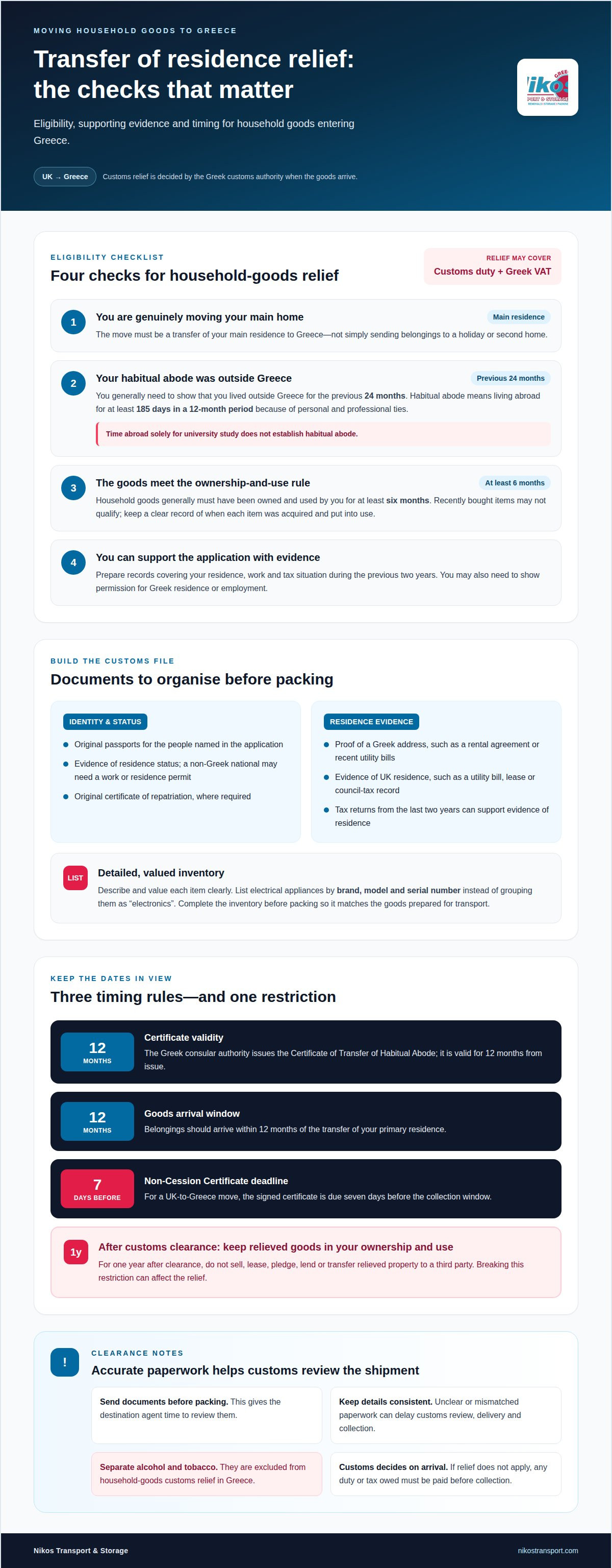
Used household goods may qualify for relief from Greek customs duty and VAT when you genuinely transfer your main home to Greece. Generally, you must have owned and used the goods for at least six months.
If relief doesn’t apply, customs duty and import VAT may be due on the goods. Greece’s customs authority decides whether to grant the exemption when your belongings arrive.
-
Check belongings’ ownership and use
First, identify the household goods you have owned and used for at least six months before moving. This is the minimum period goods generally need to meet to qualify for relief, so recently bought items may not be eligible. Keep a clear record of when you acquired and began using each item, so the shipment can be assessed against the requirement.
-
Identify the relief and charges
Establish whether you’re transferring your main residence, rather than sending belongings to a Greek holiday or second home. A genuine transfer may qualify used household goods for relief from customs duty and Greek VAT. If you don’t qualify, any duty or tax owed must be paid before you collect your belongings. Charges depend on the customs treatment of the shipment, not simply on it being a household move.
- Gather evidence of where you have lived and your plans to relocate. You generally need to show that your habitual abode was outside Greece for the previous 24 months. For this process, habitual abode means living abroad for at least 185 days in a 12-month period because of personal and professional ties. Time abroad solely for university study doesn’t establish habitual abode.
Prepare records covering your residence, work and tax situation during the previous two years. Evidence of UK residence can include a utility bill, lease or council-tax record; Greek proof may include a rental agreement or recent utility bills. Tax returns from the last two years can also support your evidence of residence.
- Confirm the residence and arrival timeline. The Greek consular authority issues the Certificate of Transfer of Habitual Abode, which is valid for 12 months from issue. The customs authority decides whether to grant relief when the goods enter Greece. Belongings should arrive within 12 months of your primary-residence transfer. You may also need to show permission for Greek residence or employment.
Customs clearance delays caused by incomplete paperwork
Household belongings sent from the UK must clear Greek customs on arrival. Used goods may qualify for relief, while any duty or tax owed must be paid before collection. Clearance timing depends on the document review and any required payment.
-
Prepare destination documents
Organise the customs information and supporting documents before the removal team packs your belongings, allowing time for review. Include clear shipment details and the destination documents required for your circumstances. For a UK-to-Greece move, the signed Non-Cession Certificate is due seven days before the collection window. Late or inconsistent paperwork can prevent customs authorities from processing the shipment promptly.
Describe the goods accurately and identify alcohol or tobacco separately. These items are excluded from household-goods customs relief in Greece, so don’t list them as ordinary personal effects.
-
Complete export declarations
Coordinate the export paperwork with the consignment instructions and destination details. Keep information consistent across the documents, including the route and the goods being transported. Mismatches can prompt questions during customs clearance. Export requirements depend on the direction of travel, so paperwork for a Greece-to-UK shipment is not interchangeable with paperwork for a UK-to-Greece move.
For Greek export clearance on UK-bound moves, the listed documents include a unique reference number from a Transfer of Residence application, consignment instructions and the EU exit point. These details apply to that direction of travel.
-
Submit paperwork for customs clearance
Send the customs information and documents before packing, giving the destination agent time to review them. Household goods clear customs on arrival in Greece, usually through an agent appointed by the removal company. Incomplete or unclear documents can hold up review, delivery and collection. A customs declaration service can help organise the paperwork for your shipment.
If relief applies, don’t sell, lease, pledge, lend or transfer the relieved property to a third party during the one-year period after customs clearance. Breaking this restriction can affect the relief. Prepare documents early and keep the goods’ intended use clear throughout the process.
What Documents Are Usually Needed?
A Greek relief application commonly needs an original certificate of repatriation, original passports for those named, a detailed valued inventory, proof of a Greek address and evidence of residence status. For a move from outside the UK or EU, prepare the core identity, inventory, address and residence documents. The precise customs file depends on your circumstances.
-
Prepare the inventory
Prepare a detailed inventory of the household goods and personal effects being imported, describing and valuing each item clearly. List electrical appliances by brand, model and serial number instead of grouping them as “electronics”. This gives customs a clearer record of the shipment and supports the declaration. Complete the inventory before packing, so the recorded items match the goods prepared for transport.
-
Gather identity and address documents
Set aside your passport, proof of a Greek address and evidence of your residence status. A Greek rental agreement can support your address evidence; a non-Greek national may need a work or residence permit, or a house purchase or rental contract. For relief, include the original certificate of repatriation and original passports for the people named in it. The file also requires a Greek VAT number, A.F.M., and the registered tax office, D.O.Y.
-
Arrange documents with the removal company
Prepare the authorisations required for the customs broker handling the shipment. The document pack includes electronic and written authorisation, plus a declaration confirming that prohibited items are not included. These documents allow the broker to act on the customs file and identify the goods being moved. Keep the inventory and declarations aligned, as differing descriptions can lead to questions during import clearance.
For a UK removal, the customs file should also bring together the inventory, identity documents and destination evidence. Greek documentation includes an affidavit where duty and tax are incurred. Private individuals moving personal-use goods typically don’t need an EORI number, so don’t confuse business import paperwork with the requirements for a household move.
Removal-company customs support
A removal company can coordinate shipment documents and customs clearance, helping reduce the risk of missing information on arrival. Agree who is responsible for each step before your household belongings are packed.
- Share customs information before packing begins. This gives the destination agent time to review documents and identify gaps while the shipment is being prepared. For example, the inventory, residence evidence and destination details for a move to Greece should all describe the same household move. Clear descriptions also help distinguish personal effects from items subject to different customs treatment.
- Confirm who will handle clearance in Greece. Household goods usually pass through an agent appointed by the removal company, who uses the shipment documents during arrival processing. The agent needs the required information and authorisations to progress the customs file. Keep one consistent record of the belongings, destination and declared purpose instead of sending conflicting versions to different parties.
- Flag goods that may need separate consideration before transport. New items usually less than six months old may be subject to tax when moved to an EU country. If goods arrive before the residence transfer, Greek customs may require a guarantee and a commitment to complete the move within six months. Clear timing helps the agent identify the relevant documents and customs arrangements.
- Make sure any transit document is closed at the destination customs office. A T1 transit document must be closed correctly; otherwise, financial penalties may apply. People who don’t qualify for relief must pay any tax or duty owed before collecting their belongings. These steps can affect release, so include them in the shipment plan rather than treating clearance as an afterthought.
For a coordinated move, plan your Greece shipment with customs paperwork considered alongside transport.
Nikos Transport & Storage: Transport To/From Greece
Nikos Transport & Storage provides Transport To/From Greece for household moves between the UK and Greece. Once you’ve organised the customs documents and prepared your belongings, you can plan their transport to your new home.
Share your moving requirements and destination to plan transport alongside your relocation. If your move-out and move-in dates don’t align, Storage Service may help bridge the gap. UK Removals is also available if you need to move within the UK before departure.
Contact Nikos Transport & Storage to discuss transport for your move to Greece.
Set your move in motion with a clear plan
Turn your document preparation into a practical moving schedule. Treat customs paperwork for moving to Greece as part of your relocation planning, and keep the file and key dates together as arrangements develop. If your destination, household contents or moving plans change, update the relevant paperwork before the shipment is prepared. This helps everyone involved work from a consistent picture of what is travelling and where it is going.
Once your customs paperwork for moving to Greece is organised, coordinate transport with your arrival and settling-in plans. Nikos Transport & Storage can arrange transport to Greece, while storage may help if your belongings and move-in dates don’t align. Transport to Cyprus is also available for moves to that destination.
For a calm next step, contact Nikos Transport & Storage to discuss your moving plans. You can move forward with a clearer sense of what needs to happen next.
Frequently Asked Questions
Can I move with pets or vehicles?
Yes, but pets and vehicles have separate requirements from household belongings. Dogs, cats and ferrets travelling to Greece need an animal health certificate issued within 10 days of travel. For a qualifying relocation, current Greek guidance allows one private passenger car per person; the car generally must have been used for at least six months before the transfer. Registration tax may apply, based on the car’s value and emissions.
Can You Move to Greece from the UK in 2026?
Yes, you can move from the UK to Greece in 2026, but long-term residence requires the correct visa or residence permission. UK citizens can usually visit Greece and the wider Schengen area visa-free for up to 90 days in any 180-day period, which is not permission for an indefinite stay. Arrange your immigration status as part of your relocation planning, separately from customs clearance for your belongings.
Do I need to pay duty or VAT when moving abroad?
Not necessarily. Eligible used household goods may receive relief when you genuinely transfer your main residence to Greece. Goods sent to a holiday or secondary home usually incur duty or tax, and new items less than six months old may be taxable. Alcohol and tobacco are excluded from Greek household-goods relief. If you don’t qualify, any duty or tax owed must be paid before you collect the shipment.
What Is an EORI Number - and Do You Need One?
An EORI number identifies an economic operator for customs processes. Private individuals moving personal-use belongings typically don’t need one. This is separate from the customs declarations and authorisations used for a household shipment. If goods are moved as part of a business activity rather than a personal relocation, the customs arrangements may differ.
What customs forms are required when moving household goods from the UK to Greece?
The paperwork can include a detailed valued inventory, identity and Greek address evidence, residence-status documents, a signed Non-Cession Certificate and broker authorisations. A declaration confirming the shipment contains no prohibited items may also be required. Where duty and tax are incurred, Greek documentation includes an affidavit form. The exact combination depends on whether you’re seeking transfer-of-residence relief and on your personal circumstances.
How do I complete a Greek customs declaration for a household move?
Describe the shipment and its contents accurately instead of relying on broad labels. For example, list individual items clearly rather than declaring everything simply as “clothes”. Include appliance brands, models and serial numbers in the packing list, and ensure the customs broker has the required authorisations. Clear descriptions help customs identify the goods and assess the declaration.


