

You can move your furniture from the UK to Greece and may qualify for relief from customs duty and Greek VAT. For transfer of residence relief from the UK to Greece, household goods must generally have been owned and used for at least six months, and the move must be a genuine change of residence. Since the UK left the EU customs union and single market on 1 January 2021, your belongings are treated as imports into Greece.
It’s understandable to want clarity before deciding what to bring, especially when recent purchases and your residence history can affect eligibility. This guide explains which used household goods and newly bought items may qualify for transfer of residence relief in Greece from the UK, how the residence rules apply, and which documents and deadlines matter. It also covers customs clearance so you can plan your move with a clearer understanding of the duty and VAT relief available.
Key Takeaways
- Find out which household goods may qualify for relief from Greek customs duty and VAT, and why electrical items have a specific limit.
- Learn when a new household purchase may still qualify, and how its timing and inclusion on the certificate matter.
- Understand how Greece assesses habitual residence, including the residence history that can affect eligibility.
- Prepare for the certificate and customs-clearance process, including key documents, deadlines and restrictions after clearance.
Customs treatment of household goods moved from the UK to Greece
Check the relief rules before arranging your move. Eligible household goods may qualify for relief from customs duty and Greek VAT. Vehicles have separate conditions, so don’t treat them like ordinary household items.
-
Check available customs and tax relief
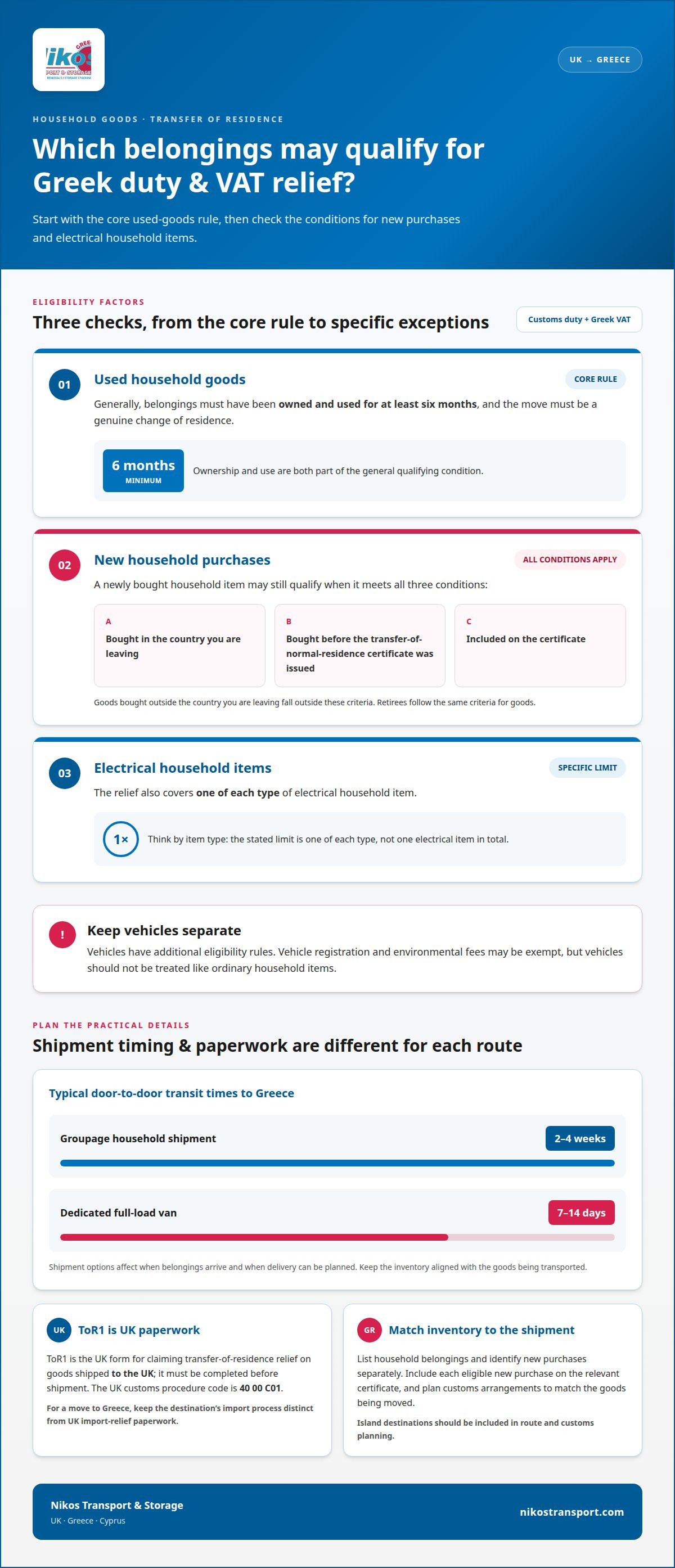
First, confirm whether your move qualifies as a genuine transfer of residence. Used household goods generally qualify for customs duty and Greek VAT relief if you’ve owned and used them for at least six months. The relief also covers one of each type of electrical household item. Vehicle registration and environmental fees may be exempt, but vehicles have additional eligibility rules.
-
Import belongings and apply within the deadlines
Arrange the Greek Certificate of Transfer of Habitual Abode and plan customs clearance within its 12-month validity. Personal belongings should generally be presented for clearance within 12 months of the certificate’s issue. If you’re already in Greece, the certificate must generally be issued within 24 months of arrival, or within 36 months for a retired person. These deadlines answer when belongings must arrive and when to apply.
-
Observe restrictions on tax-free goods
Goods imported under the relief must remain for your own use during the restricted period. For one year after customs clearance, household items and vehicles generally cannot be transferred, sold, rented, pledged or made available to third parties. Lending furniture or giving an electrical appliance to someone else may breach the conditions. Keep the customs-clearance date with your records so you know when the restriction ends.
-
Prepare documents and plan the customs route
Apply for the certificate through the Greek consulate responsible for your residence abroad. Prepare your passport, residence permit or proof of residence, Greek tax number (AFM) and a detailed inventory. Customs clearance for household goods usually goes through an agent appointed by the removal company. For an island destination, include it in the route and customs planning so the inventory and clearance arrangements match the belongings being moved. Keep the certificate with your other documents.
Treatment of household goods and new purchases
Separate used household belongings from new purchases before arranging your international shipment. This distinction affects which items may qualify for relief and how you prepare the customs inventory.
-
Check which goods qualify for relief
List the household belongings you’re taking from your former home, then identify new purchases separately. A new household item may qualify if you bought it in the country you’re leaving, before the transfer-of-normal-residence certificate was issued, and included it on the certificate. For example, a recently bought appliance must meet both the purchase-location and listing conditions. Retirees follow the same criteria for goods.
-
Identify goods excluded from relief
Keep items that don’t meet those conditions separate from goods claimed under the relief. Eligibility for newly acquired goods can depend on when and where they were acquired and whether they are listed on the relevant certificate. Goods bought outside the country you’re leaving also fall outside those criteria. Don’t assume every item in a removal shipment receives the same customs treatment.
- Prepare the UK customs paperwork for the correct direction of travel. ToR1 is the UK form for claiming transfer-of-residence relief on goods shipped to the UK, and it must be completed before shipment. The UK customs procedure code for declaring goods under transfer-of-residence relief is 40 00 C01. For a move to Greece, keep the destination’s import process distinct from UK import-relief paperwork.
- Build transit time into your arrival plans. Groupage household shipments to Greece typically take 2-4 weeks door-to-door, while dedicated full-load van shipments typically take 7-14 days. These options affect when belongings arrive and when you can plan delivery. Keep the inventory aligned with the goods being transported, including each eligible new purchase, to support a clear customs declaration.
If you’re organising the household move alongside your paperwork, plan your UK-to-Greece removal with the shipment details in view.
Habitual residence and residence-abroad eligibility
Review your residence history before planning the move. Greece considers where your normal life was based, and the customs test is separate from immigration permission and tax residence.
- Map where you habitually lived during the two years before the move. To qualify for transfer of residence relief in Greece from the UK, you generally need to have had your habitual abode outside Greece for at least two years. The destination alone doesn’t establish eligibility. Consider where your personal and professional ties placed your normal life during that period.
- Set out your residence history across the final two 12-month periods before transferring normal residence. Greece generally requires normal residence abroad during both periods. Build a clear timeline of where you were living, rather than relying only on travel dates or citizenship. UK citizens should distinguish an extended visit from a genuine change in their normal residence.
- Assess the length and nature of your stay in each place. For Greece’s customs relief, normal residence is generally established by living somewhere for at least 185 days in each 12-month period, because of personal and professional ties. This is not the same as simply choosing Greece as your future destination or owning property there.
- Keep the customs residence test separate from tax-residence and immigration questions. Spending more than 183 days in Greece in a calendar year makes a person Greek tax resident, but that calendar-year test is distinct from the customs test of 185 days per 12-month period. A residence permit concerns permission to live in Greece; it does not, by itself, prove your previous residence history.
- Record any periods of study accurately. Studying at a Greek university or another educational institution does not by itself establish that you transferred your normal residence to Greece. If you studied there before moving permanently, distinguish that period from where your personal and professional ties were centred. This timeline can support the residence evidence prepared for your belongings.
Transfer of normal residence relief from duty and VAT
Consider the residence test, certificate process and import deadline together. Since Brexit, household goods travelling from the UK enter Greece from outside the EU customs area.
- Confirm that your move is a transfer of normal residence, not simply a change to a delivery destination. Greek relief may exempt eligible personal belongings from customs duty and VAT when you genuinely move your normal residence to Greece. The national customs process depends on your residence circumstances and certificate, not the route your furniture takes.
- Arrange the transfer-of-normal-residence certificate through the Greek consulate responsible for your place of residence abroad. If you’re already living in Greece, the certificate must generally be issued within 24 months of arrival. For a retired person already in Greece, the period is 36 months from arrival. These are certificate-issue deadlines, not extra time for arranging a delivery.
- Plan the import date against the certificate and moving date. Personal belongings covered by the relief must be imported to Greece within 12 months of moving. The Greek Certificate of Transfer of Habitual Abode is valid for 12 months, so keep its issue date in view when arranging shipment. Allow customs planning to align with the certificate’s validity, whether your destination is mainland Greece or an island.
- Assess household goods and vehicles separately. Household belongings may qualify for duty and VAT relief, while vehicles have additional conditions and their own registration-tax rules. Don’t assume a vehicle receives the same exemption as furniture. If your move includes a vehicle, treat its paperwork and clearance as a separate part of the transfer.
- Coordinate transport only after the certificate route and shipment details are organised. A clear inventory helps customs relate the imported goods to your move, while the destination and delivery arrangements determine the practical route. Arrange household-goods transport to Greece with the customs and delivery details in view.
Nikos Transport & Storage: Transport To/From Greece
Nikos Transport & Storage can arrange transport for your household belongings from the UK to Greece, with door-to-door service. Once you’ve considered the Greek residence and customs requirements, the next step is to plan your shipment.
Share your destination, the belongings you intend to move and your expected timing to plan the transport arrangements. The service can suit a full household move or selected items. If there’s a gap between leaving the UK and settling in Greece, Nikos Transport & Storage also offers storage for belongings that aren’t ready to travel.
For a move involving a different route, the business also offers transport to Cyprus and UK removals. To discuss your plans, contact Nikos Transport & Storage.
Get your move ready for the next stage
Turn your eligibility decision into a practical shipment plan. The timing of your belongings, their destination and any storage needs can all shape your next steps. Keep your customs paperwork and transport arrangements aligned as you prepare for your new home.
Transfer of residence relief in Greece is one part of relocating from the UK. Nikos Transport & Storage provides transport to and from Greece and Cyprus, as well as storage, giving you options as your plans take shape.
When you’re ready to discuss the practical arrangements, contact Nikos Transport & Storage. A clear plan can help you move forward with confidence and focus on settling into life in Greece.
Frequently Asked Questions
Can you move furniture to Greece after Brexit?
Yes, you can move furniture from the UK to Greece, but it is treated as an import. Used furniture may qualify for Greek transfer-of-residence relief if you meet the residence, ownership and use requirements. Separate your personal furniture from goods being sent for someone else, include the items in your inventory and plan the customs declaration before arranging collection.
What documents are usually needed?
Prepare your passport, Greek residence permit or proof of residence, Greek tax number (AFM) and a detailed inventory. You’ll also need the Greek Certificate of Transfer of Habitual Abode for the relief process. Keep documents supporting your residence history with the certificate so the customs agent can match the paperwork to your move and listed belongings.
What is transfer of residence relief in Greece?
Transfer of residence relief is a customs and tax relief for eligible personal belongings brought to Greece as part of a genuine move of normal residence. For a move from the UK, transfer of residence relief in Greece may remove customs duty and Greek VAT on qualifying household goods. Not every item automatically qualifies, so your residence circumstances and item list matter.
What about customs?
Customs clearance is part of importing household belongings from the UK into Greece. Clearance for household goods usually goes through an agent appointed by the removal company. Give the agent handling the declaration your shipment details and inventory, and keep the certificate available. This helps connect the arriving goods with the transfer-of-residence claim.
What customs rules apply when moving belongings to Greece?
Used household goods generally need to have been owned and used by you for at least six months to qualify for relief. The certificate and import timing matter too: goods must be presented for clearance within the applicable period. After clearance, tax-relieved household goods generally cannot be sold, rented or lent during the first year. Keep the clearance date for your records.
What is transfer of residence relief in Greece for someone moving from the UK?
For someone relocating from the UK, Greek relief may apply to eligible household belongings imported as part of a genuine transfer of normal residence. It can cover customs duty and Greek VAT, subject to the residence test and goods conditions. This customs claim is separate from permission to live in Greece: it concerns imported belongings, not immigration status.


