

A car is not simply another item of household furniture at the Greek border. Since 1 January 2021, household goods moving from the UK to Greece require customs declarations, while importing a vehicle into Greece involves registration tax based on its value and emissions. The Brexit customs rules for moving to Greece in 2026 therefore depend on whether you’re moving belongings, a vehicle, or both.
That distinction can make a move harder to plan, especially if you want to bring familiar furniture and your car. Transfer of Residence relief may remove VAT on personal furniture, but eligibility rules apply, and you should arrange the relief before your goods arrive.
Without approved relief, import VAT on household goods is expected to be 19-25% of their declared value. Preparing an inventory and evidence of residence early can help you organise the paperwork. This guide explains how relief works, what customs formalities apply to furniture and belongings, and why a car has separate import considerations, so you can plan your move with greater clarity.
Key Takeaways
- Learn why bringing a car alongside your belongings doesn’t make them one customs shipment.
- See which aspects of your residence history can affect eligibility for transfer of residence relief.
- Understand why furniture and personal belongings need clear inventories and customs paperwork.
- Find out how customs declarations and transport support can help organise a move from the UK to Greece.
Can I still move a car with my household goods?
A car and household belongings can travel as part of the same relocation, but customs treats them differently. Household goods need export and import declarations, while Greek vehicle registration tax depends on the car’s value and emissions.
Relief for Used Household Goods
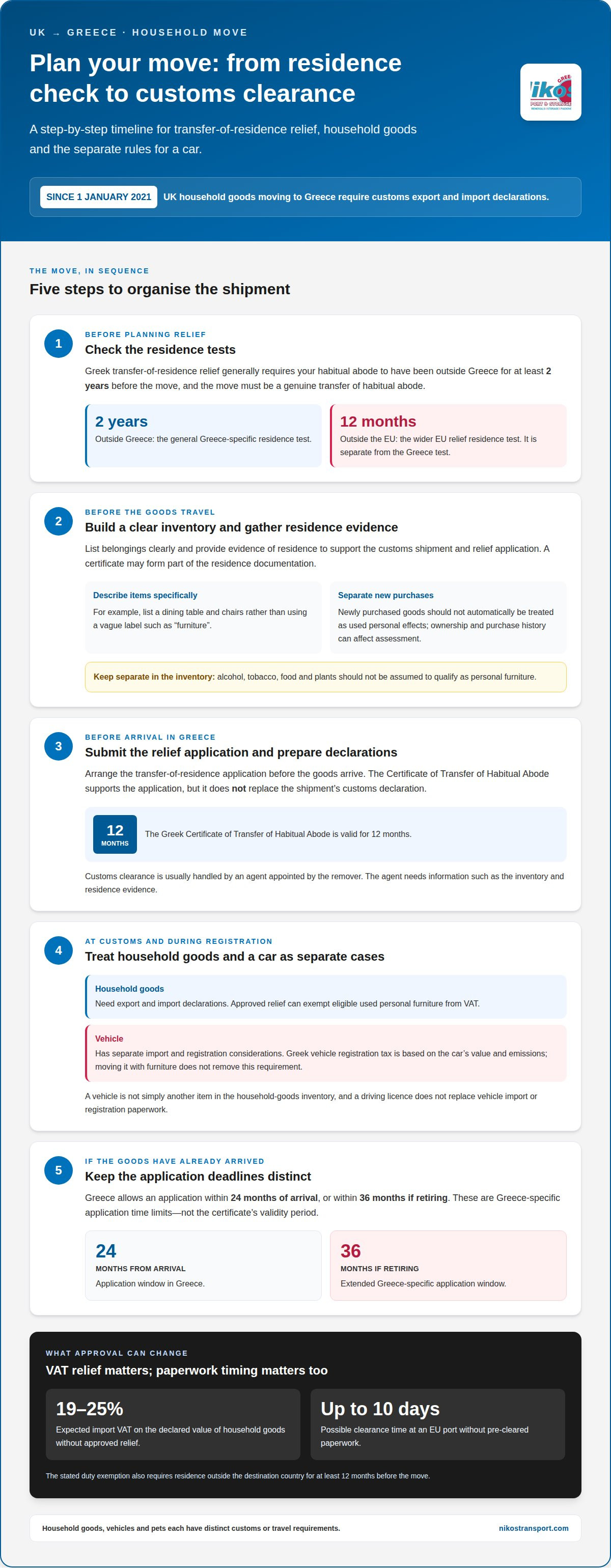
Transfer-of-residence relief can exempt eligible used personal furniture from VAT when you move your habitual home to Greece. Approval matters because, without it, import VAT on household goods is expected to be 19-25% of their declared value.
The relief applies to personal belongings, not automatically to everything in the same shipment. Newly purchased goods should not automatically be treated as used personal effects, so their status may affect eligibility. A vehicle is assessed separately: moving it alongside furniture does not remove the need to consider Greek registration tax.
Declarations and Customs Paperwork
Since 1 January 2021, a household move from the UK to the EU is a customs export and requires declarations. The paperwork supports the goods’ passage through customs and the transfer-of-residence application; prepare a detailed inventory and evidence of residence early.
For a UK-to-Greece move, customs clearance is usually handled by an agent appointed by the remover. The agent needs information such as a household inventory and evidence of residence to describe the shipment and support a relief application. A certificate may form part of the residence documentation. Submit the relief application before the goods arrive.
A car may travel as part of a relocation, but it is not simply another household item. Import and registration are separate considerations, and Greek vehicle registration tax is based on value and emissions. An animal travelling to the EU also needs separate paperwork: each pet trip requires a new Animal Health Certificate.
Costs and risks include import VAT of 19-25% on household goods without approved relief, plus possible clearance delays. Without pre-cleared paperwork, clearance at an EU port can take up to 10 days.
For UK businesses sending household goods to EU countries, the post-Brexit process includes customs export declarations. A clear inventory and early preparation of residence evidence help organise the transfer and reduce the risk of paperwork delays.
Transfer of residence relief
In 2026, UK citizens moving household goods to Greece need customs formalities and may apply for transfer-of-residence relief. Approved relief can exempt personal furniture from VAT, while eligibility depends on residence history and the move being a genuine transfer of habitual abode.
For Greece, applicants generally need to have had their habitual abode outside the country for at least two years before moving. The wider EU relief usually requires living outside the EU for at least 12 months. These are separate residence tests, so time spent outside Greece and time spent outside the EU matter differently.
Greece’s Certificate of Transfer of Habitual Abode is valid for 12 months. The certificate supports the relief application, but it does not replace the customs declaration for the shipment. Approved relief removes VAT on personal furniture; the stated duty exemption also requires residence outside the destination country for at least 12 months before the move.
If you have already arrived, Greece allows an application within 24 months of arrival, or within 36 months if retiring. This is a Greece-specific time limit. Keep the timing distinct from the certificate’s 12-month validity, and arrange the application and supporting residence evidence around your move.
Alcohol, tobacco, food and plants should not be assumed to qualify as personal furniture. Their details need separate consideration in the shipment inventory. Pets have distinct travel requirements: each EU trip requires a new Animal Health Certificate, and the animal must be microchipped and vaccinated against rabies at least 21 days before travel.
A UK passport issued less than 10 years before entry is a Schengen travel requirement, not proof of Greek residence. UK citizens can usually visit Greece visa-free for up to 90 days in any 180-day period, but a visit does not itself establish eligibility for transfer relief. This distinction helps separate travel permission from a permanent move and its customs exemption.
Importing furniture after Brexit
Furniture sent from the UK to Greece enters the EU through an import process. The shipment needs a customs declaration, and the goods must clear customs on arrival. An inventory helps identify each item and its declared value. For example, list a dining table and chairs as household belongings rather than grouping them under a vague label such as “furniture”.
Approved transfer-of-residence relief can exempt personal furniture from VAT. Without approved relief, import VAT on household goods is expected to be 19-25% of their declared value. Newly purchased furniture should not automatically be treated as used personal effects. Its purchase and ownership history can affect how it is assessed, so distinguish new items clearly in the shipment inventory.
EU customs changes for small parcels are not the same as the rules for a household removal. From 1 July 2026, goods valued below EUR 150 that are not covered by the parcel charge are charged duty under the EU’s normal tariff. Those parcel rules should not be used to calculate charges on a household shipment without considering its customs treatment.
A UK-registered vehicle also has a separate import and registration process in Greece. Registration tax is based on the vehicle’s value and emissions, so it is not calculated as part of the furniture inventory. If you take a vehicle out of the UK for 12 months or more, report it to DVLA as a permanent export. A driving licence does not replace vehicle import or registration paperwork.
For furniture, the key steps are an accurate declaration, customs clearance at the destination and an approved relief application where eligible. Application timing matters: Greece permits applications within 24 months of arrival, or 36 months for retirees. The relevant certificate and residence evidence support the relief claim, while the declaration describes the goods being imported.
Customs when moving belongings from the UK to Europe
Under the Brexit customs rules for moving to Greece 2026, a UK household move to Greece is an EU import and must clear customs on arrival. If the road journey passes through a non-EU country, the household move requires a T1 transit document. This covers passage through that country; it doesn’t replace the Greek import declaration.
A UK-to-Greece consignment has distinct export, transit and import stages. Each stage has its own paperwork purpose: a transit document covers passage through third countries, while the Greek declaration covers entry at the destination. Keeping these stages separate helps clarify which documents support each part of the journey.
A complete inventory is central to the declaration. Describe household goods clearly rather than using broad labels such as “boxes” or “personal effects”, and prepare the inventory in the destination language. For example, list a sofa, dining table and cartons of books separately. Clear descriptions help customs relate the paperwork to the shipment and distinguish personal belongings from goods requiring different treatment.
Timing affects the arrival period. With paperwork pre-cleared, EU-port customs clearance takes 1-3 working days; from June through September, peak-season delays can add 5 days. Without pre-cleared paperwork, clearance can take up to 10 days. These periods describe port clearance, not the full journey to Greece, so delivery planning needs to account for customs and road transit.
Customs clearance is usually handled by an agent appointed by the remover. The agent uses shipment details and residence evidence to present the declaration and any transfer-relief claim. Permanent relocation requires appropriate status before household belongings are imported as personal effects. A Greek residence permit and a customs declaration serve different purposes: one relates to residence, while the other identifies goods entering the EU.
These Brexit customs rules for moving to Greece 2026 make accurate paperwork central to planning a cross-border household move. For help coordinating declarations for a UK-to-Greece move, arrange a customs declaration.
Nikos Transport & Storage: Transport To/From Greece
Nikos Transport & Storage can organise household-goods transport from the UK to Greece and prepare customs declarations for your move. Its Greek Service is relevant if you’re planning a relocation and need your belongings transported alongside the paperwork required for customs clearance.
For a move involving several stages, Nikos Transport & Storage also offers storage, which can help if your belongings aren’t ready to travel or arrive at your destination. The service is for household goods, not vehicle shipping, so a car’s import and registration arrangements remain separate from the furniture move.
If you’re planning a move to Greece, contact Nikos Transport & Storage to discuss household-goods transport and customs declarations.
Shape the move around your next decisions
Planning for the Brexit customs rules for moving to Greece in 2026 is also a chance to organise the move around your priorities. Decide which belongings should travel first, whether any items need to be stored, and how your arrival plans align with the shipment. Keeping these decisions connected can make it easier to coordinate the practical details of settling into a new home.
Treat the move as a connected plan rather than a collection of separate tasks. Your household inventory, residence paperwork and delivery arrangements each serve a different purpose, but all contribute to a smoother handover. If your plans change, a clear point of contact can help you discuss the next arrangement while keeping the overall move in view.
Nikos Transport & Storage can discuss the household-goods move and the support that fits your plans. Contact Nikos Transport & Storage to talk through your next steps and move forward with greater confidence.
Frequently Asked Questions
Can You Move to Greece from the UK in 2026?
Yes, UK citizens can move to Greece in 2026, but a visa-free visit isn’t permission to settle permanently. British citizens can usually visit for up to 90 days in any 180-day period. Those relocating must register their address and apply for a Greek residence permit within 90 days of arrival. Plan residence formalities separately from customs paperwork for your belongings.
Do I pay VAT on my own furniture?
VAT may be exempt on your own used furniture if Greece approves transfer-of-residence relief. The exemption applies to eligible personal furniture, not automatically to every item in a shipment. For instance, distinguish newly bought chairs from furniture you already owned and used. A clear inventory helps show which goods are personal effects and which purchases may need separate customs treatment on import.
Do I pay import duty or VAT when moving my belongings to Europe?
Approved transfer-of-residence relief can exempt eligible personal furniture from VAT, while the duty exemption has its own residence condition. Without approved relief, import VAT on household goods is expected to be 19-25% of their declared value. For Greece, the duty exemption requires residence outside the destination country for at least 12 months before the move. Customs declarations still apply.
How long does customs take at the EU port?
With paperwork pre-cleared, EU-port customs clearance takes 1-3 working days. Without pre-cleared paperwork, it can take up to 10 days. June through September, peak-season delays can add 5 days. These figures cover customs clearance at the port, not the full journey to your home in Greece, so keep the transport and delivery stages in mind when planning arrival.
Is It Cheaper to Ship Everything or Buy Again in Greece?
Neither option is always cheaper. Compare the cost of replacing key items with the removal quote for your shipment. Your decision depends on how much you’re taking, the condition and usefulness of your furniture, and whether particular belongings would be difficult to replace. For example, shipping a few essential or personally valuable pieces may suit you better than transporting every item.
What Affects the Cost?
Cost depends on distance, volume and extra services; request a quote for an accurate estimate. Volume reflects the space your belongings need, so a small selection of furniture differs from a full household shipment. Extra services may include packing or storage. Decide what you want included, then use those details to request a quote for your move.


