
Can your car move with you to Cyprus without customs charges? If you’re asking what customs forms are needed for moving to Cyprus in 2026, the main form for household goods when transferring normal residence from outside the EU is Απ. 2. A vehicle may also qualify for relief, but the paperwork and conditions differ from those for personal effects.
It’s understandable to expect one form to cover the whole move. In practice, Customs requires the relevant declaration and supporting documents. Recently bought goods may be treated differently from belongings you’ve owned and used. A car owned and used for at least six months may qualify for residence-transfer relief, subject to the applicable requirements.
This guide explains what to declare, which personal belongings may qualify for relief, and what to consider when bringing a car. It also covers excluded goods and items that may attract charges, helping you plan with a clearer understanding of the forms and evidence Customs may require.
Key Takeaways
- Used household goods may qualify for customs and VAT relief if they meet the ownership and use conditions; recently bought items can be treated differently.
- A car’s eligibility depends on its ownership history and the circumstances of your move, and relief does not remove every registration charge.
- Some goods, including alcohol, tobacco and certain professional equipment, are excluded from personal-effects relief; new electrical appliances without CE markings may also cause issues.
- Customs declaration requirements can differ by shipment type, and low-value import rules change in 2026, so the declaration lines matter as well as the goods themselves.
What Items Are Prohibited to be Imported into Cyprus?
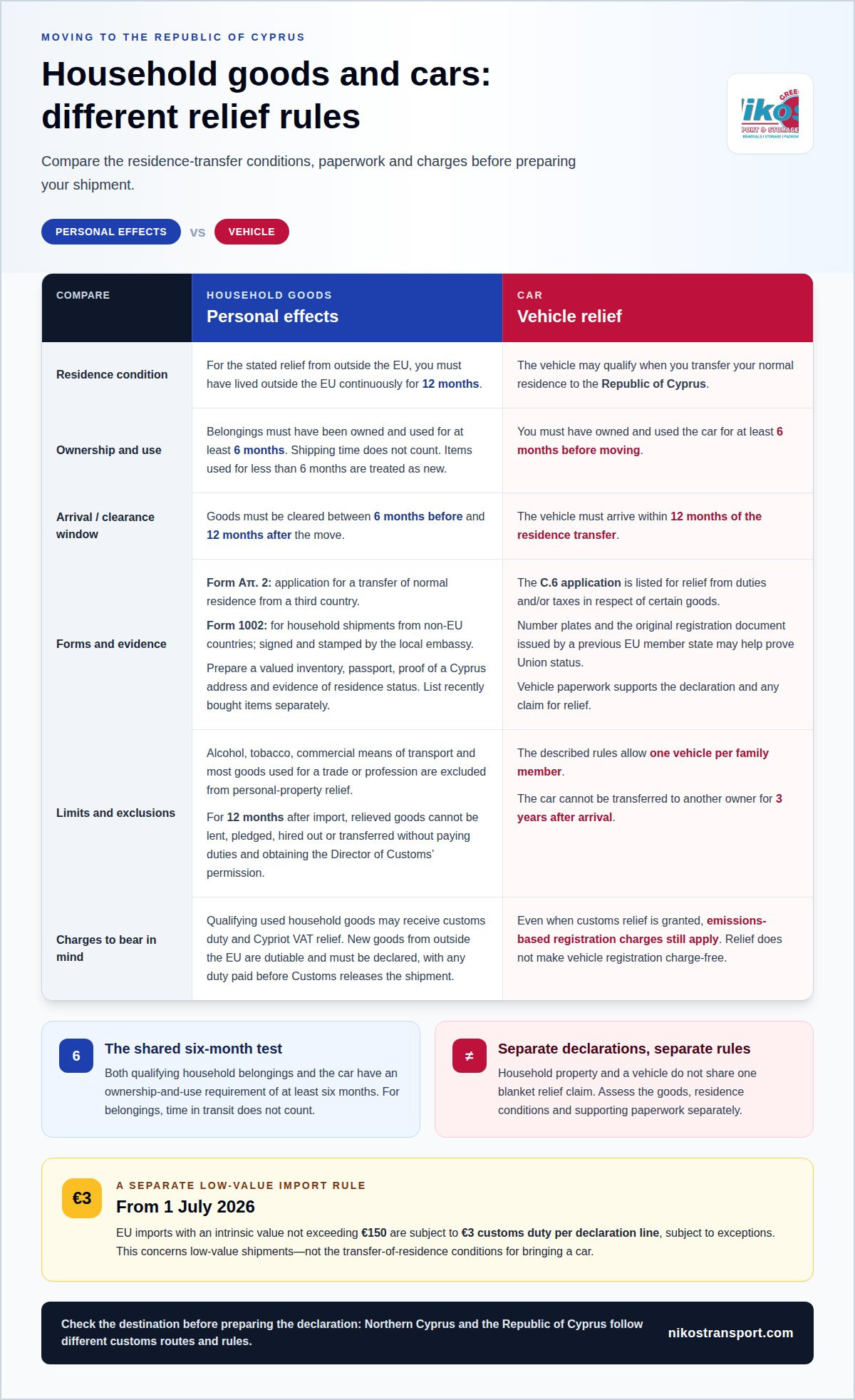
For household goods, the key test is whether you’re genuinely transferring your normal residence to Cyprus. Used belongings may qualify for customs duty and Cypriot VAT relief if you’ve owned and used them for at least six months. Shipping time to Cyprus doesn’t count towards that period. Items owned and used for less than six months are treated as new.
New goods arriving from outside the EU are dutiable. You must declare new personal effects and pay any duty due before Customs releases the shipment. List recently bought items separately from used household goods. Cyprus Customs may confiscate electrical appliances without CE markings if they’re found in a shipment.
For household shipments from non-EU countries, Form 1002 must be signed and stamped by the local embassy. People transferring normal residence from a third country use Form Απ. 2 and submit it with supporting documents to a customs station. Prepare a valued inventory, passport, proof of a Cyprus address and evidence of residence status. Items used for less than six months must be listed separately from goods on Form Aπ.2.
Are Cyprus customs forms different for Northern Cyprus and the Republic of Cyprus? Yes. Northern Cyprus is outside EU customs control, so shipments follow different routes and rules from those entering the Republic of Cyprus. Confirm the destination before preparing the customs declaration.
Alcohol, tobacco, commercial means of transport and most goods used for a trade or profession are excluded from personal-property relief. This doesn’t mean every such item is prohibited; it means the household-goods relief doesn’t cover them. If goods are liable for duties and VAT, options include paying the charges, placing them in a customs warehouse, sending them to another EU member state or exporting them to a third country.
Relieved goods also carry a post-import restriction: for 12 months, you can’t lend, pledge, hire out or transfer them without first paying duties and obtaining the Director of Customs’ permission.
Importing a car under transfer-of-residence relief
A vehicle may qualify for relief when you transfer your normal residence to the Republic of Cyprus. The car’s ownership history, arrival date and supporting documents all affect eligibility.
Incoterms and Import Charges
Incoterms are trade terms that allocate transport costs and responsibilities between a seller and buyer. They can clarify who arranges transport and handles import charges for an international purchase. However, Incoterms don’t determine whether a privately owned car qualifies for transfer-of-residence relief. For a relocation, distinguish the shipping arrangement from the customs assessment: the car’s history and your residence transfer determine eligibility for relief.
Vehicle Documents and Exemptions
Vehicle import documents support the declaration and any claim for relief. The Cyprus Customs and Excise Department lists the C.6 application for relief from duties and/or taxes in respect of certain goods. For personal effects, number plates and the original registration document issued by a previous EU member state may help prove Union status. A vehicle’s registration charges can still apply, even when customs relief is granted.
For residence-transfer relief, the owner must have owned and used the car for at least six months before moving. The vehicle must arrive within 12 months of the residence transfer, and it cannot be transferred to another owner for three years after arrival. The described rules allow one vehicle per family member. Emissions-based registration charges still apply, so duty relief doesn’t mean registration is charge-free.
Personal belongings follow separate conditions. For the stated relief from outside the EU, you must have lived outside the EU continuously for 12 months. Belongings must be cleared between six months before and 12 months after the move. These requirements concern household property, not the car’s separate vehicle declaration.
Low-value import rules are another separate matter. From 1 July 2026, EU imports with an intrinsic value not exceeding €150 are subject to €3 customs duty per declaration line, subject to exceptions. This change concerns low-value shipments, not the transfer-of-residence conditions for importing a car.
Cyprus customs relief for personal effects
Household goods may qualify for duty and VAT relief when you transfer normal residence to Cyprus from outside the EU. To qualify under the stated rules, you must have lived outside the EU continuously for 12 months, and the goods must meet the ownership and use conditions.
Personal Property Eligible for Relief
Eligible personal property generally means belongings intended for household use, rather than goods for resale or business. Prepare a detailed, valued inventory so Customs can distinguish everyday possessions from items bought for the move. Alcohol, tobacco, commercial means of transport and most articles used in a trade or profession are excluded from this relief. List new or recently bought belongings separately, as they may not qualify.
Transfer-of-Residence Relief
Transfer-of-residence relief can remove customs duty and VAT on qualifying belongings accompanying a genuine move. For a move from a third country, including the UK, Cyprus directs applicants to Form Απ. 2. The application and supporting documents go to any customs station. The framework includes Regulation EC/1186/2009, Directive EC/2009/55 and Cyprus’s KDP 377/2004 regulations.
Normal-Residence Relief
Normal residence is assessed through a person’s occupational and personal ties, not simply the destination of a shipment. If occupational ties differ, Cyprus regards the place of personal ties as normal residence when the person returns there regularly. Attending a university or school alone doesn’t establish normal residence in that country. This distinction can affect whether your move qualifies.
Eligibility Rules and Time Limits
What are Cyprus’s eligibility rules and time limits for duty and VAT relief on household goods? You must have lived outside the EU continuously for 12 months, and belongings must be cleared between six months before and 12 months after the move. Used goods generally need to have been owned and used for at least six months; shipping time doesn’t count.
Support your application with a passport, proof of a Cyprus address, evidence of residence status and a detailed, valued inventory. List newly bought items separately, as they may be dutiable. Your residence-transfer and clearance dates help determine whether the goods fall within the relief period.
De minimis threshold and customs declaration lines
A de minimis threshold is a value limit used to determine whether low-value imports incur customs duty. For shipments from the UK to Cyprus, distinguish this parcel-import rule from transfer-of-residence relief for household belongings. The destination, type of goods and declaration period matter. Knowing what customs forms for moving to Cyprus 2026 apply helps keep these separate processes clear.
Before 1 July 2026, goods imported into the EU in shipments with an intrinsic value not exceeding €150 could enter without import duty under the de minimis exemption. VAT is separate: EU imports have been subject to VAT regardless of value since 2021. From 1 July 2026, shipments valued at €150 or less are subject to €3 customs duty per customs import declaration line, subject to exceptions. This change concerns duty, not VAT.
Declaration lines also need accurate product details. From 1 July 2026, Product Identifier details are required for each product imported into the EU customs territory, regardless of value. Enforcement begins on 1 November 2026. A declaration covering several products therefore needs the required identifier details for each product, rather than relying only on the shipment’s total value.
For someone living in the UK and moving to Cyprus, the low-value threshold doesn’t replace a household-goods relief application. Customs assesses relocation belongings under transfer-of-residence rules, while low-value import duty applies to qualifying shipments and declaration lines. If you’re clarifying what customs forms for moving to Cyprus 2026 apply, separate the household-relief paperwork from declarations for low-value imports.
Clear item descriptions and correct declaration lines help Customs assess the shipment and applicable charges. Arrange a customs declaration for your move to Cyprus.
Nikos Transport & Storage: Transport To Cyprus
Nikos Transport & Storage organises transport to Cyprus and customs declarations for household moves from the UK. Once you’ve identified which belongings may qualify for relief, the next step is to coordinate your shipment and declaration with your moving dates and supporting documents.
A customs declaration must accurately reflect the shipment, including items that may be treated differently from used personal effects. Clear inventory details and paperwork help ensure the declaration matches what’s being shipped. If your move dates and arrival plans don’t align, storage offers a separate option for belongings awaiting onward transport.
For a move involving Greece, Nikos Transport & Storage also provides transport to and from Greece. You can discuss the shipment and customs declaration together, so the arrangements reflect your destination and circumstances.
Contact Nikos Transport & Storage to discuss your move to Cyprus.
Set your move in motion with a clear plan
Knowing what customs forms are needed for moving to Cyprus in 2026 is one part of preparing for the transition. The next is fitting the declaration and shipment arrangements around your moving dates, destination and plans for your belongings. A clear schedule can also help you decide whether storage is useful between leaving one home and settling into another.
Nikos Transport & Storage can help with transport to Cyprus, transport to and from Greece, and storage. The right arrangement depends on your route and what you need moved or held. When you’re ready to discuss the practical details, contact Nikos Transport & Storage to talk through your move.
With a considered plan, you can take the next steps towards your new home with greater clarity and confidence.
Frequently Asked Questions
Can I Take a Motor Vehicle with Me to Cyprus?
Yes, you can take a car, and it may qualify for transfer-of-residence relief. For the stated relief, you must have owned and used it for at least six months before moving, and it must arrive within 12 months of your residence transfer. The vehicle cannot be transferred to another owner for three years after arrival. Customs relief doesn’t remove emissions-based registration charges.
Is There Anything Else I should Know?
Yes. Solid wood used for overcasing, bracing or blocking must meet the stated ISPM15 requirements and bear the specified markings. Customs may confiscate appliances without CE markings found in a shipment. Household goods arriving from non-EU countries are inspected, so the inventory and declaration should accurately reflect the shipment’s contents. Packing materials and electrical appliances are worth considering alongside the personal belongings listed for import.
What are Personal Effects?
Personal effects are belongings for an individual’s or household’s personal use, rather than goods intended for resale. They can include furniture, clothing, books and kitchen items. Your customs inventory should identify belongings clearly and give their values, helping distinguish ordinary household property from commercial goods. Alcohol, tobacco, commercial means of transport and most equipment used for a trade or profession fall outside the stated personal-property relief.
What customs forms are required to move household goods to Cyprus in 2026?
For a transfer of normal residence to Cyprus from outside the EU, the application form is Απ. 2. Form 1002 is also required for household shipments from non-EU countries and must be signed and stamped by the local embassy. These forms serve different customs purposes. The relevant application should be submitted with its supporting paperwork, rather than treating one form as a substitute for the other.
What documents are needed to import personal belongings to Cyprus from the UK?
For a move from the UK, prepare a passport, proof of your Cyprus address, evidence of residence status and a detailed, valued inventory. If your spouse is travelling with you and has a different surname, submit a copy of your marriage certificate to Cyprus Customs. These documents help establish who is importing the goods, where they’re moving and which belongings are included.
Does Cyprus require a customs declaration for a change of residence and transfer of residence relief?
Yes. Applicants transferring normal residence to Cyprus from a third country must submit the completed Απ. 2 form with supporting documents to a customs station. The application is for relief, not a guarantee that every item qualifies. New or recently bought belongings should be identified separately, since they may be treated differently from used household property when Customs assesses the declaration.


