

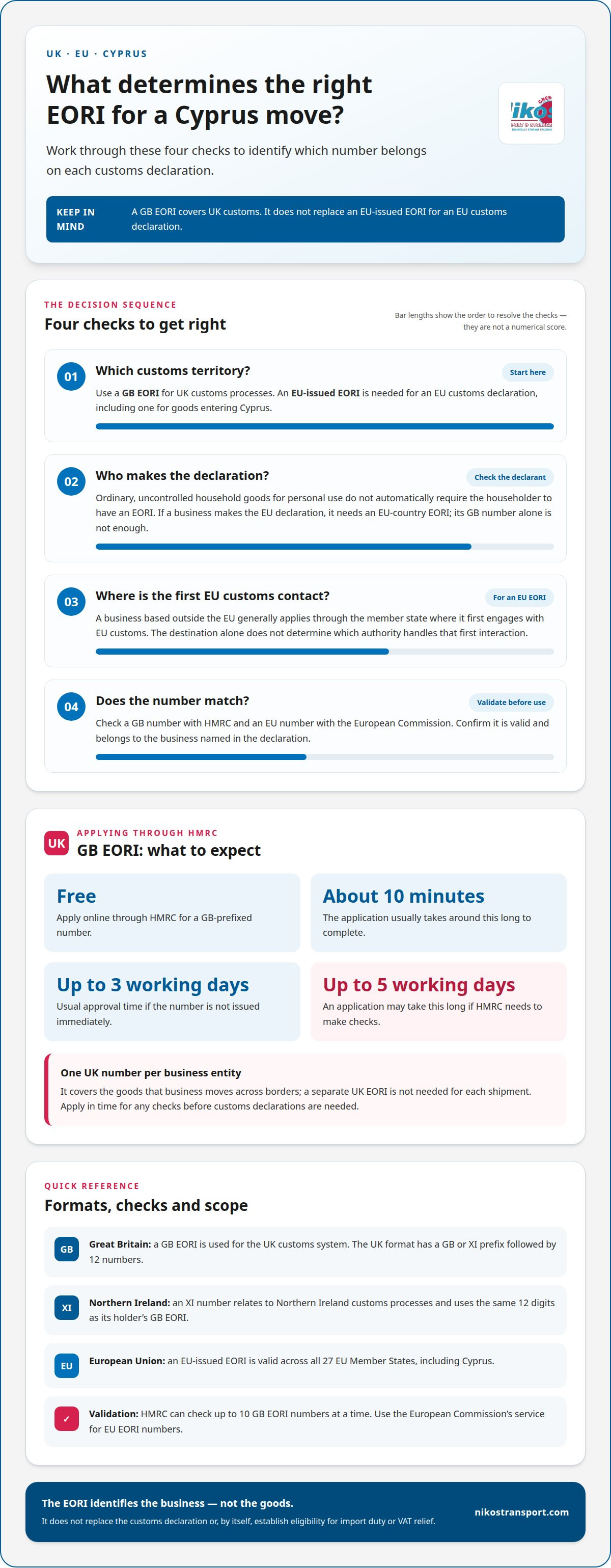
A UK EORI number isn’t the whole answer when moving goods to Cyprus. An EORI number for a moving company’s goods identifies the business involved in customs procedures. A UK business uses a GB number for UK customs, while an EU-issued EORI is needed to make customs declarations in the EU. The EU number is obtained from the member state where the business first engages with EU customs.
It’s understandable if the distinction feels confusing: the numbers serve related purposes, but one doesn’t automatically replace the other. Using the correct number for each customs process can help avoid delays caused by a missing or invalid EORI.
This guide explains what an EORI number does, how to apply for a UK number through HMRC, how to check its validity and how to recognise its format. It also explains how UK and EU numbers apply to a goods move to Cyprus, so you can understand which customs requirements apply to each part of the journey.
Key Takeaways
- A GB EORI identifies a UK business for UK customs; EU customs declarations require an EU-issued EORI, so a move to Cyprus may involve both.
- A UK EORI application is free through HMRC. Allow time for processing before goods move, as a missing or invalid number can delay customs clearance and lead to storage costs.
- Use HMRC’s checker to validate a GB number and the European Commission’s service to validate an EU number.
- Recognise the UK format by its GB or XI prefix followed by 12 numbers, then read the article to understand which format applies to different movements.
What is an EORI number?
An EORI number identifies a business or individual involved in international trade for customs purposes. For Cyprus, the relevant requirements depend on whether the shipment contains private belongings or a business is making an EU customs declaration.
EU EORI requirements for customs declarations
An EU EORI is an identification number a business needs to make customs declarations or obtain customs decisions in the EU. The European Commission says an EORI is mandatory for customs clearance of imports, exports and transit in the EU customs territory. A GB EORI does not replace an EU number for an EU declaration. If a company handles a declaration for goods entering Cyprus, customs authorities need its valid EU EORI to process it.
EORI requirements for household moves to Cyprus
For private individuals, the answer depends on the goods and who makes the declaration. The UK Government says an EORI isn’t needed when goods are uncontrolled and for personal use only. So moving ordinary personal household goods from Great Britain to Cyprus doesn’t automatically mean the householder needs an EORI. If a business makes the EU customs declaration, it needs an EU-country EORI; its GB number alone isn’t enough. This distinction matters when a shipment includes business goods.
A missing or incorrect EORI can interrupt customs processing and delay a shipment. Goods may be held while the correct number is obtained, potentially adding storage costs. An incorrect number can cause similar disruption if customs authorities can’t match it to the business making the declaration. Registering in the right customs system is part of preparing a business shipment, not a substitute for the customs declaration itself.
The customs declaration is the key document for declaring goods moving across the border. The EORI identifies the business or declarant connected with that declaration; it doesn’t describe the belongings. Supporting paperwork depends on the shipment, so don’t treat the EORI number as a complete set of customs documents.
An EORI number doesn’t itself provide relief from import duty or VAT. It identifies the party involved in customs procedures, while any relief for personal belongings is a separate issue. Holding a GB or EU EORI alone doesn’t establish that a household move qualifies for duty or VAT relief in Cyprus.
Applying for a UK EORI number
A UK business trading across borders can apply online through HMRC for a GB-prefixed EORI number. The application is free and usually takes around ten minutes to complete. One UK EORI number per business entity covers the goods it moves across borders, so a separate UK number isn’t needed for each shipment. For a moving company transporting goods to Cyprus, this number covers UK customs procedures.
Have the business details requested for the application ready, and ensure they identify the business that will use the number. If HMRC issues it immediately, it can be used once issued. Otherwise, approval usually takes up to 3 working days; if HMRC needs to make checks, an application may take up to 5 working days. Applying before arranging an EORI number for moving company goods to Cyprus gives time for those checks before customs declarations are needed.
The GB number covers the UK side of customs processes, but it doesn’t replace an EU EORI for EU customs declarations. Businesses moving goods between the UK and the EU often need both numbers. The requirements for an EORI number for a moving company’s goods travelling to Cyprus depend on where the goods are moving to and from, and which customs authority receives each declaration.
A business based outside the EU that needs to make EU customs declarations or obtain a customs decision applies for an EU EORI through an EU member state’s customs authority. The application is generally made in the first EU country where the business engages with customs. For a shipment to Cyprus, identify where the first EU customs interaction takes place rather than assuming a GB number covers the European process.
Each EU member state issues its own EORI numbers and determines its registration procedure. A UK business may therefore need separate applications with HMRC and the relevant EU customs authority. Consider the route and declaration arrangements before the goods move: the destination alone doesn’t establish which EU authority handles the first customs interaction.
Checking EORI number validity
Check the number in the customs system that issued it before preparing a shipment. A valid number must match the declaration’s customs territory and the business involved.
Checking whether a business has an EORI
Start by finding the number recorded for the business that will appear on the customs declaration. If the business has previously imported or exported goods, it may already have an EORI; check its records before starting another registration. An EORI is associated with the business it was issued to, so don’t automatically treat a parent or related company’s number as the same business’s identifier.
For a GB number, HMRC’s online checker can confirm whether it’s valid. It can check up to ten GB EORI numbers at a time, which is useful when preparing several business records for shipments. Keep the result with the shipment paperwork so you can match the number used for customs declarations to the correct economic operator.
Checking GB, XI and EU EORI numbers
Use the checker for the number’s issuing system: HMRC provides validation for GB EORI numbers, while the European Commission provides a validation service for EU EORI numbers. An EU-issued EORI is valid across all 27 EU Member States, including Cyprus. A successful check confirms validity, but the number must still belong to the business named in the declaration.
An XI number relates to Northern Ireland customs processes, while a GB number applies to Great Britain’s customs system. The XI number uses the same 12 digits as its holder’s GB EORI, but the prefixes aren’t interchangeable. For a move from Northern Ireland to Cyprus, or from another EU country, the route and customs procedure affect which rules apply. The EU-wide validity of an EU EORI doesn’t mean every movement follows identical procedures.
Checking validity helps identify an expired-looking, mistyped or mismatched number before goods move, though an EORI itself doesn’t expire. A valid number doesn’t replace the customs declaration or establish the goods’ customs treatment. Verify the number and the business identity together, then use the appropriate number for each declaration involved in the shipment.
EORI number format
An EORI combines a country prefix with a unique identification number. Its format shows which customs system issued it, but the number’s appearance alone doesn’t prove it’s valid or suitable for a declaration.
For UK numbers, the prefix is GB or XI, followed by 12 numbers. A GB EORI for a VAT-registered business generally contains GB, the business’s nine-digit VAT number and the suffix 000. For example, the VAT digits form the first part of the number, and 000 completes the 12-number sequence. A non-VAT-registered business instead receives a unique number from HMRC.
The XI format uses the same 12 digits as the holder’s GB EORI, with XI as the prefix. The different prefix matters: it identifies the number’s customs system, so don’t replace GB with XI simply because a shipment involves Northern Ireland. Use the prefix and number issued for the relevant customs process.
EU EORI numbers use the issuing EU member state’s two-letter country code, followed by up to 15 digits. For instance, an EU-issued number starts with that country’s code, rather than GB or XI. Formats and registration procedures are set by individual member states, so EU numbers may look different from UK ones. The format identifies the national issuing system; it doesn’t identify the type of goods.
More broadly, an EORI consists of a two-letter country code and a unique number of up to 15 characters. UK and EU formats have specific structures, so use the rules for the system that issued the number. An EORI identifies an economic operator for customs declarations and clearance; it isn’t a commodity code describing the goods crossing the border.
Before a declaration is submitted, match the prefix and digits to the issuing system and check the number’s validity. For support with the paperwork for a Cyprus shipment, arrange a customs declaration.
Nikos Transport & Storage: Transport To Cyprus
Nikos Transport & Storage provides Transport To Cyprus for people planning a move from the UK. Once you’ve established which EORI requirements apply to your shipment, we can help with the transport, whether you’re relocating household belongings or arranging a goods move.
Turn to us when you’re ready to plan the journey and want support shaped around your move. We also offer packing and storage, which can help if your belongings need preparation or a place to stay before delivery. For moves involving Greece or a UK relocation, our related transport and removal services may also suit your plans.
Share your moving details with Nikos Transport & Storage, and we can discuss the next step together.
Plan your Cyprus move with confidence
Once your customs arrangements are in hand, coordinate transport around your shipment and circumstances. If you’re organising an EORI number for moving company goods to Cyprus, keep the customs paperwork and transport plans aligned so responsibilities for each part of the move are clear.
Nikos Transport & Storage can help with Transport To Cyprus, Transport To/From Greece and Storage Service. Whether your belongings are ready to travel or need storage while plans come together, a clear moving plan can make the next stage easier to organise.
Contact Nikos Transport & Storage to discuss your move and take the next step at a pace that works for you.
Frequently Asked Questions
Do I need my own EORI if a freight forwarder handles my customs?
Not necessarily, if the forwarder handles an occasional movement under its own EORI. The key point is which business makes the customs declaration or seeks a customs decision. If your moving company carries out either task itself, it needs the relevant EORI for that customs system. Agree who is responsible for each declaration before preparing the shipment.
How do I get a new EORI code?
For a UK number, apply online through HMRC. A business trading across borders applies for a GB-prefixed EORI, and the application is free. If your company needs to make customs declarations in the EU, apply separately through an EU country’s customs authority. A new code doesn’t replace a number already issued to the same business.
How do I get one?
Choose the application route based on where the customs activity takes place. For UK customs, apply online to HMRC. For EU customs, apply to the authority in the first EU country where your business engages with customs. For example, a UK company making its first EU customs declaration in Cyprus would apply through the relevant EU-country process.
What information is needed to apply?
Have the business identification details requested by HMRC ready before starting the online application. The information should relate to the legal business applying, not simply the employee arranging transport. If the company belongs to a larger holding group, make sure the application reflects the business that will use the EORI number. This helps ensure the number is associated with the correct business entity.
When is an EORI number required for a UK moving company transporting goods to Cyprus?
A UK moving company needs an EORI when it makes customs declarations or handles other customs procedures for cross-border goods. For UK customs, that generally means a GB EORI; an EU EORI is required for EU customs declarations. The moving company’s role matters: transporting goods alone is different from acting as the business responsible for a customs declaration.
Which EORI number is needed for UK-to-Cyprus removals, UK or EU?
A business handling customs on both sides may need a GB EORI for UK procedures and an EU-issued EORI for EU declarations. A GB number can’t be used instead of an EU number for an EU customs declaration. The numbers identify the business in separate customs systems, so establish who submits each declaration and which authority receives it.


