
Yes, you can move from the UK to Greece, but a visa-free visit isn’t permission to live there long term. UK citizens can usually stay in Greece and the wider Schengen area for up to 90 days in any 180-day period; a longer stay requires the appropriate residency route. Understanding how to plan a move to Greece without stress starts with separating entry permission from the steps needed to settle.
Moving abroad involves paperwork, accommodation and travel arrangements, so it helps to tackle them in a clear order. If you’re planning a move to Greece without stress, first identify which arrangements affect your eligibility and which can wait until your plans are confirmed.
This guide covers Greek tax numbers, accommodation, residency, insurance, driving permits and final travel checks. It also explains how to plan a move to Greece without stress by setting out the practical decisions to tackle before departure, helping you prepare for the transition from the UK with greater confidence.
Key Takeaways
- For a long-term move, prepare your Greek tax number, proof of accommodation and private health insurance as part of your residency application.
- Plan your stay around the Schengen limit: UK citizens can usually visit for up to 90 days in any 180-day period, but longer stays need the appropriate residency route.
- Include health cover and your driving licence in your preparations, especially if you’ll become resident in Greece.
- Before travelling, organise the documents and arrangements relevant to your circumstances, including any requirements for children, pets or study.
1. Greek tax number and accommodation requirements
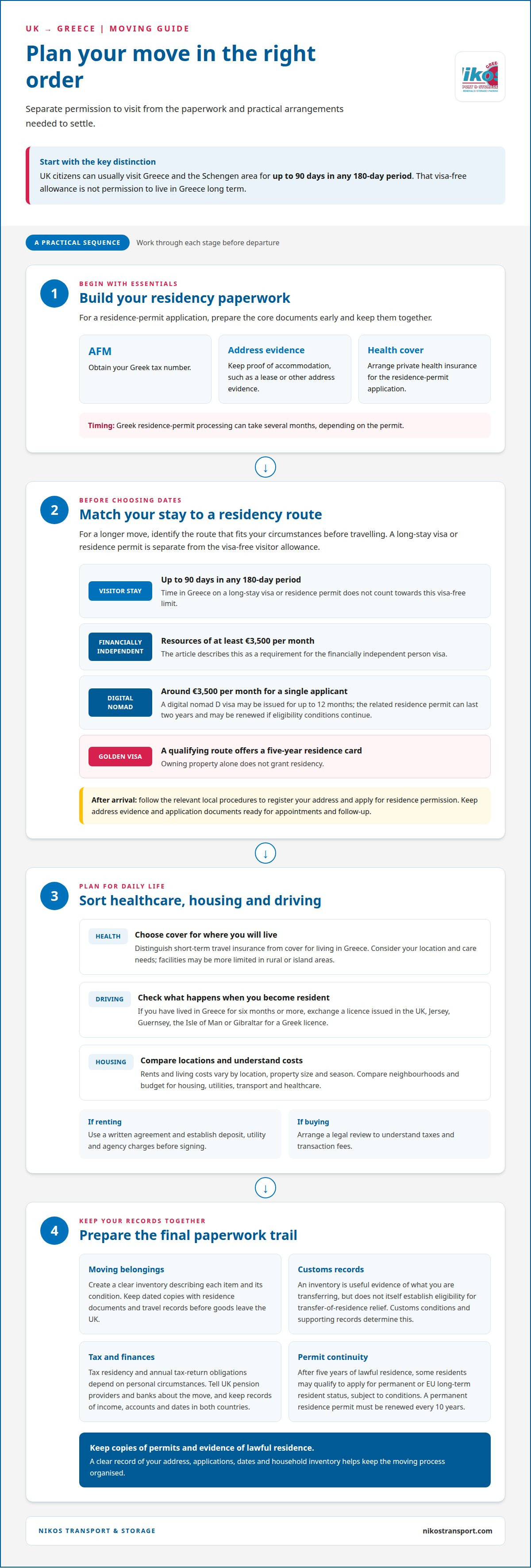
Start the Greek paperwork with an AFM, the Greek tax number. Applicants need an AFM, proof of accommodation and private health insurance before a residence permit can be approved. A useful starting point for anyone asking how to plan a move to Greece without stress is to organise these documents early, alongside the lease or other accommodation evidence.
Greek residence-permit processing can stretch to several months, depending on the permit. A digital nomad D visa may be issued for up to 12 months; the related residence permit can last two years and be renewed if eligibility conditions continue.
Greek tax residency and annual tax-return obligations can depend on a person's circumstances, so check the requirements before moving. Tell UK pension providers and banks about your move, and keep records of income, accounts and dates in both countries; US citizens may also have separate US filing obligations.
Living costs and rents vary by location, property size and season. Central Athens, Thessaloniki and island communities have different housing markets. Budget for rent or purchase costs, utilities, transport and healthcare, then compare neighbourhoods rather than assuming island life will be cheaper.
For a rental, use a written agreement and establish which deposit, utility and agency charges apply before signing. For a purchase, arrange a legal review to understand taxes and transaction fees. Secure evidence of your accommodation, as proof of an address is needed for residence-permit approval.
Healthcare facilities may be more limited on Greek islands, so a transfer to Athens could become part of a treatment plan. Decisions about a larger hospital or onward transport depend on medical advice and the patient’s stability. Contact the insurer promptly and provide a written medical report covering the diagnosis, current condition and recommended next steps.
For Greek-speaking medical support, ask the treating clinic or hospital to help with communication. Keep key medical details in a written report to support discussions about treatment or transport between an island and Athens. Organising these practical details can make the move easier to manage.
2. Schengen short-stay allowance and long-term residency
For UK citizens, visa-free travel to Greece and the wider Schengen area usually allows stays of up to 90 days in any 180-day period. This is a visitor allowance, not permission to settle. Time spent in Greece with a long-stay visa or residence permit doesn’t count towards that visa-free limit.
For a longer move, identify the residency route before travelling. After arrival, follow the relevant local procedures for registering your address and applying for residence permission. Keep the address evidence and application documents together, so you can manage appointments and follow-up without losing track of essential paperwork.
Routes depend on your circumstances. A financially independent person visa requires resources of at least €3,500 per month. Greece’s digital nomad route commonly cites income of around €3,500 per month for a single applicant. A qualifying golden visa offers a five-year residence card, but owning property alone doesn’t grant residency.
After five years of lawful residence, some residents may qualify to apply for permanent or EU long-term resident status, subject to the applicable conditions. A permanent residence permit must be renewed every 10 years. Keep copies of permits and evidence of lawful residence, as continuity matters when preparing a future application.
Moving household belongings involves separate logistics from securing residency. Prepare a clear inventory describing each item and its condition, then keep it with your moving documents. An inventory is useful evidence of what you’re transferring, but it doesn’t itself establish eligibility for transfer-of-residence relief. Applicable customs conditions and supporting records determine that.
Moving or shipping goods at a later date can complicate paperwork if your records are incomplete. Keep dated copies of your inventory, residence documents and travel records together, and organise them before your goods leave the UK. This helps distinguish personal belongings from items added after the move.
3. Travel insurance and driving permits
Arrange health cover before travelling, and distinguish short-term travel insurance from cover for living in Greece. Greece has public and private healthcare systems, and many expats choose private cover, particularly in rural or island locations where facilities may be more limited. Consider where you’ll live, the care you may need and whether your policy supports access in your chosen area.
Read the policy terms before departure. Keep the insurer’s contact details, policy documents and relevant medical information accessible, rather than packed with your household belongings. If illness or an accident requires treatment, contact your insurer immediately and provide a medical report as soon as possible. Ask the treating doctor for a written report covering the diagnosis, current condition and recommended next steps.
A report helps the insurer understand the situation and supports discussions about treatment. Greek clinics or hospitals may stabilise a patient, but onward care or transport may need external coordination. Decisions about transfer to a larger hospital, private treatment or returning to the UK should reflect medical advice and the patient’s stability. Options for someone on an island may differ from those in Athens or another large city.
Your driving licence needs attention once you become resident. If you’ve lived in Greece for six months or more, exchange a licence issued in the UK, Jersey, Guernsey, the Isle of Man or Gibraltar for a Greek licence. A person resident for at least six months can apply for a Greek driving licence. Treat the six-month point as a practical milestone and arrange the exchange process rather than relying on your UK licence indefinitely.
Before moving, gather your current licence and insurance documents alongside your residency paperwork. Keep digital copies accessible while travelling, and retain any medical report if treatment begins before your move is complete. This simple document routine can make communication with insurers and healthcare professionals clearer, whether you’re travelling between cities, mainland regions or islands.
4. Entry requirements and final travel checks
Match your travel documents to the reason for staying in Greece. If you plan to study for longer than 90 days, you’ll probably need a Type D National Visa. Keep your passport, visa and residence paperwork together, and make digital copies for use during the journey.
British nationals who moved to Greece before 1 January 2021 should carry a biometric residence document showing their rights under the Withdrawal Agreement. If you’re moving under a different residency route, keep the relevant permit and application records accessible. Separate essential documents from packed belongings so you can find them quickly at arrival.
Children aged 17 and under need a letter of authority when travelling out of Greece without a parent or legal guardian. Prepare the letter before departure and keep it with the child’s travel documents. This requirement matters, for example, when a child leaves Greece with another adult or travels alone.
For pets, arrange a microchip, rabies vaccination and an Animal Health Certificate or pet passport. Pets that meet EU rules don’t need to be quarantined when travelling to Greece. Keep the animal’s documents together and make sure the paperwork relates to the pet travelling with you.
Set your travel goals before choosing a destination or booking onward journeys. A family settling in Thessaloniki may need different arrival arrangements from someone staying temporarily on an island. Consider where you’ll live, who is travelling with you, whether pets are coming and which documents each person needs. These decisions help you make a practical final check instead of leaving essential details until departure.
Before setting off, match each traveller’s passport and supporting documents to their circumstances. Check that study visa, residence evidence, a child’s authority letter or pet paperwork is easy to reach during travel. Keep copies separate from originals, so a misplaced document doesn’t leave you without the details needed to continue your journey.
Nikos Transport & Storage: Transport To/From Greece
Nikos Transport & Storage provides transport to and from Greece for households moving from the UK. Once you’ve arranged your residency paperwork and chosen where you’ll live, we can help move your belongings as the next step in your relocation.
Share your collection and delivery locations and details of the belongings you plan to take. This helps us plan transport around your move. If your new home isn’t ready for everything, our storage service can bridge the gap. We also offer a packing service to prepare household items for transport.
Whether you’re moving permanently or arranging a staged relocation, a clear plan for your belongings can make the practical side easier to manage. Contact Nikos Transport & Storage to discuss your move to Greece and request a quote.
Make your next move a practical one
Planning a move to Greece without stress means turning decisions into a workable sequence. Give yourself time to settle into your new home before making every final arrangement. A staged move can help you manage your belongings around your own timetable.
As your plans take shape, decide what needs to travel with you first and what can follow later. For transport to Greece or Cyprus, or if you need temporary storage, Nikos Transport & Storage can discuss the relevant service with you. Sharing your intended route and moving requirements gives the conversation a practical starting point.
Your move is personal, so the next step should fit the way you want to relocate. Contact Nikos Transport & Storage to discuss your plans and take the next step towards settling in Greece with confidence.
Frequently Asked Questions
Can you move to Greece from the UK in 2026?
Yes, UK nationals can move to Greece in 2026, but a visa-free visit doesn’t authorise long-term residence. It’s suitable for a temporary stay of up to 90 days in any 180-day period; a longer move requires an appropriate visa or residence route. For example, someone planning to work remotely needs to establish which residence option fits their circumstances before making the move.
Is it cheaper to ship everything or buy again in Greece?
Neither option is automatically cheaper. The right choice depends on what you own and what you’ll need in your Greek home. List essential, high-value and sentimental belongings separately from items that are easy to replace. For example, furniture that suits your new property may be worth moving, while bulky items that won’t fit could be left behind. Compare the practical options item by item.
What affects the cost?
For transport arranged through Nikos Transport & Storage, the cost depends on distance, volume and extra services. Request a quote for an accurate estimate. The volume of your belongings and the route are useful starting details when describing your move. Optional boxes and tape are available at additional cost. Tell us if you need packing or storage so the quote reflects the services you require.
What documents are usually needed?
Prepare your passport and the documents relevant to your route, such as visa or residence paperwork. An application may also involve your Greek tax number, accommodation evidence and health insurance documents. Keep originals together with accessible copies, and organise each family member’s papers separately. If a pet is travelling, include its microchip, rabies vaccination and Animal Health Certificate or pet passport documents.
What are the visa and residence requirements for UK citizens moving to Greece?
UK citizens need an appropriate visa or residence route to live in Greece beyond the visa-free visitor allowance. The right route depends on why you’re moving, such as for remote work or financial independence, and on its eligibility conditions. After arrival, residents need to complete the address registration and residence application process. Buying property alone doesn’t automatically confer residency, so choose the relevant scheme.
How much does it cost to move from the UK to Greece?
Nikos Transport & Storage provides a quote rather than a fixed published price for transport to Greece. The cost depends on distance, the volume of belongings and any extra services, such as packing or storage. A clear inventory and collection and delivery details help describe the move accurately. Boxes and tape can be supplied at additional cost when requested.


