
A corporate move to Greece is more than getting belongings from one address to another. British citizens planning to stay in Greece for more than 90 days in a 180-day period need to apply for a Type D long-stay visa, according to the Hellenic Republic Ministry of Foreign Affairs. Corporate relocation services to Greece can help coordinate the employee move with household transport, customs declarations and delivery planning.
It’s understandable that employers and employees want a move to feel organised, rather than like a series of separate tasks. Coordinating the practical arrangements helps the business plan an employee’s transition while household belongings make their way to a new home.
This article explains how relocation support fits into a move to Greece, what can affect the process and how employers can consider business and employee needs together. You’ll also learn how transport, packing, storage and customs declarations can make the practical side more manageable.
Key Takeaways
- Coordinate customs declarations and delivery arrangements as part of the household move to help keep the transition organised.
- Plan transport around the employee’s destination, belongings and move requirements, rather than treating delivery as a separate task.
- Factor in the employee’s immigration status, family needs and practical priorities when sequencing relocation arrangements.
- Consider transport and storage support when coordinating an employee’s move between the UK and Greece.
Why Relocation Services?
Relocation support aligns an international employee move with the employer’s start date and the household’s needs. For corporate moves to Greece, it connects business planning with practical arrangements for individuals. Teams can map documentation, delivery priorities and family requirements before belongings travel, giving employers a clearer sequence for coordinating workplace and household preparations.
British citizens planning to stay in Greece longer than 90 days in a 180-day period need to apply for a Type D long-stay visa, according to the Hellenic Republic Ministry of Foreign Affairs. Visa planning therefore belongs alongside the move timeline, rather than after it. Nationality, immigration status and the purpose of the move help determine which priorities come first.
Which companies provide corporate relocation services in Greece? Specialist relocation and international moving companies can coordinate practical moving arrangements. Employers may also assign relocation tasks to their HR or mobility teams. The scope varies: one service may focus on household transport, while another supports administration or settling-in arrangements.
How can employers find housing and schools for relocating employees in Greece? Treat home-finding and school selection as linked priorities, considering the employee’s work location and family needs. For example, agreeing on a preferred commuting area can narrow the housing search before school options are assessed. This makes location requirements part of the move plan.
Remote administrative support can help organise documents, appointments and decisions across the UK and Greece. A shared sequence of tasks gives the employer and employee a practical way to track progress. For example, the employee can prepare personal documentation while the employer coordinates the start date and workplace arrangements.
Greek administration also affects the order of practical tasks. An AFM, Greece’s tax registration number, is required for most administrative procedures, including property rentals, banking and tax registration. Include this step in the employee’s settling-in plan to connect housing and financial arrangements with other relocation priorities.
Investors, families and professionals may need different kinds of support. An investor’s priorities may centre on property and documentation, while a family may focus on housing and schools. A professional moving alone may prioritise accommodation near work. Corporate relocation services to Greece help employers plan for these differences rather than treat every employee’s move alike.
Customs clearance and delivery in Greece
Customs documentation and physical delivery are connected parts of an international household move. A clear inventory describes the shipment’s contents, while delivery planning identifies its destination. Keeping these details together gives the move team a practical reference from collection through arrival at the employee’s residence.
Start with the shipment’s contents. The inventory should describe household belongings clearly, rather than relying on broad labels such as “personal items”. Listing furniture, books and kitchen equipment separately, for example, gives a more useful description. Accurate documentation also helps organise the shipment and prepare its customs declaration.
Next, establish the delivery address and access details in Greece. A central Athens flat, for instance, may have different unloading arrangements from a detached home outside the city. Details such as floor access, parking and a suitable delivery contact help coordinate the final stage. This connects customs processing with the practical arrival of personal belongings.
Keep the employee’s living arrangements in view. If the permanent residence is not ready, the delivery plan may need to include storage until the household can receive its goods. If the home is ready, delivery can be organised around the address and move-in plans. These choices help the shipment support the employee’s circumstances, not just follow a route.
A coordinated sequence can include preparing the inventory, arranging the customs declaration, planning transport and organising delivery. Each step uses information from the one before it. A final address, for example, helps shape delivery arrangements, while a complete inventory supports shipment documentation. Registration and residence arrangements are separate from moving paperwork, so keep those administrative tasks distinct.
For employers managing a private household move, transport to Greece and customs declaration support can bring shipment planning together. The right delivery plan depends on the belongings, destination and readiness of the home. Clear communication about these details helps align the shipment with the employee’s arrival.
End-to-end relocation coordination
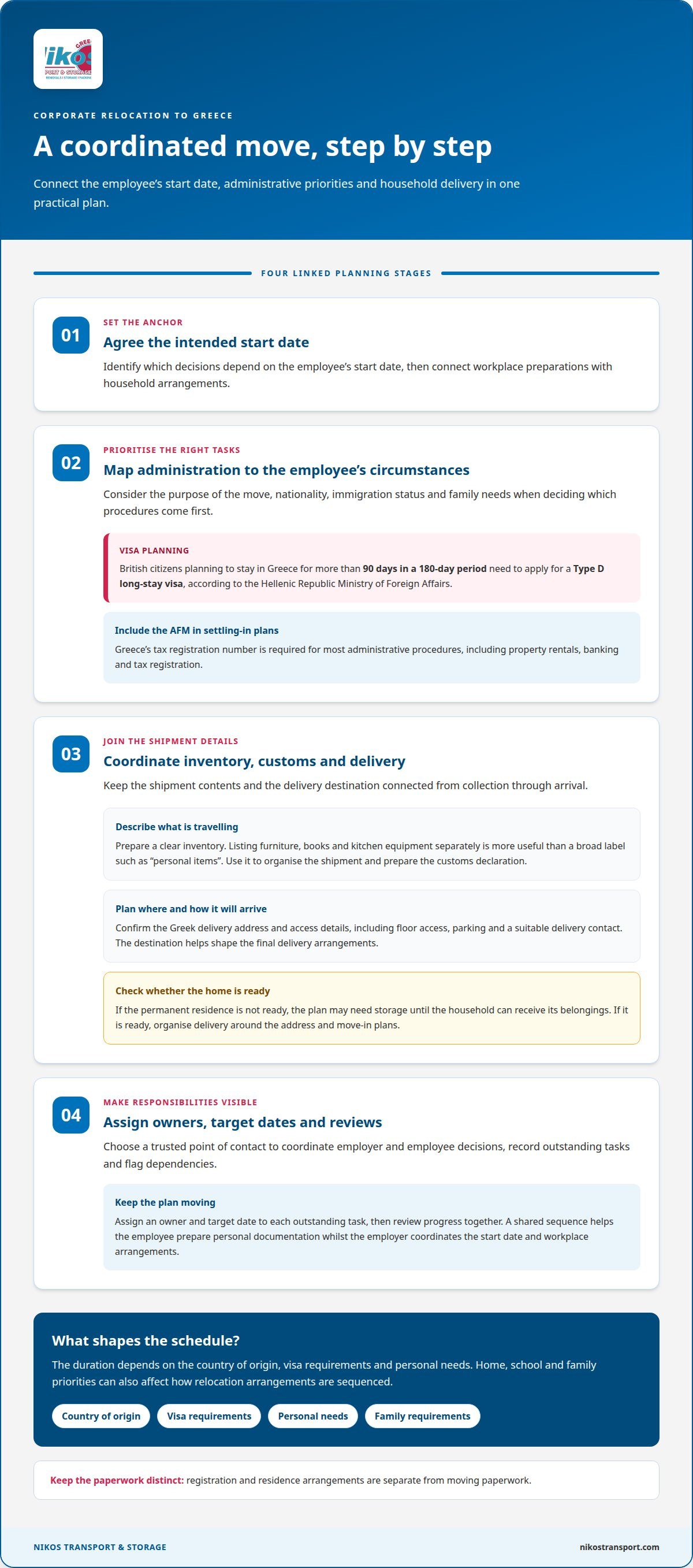
A single move plan helps employers connect business deadlines with the employee’s practical arrangements. Start by assigning a trusted point of contact who can coordinate decisions between the employer and employee. That person can keep responsibilities clear, record outstanding tasks and flag when a decision affects another part of the move.
Build the plan around the move’s purpose, nationality, immigration status and family needs. These factors influence which procedures take priority and how the schedule is arranged. The duration depends on the country of origin, visa requirements and personal needs, so a fixed schedule may not suit every employee.
A practical sequence can make responsibilities easier to follow:
- Agree the employee’s intended start date and identify the decisions that depend on it.
- Map immigration and residence-permit tasks against the employee’s circumstances.
- Set out household moving and delivery arrangements alongside the destination address.
- Assign owners and target dates for each outstanding task, then review progress together.
If a start date changes, for example, the employer can review related arrangements before they become disconnected. A shared task record also helps the employee understand which decisions are theirs and which need employer input. Remote meetings and document sharing can keep the employer and employee aligned with contacts in Greece.
Responsibilities continue after arrival. Keep residence-permit expiry dates on the relocation timeline and begin renewal arrangements at the appropriate time. This reminds the employee and employer to address ongoing immigration procedures, rather than treating arrival as the final task.
Coordination should distinguish the work the employer controls from personal decisions. The employer can organise internal approvals and agree on the employee’s start date; the employee can provide information needed for personal arrangements. Regular updates help both sides resolve dependencies, such as a change in work location affecting the employee’s preferred destination.
For a move to Greece, this structured approach brings corporate deadlines and personal logistics into one manageable plan. It helps everyone see the next action, who is responsible and which decisions could affect the wider relocation.
Corporate and employee relocation to Greece
A successful move needs to work for both the employer and the person relocating. Corporate relocation services to Greece can help align the employee’s arrival, household arrangements and workplace start date. The plan should reflect the move’s purpose, nationality, immigration status and family needs, as these factors shape priorities and timing.
What Greek work visa and residence permit requirements apply to relocating employees? British citizens planning to stay in Greece longer than 90 days in a 180-day period need to apply for a Type D long-stay visa. Employers should also track residence-permit expiry dates and begin renewal arrangements at the appropriate time.
Moving to Greece also involves practical steps beyond immigration. A tenant needs a Greek tax registration number, known as an AFM, before signing a home lease. The AFM is required for most administrative procedures, including property rentals, banking and tax registration. Build this step into the housing timeline, rather than leaving it until after accommodation is chosen.
What risks and common challenges should companies plan for when relocating employees to Greece? Visa requirements, delayed housing decisions, family needs and administrative tasks can affect the sequence. A change in work location, for example, may alter where an employee wants to live. Assigning an owner to each task and making dependencies visible helps teams respond when one decision affects another.
Tax residence is another consideration for employees and employers. Living in Greece for over 183 days a year typically makes a person a Greek tax resident who must declare global income there. This can have implications beyond the move itself, so include tax planning among the employee’s relocation priorities. Greece offers different practical and lifestyle considerations for each household, and a smooth transition depends on addressing them early.
For the household move itself, arrange transport to Greece around the employee’s destination and timing. This helps connect the delivery plan with the wider relocation schedule, while the employer coordinates workplace and administrative priorities.
Nikos Transport & Storage: Transport To/From Greece
Nikos Transport & Storage helps employers and employees arrange household transport between the UK and Greece. The service can fit into a relocation plan when a new role, family move or change of residence means belongings need to travel.
Each employee’s household move has different requirements. A household moving straight into a permanent home may need a different arrangement from one whose accommodation is not ready. Transport can be planned around the destination and the employee’s circumstances, with packing and storage available to support the move.
For employers, including household transport in the wider relocation schedule helps connect the employee’s arrival with delivery planning. Individuals can also arrange a move independently, while UK Removals can support a separate domestic move as part of the relocation process.
If you’re planning an employee or household move to Greece, contact Nikos Transport & Storage to discuss the transport arrangements.
Make the next move a clear one
Plan the household move alongside the employee’s first priorities in Greece, so practical arrangements support the transition rather than compete with it. Start by outlining what needs to travel, when the employee can receive it and whether storage may be needed. This gives the employer and employee a clear basis for discussing the transport plan.
Nikos Transport & Storage provides storage and transport to Cyprus, as well as support for moves between the UK and Greece. For organisations arranging corporate relocation services to Greece, matching transport to the employee’s circumstances can make the practical side easier to organise.
Share the move’s destination, household requirements and timing to begin a focused conversation about the arrangements. Contact Nikos Transport & Storage to discuss your move and take the next step with confidence.
Frequently Asked Questions
How long does the relocation process take?
There’s no single timetable for every employee move. The duration depends on the country of origin, visa requirements and personal needs. Household transport follows its own schedule, separate from immigration procedures. A move with an undecided start date or home address, for example, may need different sequencing from one with arrangements already in place. Customs clearance is outside the mover’s control, so no clearance duration can be promised.
What do corporate relocation services to Greece include?
The moving arrangements can include household transport, packing, storage and customs declarations. An employee whose new home is not ready, for example, may need belongings stored before delivery. These services are distinct from immigration, housing and school support, which involve separate decisions and processes. Define the household’s needs and delivery destination early so transport can be planned around the employee’s circumstances.
What are the steps and typical timeline for relocating an employee to Greece?
Begin by agreeing the employee’s start date and identifying the move requirements. Then organise the shipment details, documentation and delivery arrangements around the destination. Scheduled road groupage from the UK starts every Saturday and arrives at the Greek depot within 7 days. This is a transport schedule, not a full relocation timeline; visa procedures, personal needs and customs clearance affect the wider process.
What relocation support is available across Greece?
Household transport can be arranged to destinations across mainland Greece and the islands. Door-to-door delivery in Greece is available for a small fee, while collection from the Greek depot is free. An employee moving to an island, for example, can plan delivery around the destination address and household requirements. Keep transport arrangements distinct from local settling-in support.


