
The most important decisions come before you pack the first asset. When relocating business assets to Cyprus, decide where management will be based, whether the existing company will move or a new entity will be created, how staff will work in Cyprus, and how you’ll close the UK tax position. The business, its people and its governance need to move together.
It’s understandable to focus first on getting equipment, stock and documents safely from the UK to Cyprus. Planning the company’s structure and practical needs alongside the physical move helps you identify what to arrange and in what order.
This guide explains which requirements to research, how to plan office space and infrastructure, and which professional fees may form part of a Cyprus move. It also covers how VAT and customs considerations affect business assets, what influences the relocation timeline, and how transport and storage can fit into the wider plan.
Key Takeaways
- Plan office space, equipment needs and staff arrangements alongside the move, so your new base can support day-to-day operations.
- Decide whether to continue the existing company or create a new structure, and research Cyprus’s legal, tax and licensing requirements before acting.
- Set the order of corporate approvals, registrations, staffing and asset transport carefully; the business, its people and its governance need to move together.
- Build a budget around the professional work required, including company setup, tax advice, accounting and any sector-specific requirements.
- Identify how VAT, customs and import rules apply to each asset moving from the UK, as the treatment depends on the goods and the circumstances of the transfer.
Business infrastructure and relocation support
Choose a Cyprus base that suits the work, not just the company’s registration paperwork. A business can rent or purchase office space, but the premises must support its operations and provide adequate room for employees and equipment. For example, a firm moving servers, product samples and a small team needs a different layout from a consultancy using laptops and meeting rooms. Measure equipment, assess storage needs and confirm staff numbers before comparing premises.
Practical risks include choosing a workspace that cannot accommodate equipment, delays in setting up banking, and staff being unable to start because permits remain unresolved. Planning the office, workforce and asset transfer separately can disrupt operations.
Cyprus sits at the crossroads of Europe, Asia and Africa, and offers businesses access to 500 million EU consumers. That setting may support regional operations, but location alone doesn’t establish a suitable working base. Compare the premises with your actual needs: access for deliveries, secure equipment storage, reliable connectivity and space for employees to work together. Build these requirements into the site decision before arranging the physical move.
- Premises: match floor space and access to equipment, staff and daily tasks.
- People: identify which employees will move and what permissions they need.
- Operations: plan how equipment will reach the office and become usable.
Cyprus offers tax and other incentives to support the physical relocation of key individuals, including owners and employees. Treat these as part of workforce planning rather than assuming every employee qualifies. List each person’s role, work location and intended start date. This helps organise staffing around operational needs and identify where immigration arrangements apply.
For third-country national employees, Cyprus offers temporary work and residence permits of up to 3 years, renewable upon expiry. Companies should factor permit arrangements into recruitment and relocation timelines. A foreign director or employee moving with the business may need a different plan from a UK-based colleague who continues working remotely. Establish who will be based in Cyprus and how their presence supports daily management.
A Cyprus business also needs a bank account to receive customer payments, pay suppliers and employees, and manage its finances. Include account setup in the operational sequence, alongside office arrangements and equipment transfers. Without a functioning account, routine transactions can become an obstacle even after the workspace is ready.
Use a written asset schedule to coordinate the move. Record each item’s owner, destination, intended use and delivery priority. Separate essential equipment, such as computers needed on opening day, from items that can follow later. This helps directors understand dependencies and align the company’s registered presence, workforce and physical operations.
Researching legal, regulatory and tax requirements
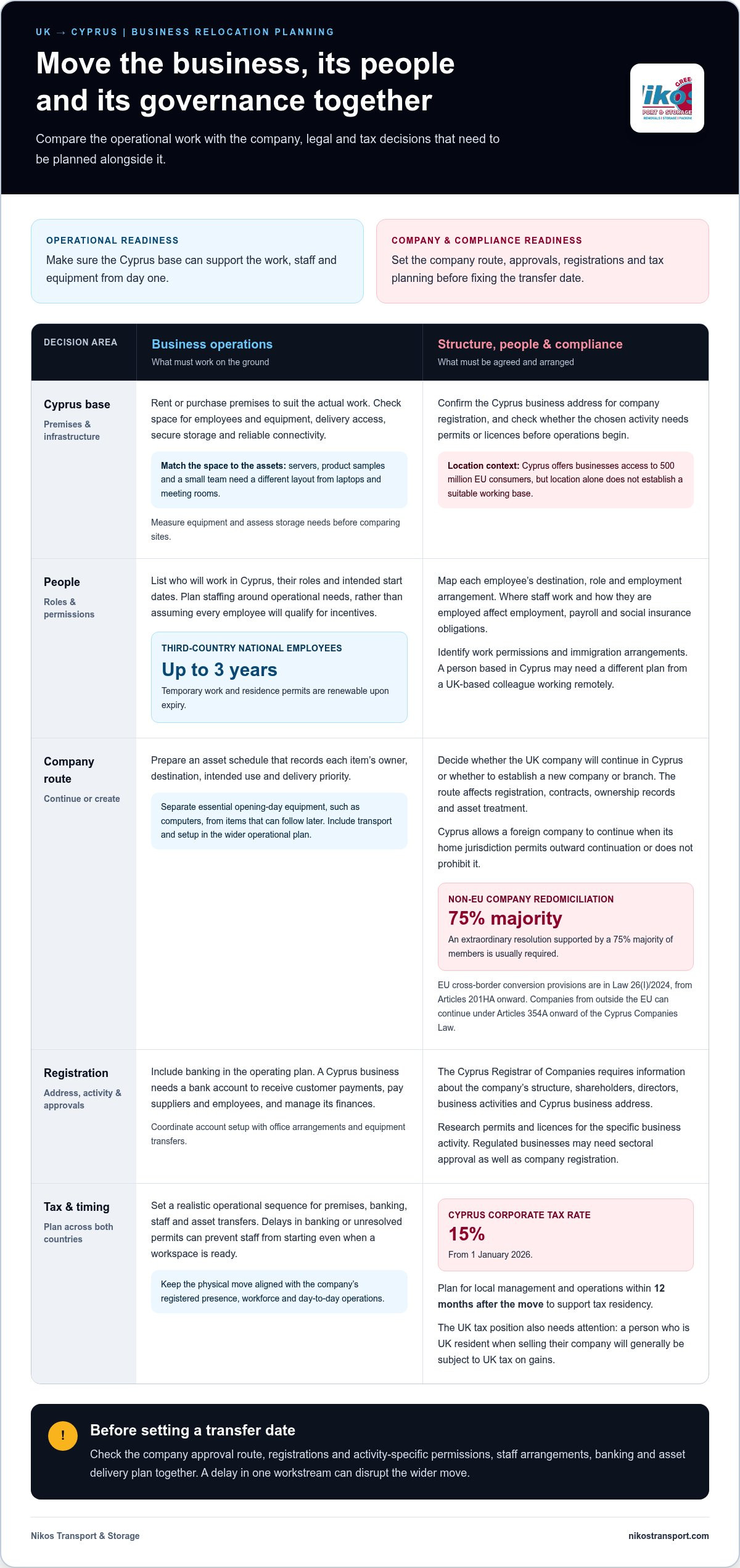
Start by deciding what the move means legally: will the UK company continue in Cyprus, or will you establish a new company or branch? That choice affects registration, contracts, ownership records and the treatment of business assets. Cyprus company law allows a foreign company to continue in Cyprus when its home jurisdiction permits outward continuation or does not prohibit it. A non-EU company’s redomiciliation usually requires an extraordinary resolution supported by a 75% majority of members.
For an EU cross-border conversion, Cyprus company law includes provisions inserted by Law 26(I)/2024, from Articles 201ΗΑ onward. A company from outside the EU can continue under Articles 354Α onward of the Cyprus Companies Law. The relevant route depends on the company’s origin and legal structure. Check the UK company’s governing documents and approval process before setting a transfer date.
Registration is a separate step. Businesses relocating to Cyprus must provide the Cyprus Registrar of Companies with information about their structure, shareholders, directors, business activities and Cyprus business address. Research permits and licences required for the specific activity before operations begin. A regulated business may need sectoral approval as well as company registration, so include this in the planned sequence.
Tax planning must cover both the destination and the country being left. Cyprus’s corporate tax rate is 15% from 1 January 2026. Companies should plan for local management and operations within 12 months after the move to support tax residency. The UK tax position also needs attention: a person who is UK resident when selling their company will generally be subject to UK tax on gains. The company’s structure, management location and timing all matter.
- Company structure: identify the legal route and required shareholder approvals.
- Operations: list permits and licences tied to the business activity.
- Tax: map company and personal tax questions across both countries.
- Staff: identify employee location, payroll arrangements and work permissions.
Employment, payroll and social insurance obligations depend on where staff work and how they’re employed. Moving employees to Cyprus means planning local payroll and social insurance arrangements, rather than assuming UK processes will continue unchanged. Map each employee’s destination, role and employment arrangement before setting the transfer date.
Immigration is a separate workstream for employees who are not EU nationals. Cyprus has a Business Facilitation Unit scheme for third-country nationals when the company has at least €200,000 in share capital. Eligibility and employment conditions affect whether this route fits. Keep immigration planning alongside corporate and payroll decisions, not as a final administrative task.
Once the legal route, approvals and asset schedule align, plan the physical transfer around the company’s operational priorities. Transport to Cyprus can form part of that practical plan for business assets moving from the UK.
Moving a UK business to Cyprus
A UK-to-Cyprus move is a corporate decision, not simply an international shipment. Before setting dates, decide where management will actually be based, which entities will move or be created, how staff will work, and how the UK tax position will close. These choices shape the order of approvals, registrations and operational changes.
Keep the company’s structure, people and governance aligned. For example, moving equipment to a Cyprus office while directors continue managing the business from the UK may create a mismatch between physical operations and management arrangements. Map who will make decisions in Cyprus, which contracts or activities will sit there, and how responsibilities will change. Consider personal residence and domicile separately from the company’s location.
Use a staged plan to bring the major workstreams together:
- Set the structure: decide whether the existing company will continue, or a Cyprus entity will be created.
- Confirm management: assign decision-making roles and identify where directors will perform them.
- Plan staffing: map employee locations, employment arrangements and any required work permissions.
- Prepare the UK exit: schedule tax and operational closure tasks alongside Cyprus setup.
- Sequence the assets: prioritise equipment needed to restart operations, then schedule less urgent items.
The Cyprus Registrar of Companies typically takes 5-15 working days to process a complete continuation or incorporation filing. This processing period is not the whole relocation timeline. A straightforward company relocation to Cyprus, excluding sectoral licensing, typically takes 8-16 weeks after corporate approvals are finalised. The filing route, completeness of documents and any additional approvals affect the sequence.
Build the timetable backwards from the date Cyprus operations need to begin. Work out when corporate approvals must be final, then place registration, staff arrangements, premises readiness and asset delivery around that milestone. If a business needs specialist licensing, include that work separately, because the 8-16-week timeframe excludes sectoral licensing. Treat the Registrar’s processing time as one part of the schedule, not a substitute for the wider plan.
Cyprus is an EU member state, giving businesses access to European consumers. That opportunity becomes practical only when customer-facing operations can function from the destination. Identify which systems, records and equipment must be available at launch. A professional services firm may prioritise computers and client files, while a distributor may need stock and handling space ready. These examples help set delivery priorities without assuming every asset must move at once.
Keep a single relocation schedule recording each decision, responsible person and dependency. Directors can use it to spot conflicts, such as an office opening before essential equipment arrives or staff moving before their work arrangements are ready. This joined-up approach helps reduce avoidable disruption and move the company’s structure and operations in a deliberate order.
Relocation costs and professional fees
Compare the full cost of establishing and operating in Cyprus with the cost of keeping the business in the UK. A move adds formation, legal, tax, accounting and audit work, while retaining the UK structure avoids Cyprus setup tasks. The tax outcome depends on the company’s structure, management and operations, as well as the position of its owners and employees.
Cyprus’s corporate tax rate is 15% from 1 January 2026. This rate alone doesn’t show whether moving will reduce the company’s overall tax burden. The business must also consider where it is managed, whether it has genuine substance in Cyprus, how income is earned and how the UK tax position will close. A tax comparison should assess both countries’ obligations against the company’s expected activities.
Build a budget that separates one-off setup work from recurring obligations. Legal and corporate advice may cover formation, a tax opinion, shareholder approvals, and documents for continuation or incorporation. Other professional work can include tax and VAT registration, accounting, company secretarial support, a registered office and annual audit. The company’s size, structure, transaction volume and regulatory needs determine which tasks apply.
For individuals and employees, assess personal tax and eligibility for any relevant exemption separately from company taxation. An incentive may depend on the person’s circumstances, income and employment arrangement. Don’t treat a potential exemption as guaranteed savings in the business budget. Record the conditions to meet and the evidence needed to support a claim.
- Formation and advice: identify the legal route, approvals and tax analysis required.
- Annual administration: include accounting, company secretarial and registered-office obligations.
- Compliance: allow for audit, VAT and any sector-specific reporting needs.
- People: assess payroll, social insurance and individual tax arrangements.
- Physical move: list assets, packing needs, delivery priorities and storage requirements.
Keep the asset-transfer budget separate from professional fees. The physical move’s cost depends on the volume and nature of the items, packing requirements, access at each address and whether storage is needed. A detailed inventory helps identify bulky equipment, fragile items and assets that can move later. It also helps coordinate delivery with premises readiness and operational priorities.
Before committing, request a written breakdown of professional work by task, separating one-off and recurring costs. Compare like with like: a formation-only estimate does not cover ongoing accounting or audit, while a tax opinion may not include implementation. For relocating business assets to Cyprus, a joined-up budget should also show how the physical transfer fits the legal and operational timetable.
How do Cyprus VAT, customs and import rules apply to business assets moved from the UK?
Cyprus is an EU member state, so moving assets from the UK to Cyprus requires VAT and import planning before dispatch. Treatment depends on what each item is, who owns it, why it is moving and how the company will use it. A computer transferred for the company’s own operations may require different consideration from stock being sent for sale.
Start with an itemised asset inventory. For each item, record its description, quantity, serial number, ownership, purchase details, current location and intended use in Cyprus. Separate company equipment from goods intended for customers. This gives the business a clear basis for preparing shipment information and assessing the relevant tax and import treatment.
Keep supporting records with the inventory. These may include purchase invoices, transfer documents, equipment registers and details of the receiving company or site. If the UK business and Cyprus entity are separate, document which entity owns each asset and whether ownership is changing. That distinction can affect the VAT analysis and the information required for the movement.
- Equipment: identify each item and state whether it is being transferred for continued business use.
- Stock: distinguish goods moving for resale from assets used by employees.
- Ownership: record whether the same company retains ownership or another entity receives the goods.
- Shipment details: match the inventory to the consignment and destination records.
Next, assess VAT and import requirements before setting a collection date. The relevant treatment depends on the goods, their value, ownership and purpose, as well as the business arrangement behind the transfer. Keep the company’s registration details and receiving address consistent across records. Differences between the asset schedule, transfer paperwork and shipment details can cause delays while information is clarified.
Plan for items that need separate treatment. For example, equipment leased from a UK supplier differs from equipment owned outright by the company. Goods sent temporarily for repair or demonstration also have a different purpose from assets permanently moved to support Cyprus operations. Flag these cases in the inventory instead of grouping everything under “office equipment”.
Before dispatch, organise the asset list, ownership evidence and destination details in one file. This helps the person preparing the shipment understand what is moving and why. For a cross-border transfer, arrange a customs declaration as part of coordinating the paperwork and transport to Cyprus. Clear records help connect the business decision with the physical movement of each asset.
Alongside the movement paperwork, consider whether the wider ownership and tax position needs separate review. UK anti-avoidance rules may apply if a person moves abroad after selling a business and returns to the UK within a specified period. A Cyprus tax resident who qualifies as non-domiciled may benefit from the Cyprus non-domicile regime if resident there for less than 17 years. Cyprus non-domiciled tax residents can be exempt from tax on dividend and interest income.
The Cyprus non-domicile rules allow individual shareholders to receive dividends and interest free of defence contribution for up to 17 years. Cyprus exempts capital gains from the sale of securities and profits from foreign permanent establishments. Cyprus’s IP Box Regime offers reduced tax rates for revenues generated from intellectual property rights. These matters are distinct from the treatment of the assets in transit.
Nikos Transport & Storage: Transport To/From Greece
Nikos Transport & Storage can help move business assets from the UK to Cyprus once you have organised the destination, inventory and delivery priorities. Its Cyprus Service is suited to office equipment, stock and other business belongings moving to a new base. The Packing Service can help prepare items, while the Storage Service may help if there is a gap between collection and the Cyprus premises being ready.
If you’re coordinating a UK office move alongside the international transfer, UK Removals can support the domestic part of the plan. Keep an asset list and delivery priorities ready to help align transport with your operational schedule and customs paperwork.
To discuss transport or storage for your move, contact Nikos Transport & Storage.
Prepare your next move with confidence
Before booking transport, turn your relocation plan into a practical move brief. List the assets, note which items must arrive first, and identify any gap between leaving the UK premises and using the Cyprus base. This gives you a clear starting point for coordinating the physical move with your wider business plans.
For businesses relocating business assets to Cyprus, Nikos Transport & Storage offers its Cyprus Service, alongside Greek Service and Storage Service. These services can support the transport of business belongings and help manage a timing gap when assets cannot move directly into the new premises.
Share your planned route, asset requirements and preferred schedule with the team to discuss the practical arrangements. A clear brief helps you consider how transport and storage fit into your move.
Contact Nikos Transport & Storage to discuss your business move and take the next step with a considered plan.
Frequently Asked Questions
What should be decided before a relocation?
Decide what will move, which company will own each asset afterwards, and what must be ready for trading on arrival. For example, distinguish equipment transferred between entities from stock intended for sale. Set the intended handover date, identify who can approve each decision, and plan how customer orders will be handled during the changeover. These practical choices connect the business transition with the movement of physical assets.
What are the tax implications of relocating a UK business and its assets to Cyprus?
Tax depends on the company’s structure, where it is managed, how it operates and how assets are transferred. Cyprus’s corporate tax rate is 15% from 1 January 2026, but comparing rates alone won’t establish the overall effect. A UK-resident individual selling a company will generally be subject to UK tax on gains. Assess company tax residence, asset-transfer VAT and import treatment, plus any relevant personal tax position, as separate questions.


