
Customs paperwork needs planning as carefully as the transport itself. For a UK Transfer of Residence application, it can take 7 to 21 days to receive an approval code. For office equipment transport UK to Greece, the paperwork and freight choice depend on what your business is moving and how the shipment is arranged.
It’s understandable to want clear answers before desks, IT equipment, racking or machinery are packed. This guide explains the customs paperwork to prepare, how road and sea freight can suit different loads, and which factors affect the quote, so you can plan without relying on a one-size-fits-all estimate.
You’ll also learn how to plan around the shipment’s size, handling needs and destination, helping you make informed decisions and keep the move organised from the UK to Greece.
Key Takeaways
- Start customs planning early: a UK Transfer of Residence application can take 7 to 21 days to receive an approval code.
- Match road freight to the size of your load, and plan around packing readiness and the shipment’s route to its associated warehouse.
- For larger moves, compare sea freight with road options by considering shipment volume and the time needed for transport to the port.
- Prepare IT equipment, office furniture, racking and machinery according to their handling needs, and organise a clear inventory before packing.
- Transport costs depend on the shipment and its requirements; a price is provided after a quote request.
Customs paperwork and Transfer of Residence forms
Prepare a customs file that describes the shipment and explains its purpose. For office equipment transport UK to Greece, accurate records help keep the declaration, inventory and delivery details consistent.
UK Customs Clearance
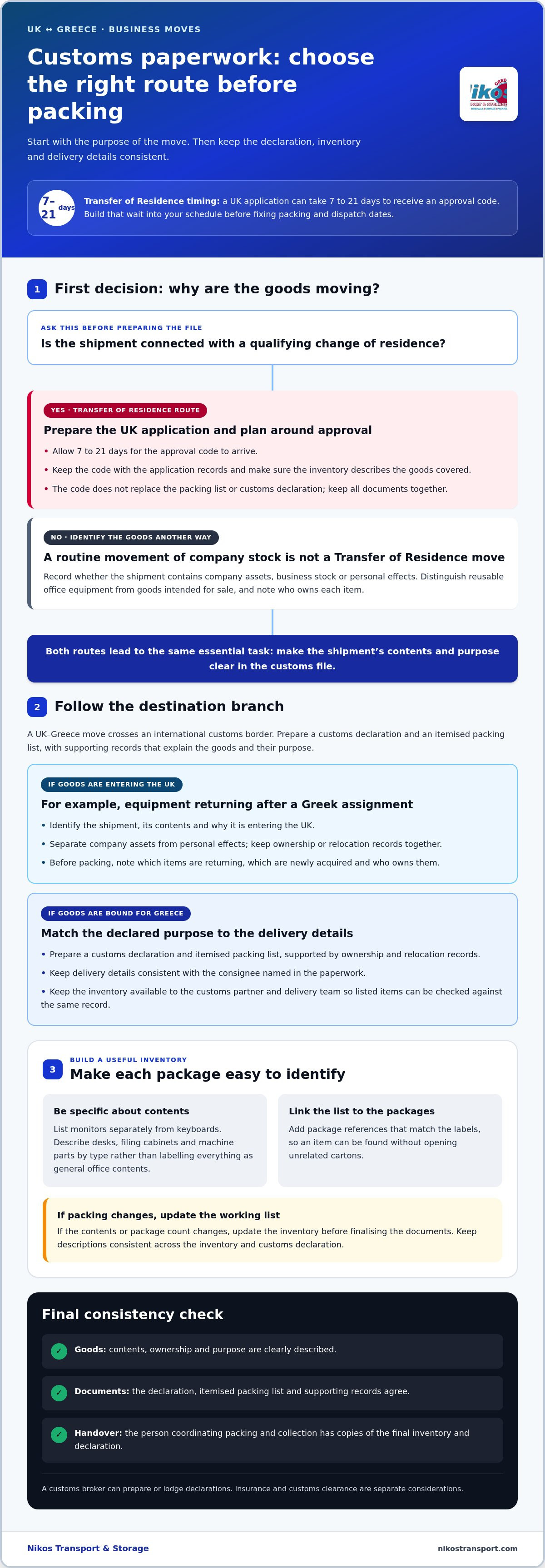
Customs clearance also matters when goods enter the UK, such as equipment returning after a Greek assignment. The file should identify the shipment, its contents and why it is entering the country, with details consistent across the declaration and packing list. Separate company assets from personal effects, and keep ownership or relocation records together for the customs process.
Before packing, note which items are returning, which are newly acquired and who owns them. This gives the person preparing the declaration a clear basis for describing the goods, rather than treating every box as identical office contents.
Greek Customs Clearance and Delivery
For a Greece-bound move, prepare a customs declaration and itemised packing list, supported by ownership and relocation records that explain the declared purpose. The paperwork depends on whether the shipment contains company assets, business stock or personal effects connected with a Transfer of Residence application. Keep delivery details consistent with the consignee named in the paperwork.
A customs broker can prepare or lodge declarations. Insurance and customs clearance are separate considerations. Keep the inventory available to the customs partner and delivery team, so questions about a listed item can be answered against the same record.
Packing Lists and Customs Declarations
Make the packing list specific enough to identify the contents of each package. For example, list monitors separately from keyboards, and describe desks, filing cabinets or machine parts by type. Add package references that match the labels, so a declared item can be found without opening unrelated cartons.
Use consistent descriptions across the inventory and customs declaration. Record ownership and the shipment’s purpose, and distinguish reusable office equipment from goods intended for sale. If packing changes the contents or package count, update the working list before finalising the documents.
Post-Brexit Customs Procedures
Since the UK left the EU, a move between the UK and Greece crosses an international customs border. Treat it as an international relocation, not an ordinary domestic transfer. The shipment needs a clear description, a customs declaration and supporting records explaining its destination and purpose.
Keep copies of the final inventory and declaration with the person coordinating packing and collection. A transport partner can use matching descriptions for the customs file and delivery paperwork, reducing confusion when equipment is identified at different stages of the journey.
Transfer of Residence Forms
A Transfer of Residence application is relevant when the shipment is connected with a qualifying change of residence, rather than a routine movement of company stock. The UK application can take 7 to 21 days to receive an approval code. Build that waiting period into the relocation schedule before fixing packing and dispatch dates.
Keep the approval code with the application records and ensure the inventory describes the goods covered. The code does not replace the shipment’s packing list or customs declaration. Keep those documents together so the declared items and reason for the move remain clear during customs processing.
Road freight for smaller shipments between the UK and Greece
Road freight suits smaller loads, from one pallet to 25 cubic metres. Measure the shipment before deciding how to group and prepare its belongings.
Door-to-Door Removals
Door-to-door transport connects collection at your UK premises with delivery to the Greek destination. For example, a business relocating one department can record its collection address, access arrangements, delivery address and receiving contact. These details help organise handovers and ensure the shipment reaches the right place.
Small-volume road freight can carry loads ranging from one pallet to 25 cubic metres. A stated pallet size is 120 cm long, 100 cm wide and 200 cm high, giving an outer volume of 2.4 cubic metres. Measure packed items too, as furniture shapes and protective packing affect how space is used.
Before collection, group belongings by destination and label cartons with their contents and department. Keep fragile IT equipment separate from heavier items, and make sure the inventory matches the packed shipment. This gives everyone handling the load a useful reference at collection and delivery.
For a residential move or business relocation, check that collection and delivery dates align with access to both premises. If the move involves several floors, restricted loading access or a separate delivery point, include those details in the transport plan.
Transit Times
Road freight can be an option for moving goods between the UK and Greece, but arrival timing depends on the shipment and transport arrangements. This is a warehouse arrival estimate, not a promise of door-to-door delivery on the same day. Allow for the onward journey and delivery arrangements when setting an opening or relocation date.
Use the ready-to-depart date as your planning reference. Packing delays, incomplete inventories or changes to collection arrangements can affect when a shipment is ready. Group and document the equipment before collection, so the transport schedule can be organised around a complete load.
Choose a delivery window that leaves time to receive and place essential items before staff return. For example, identify which desks or computers are needed first, then plan unloading around the destination’s access and room layout. This makes the handover easier to manage.
For a UK-to-Greece move, road transport between the UK and Greece is one option to consider for a smaller, measured load. Compare the shipment’s volume, packed dimensions and destination access before settling the collection and delivery plan.
Office and factory removals from the UK to Greece
An international office or factory move needs a plan for the whole load, not just individual boxes. Start by listing desks, IT equipment, racking and machinery, then group items by their destination in Greece. This gives the packing and transport teams a clear view of what must travel together and what needs separate handling.
For larger consignments, sea freight may suit the volume better than a smaller road shipment. Consider it for loads exceeding 25 cubic metres, and compare the packed volume with the space required for safe loading. A full 20 ft container is another option for a substantial move. For example, a business relocating its office and workshop can assess whether equipment, furniture and stock fit together in one load.
Timing matters for a move from England to Greece. Sea-freight transit from packing until arrival at the port is approximately 15 to 25 days. That period is not the complete door-to-door schedule: collection, customs processing, port handling and onward delivery also affect the overall plan. Set the packing date against the required arrival window, then allow time to organise the stages around it.
Prepare the site before packing begins. Identify machinery that needs dismantling, mark components that belong together and keep fixings with the relevant equipment. For office furniture, label desks and cabinets by room or department. A factory move may also need a clear loading sequence, so essential production equipment can be unloaded in the right order at the Greek destination.
Match each item’s packing method to its shape, weight and sensitivity. Protect the edges of desks and cabinets, secure loose parts, and keep fragile equipment apart from heavy machinery. A detailed inventory helps the team identify each item at collection and delivery, while clear labels make it easier to place belongings in the right area.
A removal quote depends on the shipment’s volume, weight, packing requirements, access at collection and delivery, and the chosen freight method. Pricing is quote-based. A measured inventory and clear details about both sites help shape an estimate around the actual international move, rather than a broad comparison with another shipment.
Business moves involving IT equipment
Plan IT equipment as a distinct part of the business relocation, not as miscellaneous office contents. Computers, monitors, servers, printers and network devices each need clear identification and careful handling. A named person from your IT team can coordinate preparation, packing and setup at the Greek destination.
Start with an asset inventory. Record each device’s description, asset tag, current location and intended department or room in Greece. For example, link a desktop computer, monitor and keyboard to the same workstation reference. This helps staff match equipment to its user and reduces confusion when boxes arrive at the new premises.
Before packing, ask your IT lead to save or transfer business data through the company’s usual process. Record which devices must be shut down and disconnected, and keep essential cables with their corresponding equipment. A labelled bag attached to a monitor stand or desktop helps prevent loose leads from becoming separated from the right device.
Prepare each item according to its shape and fragility. Protect monitor screens from pressure, keep small accessories together, and use clear labels such as “IT equipment, room two” rather than vague marks like “miscellaneous”. Keep equipment cartons apart from heavy furniture or machinery, so the contents remain identifiable during handling.
For printers and other devices with removable parts, follow the manufacturer’s packing guidance and secure loose components separately. Photograph cable connections before disconnection if the IT team will need a visual reference during installation. For example, an image of a router’s ports can help staff reconnect the correct leads at the Greek office.
Make the unpacking sequence practical. Mark priority equipment that staff need first, such as the reception computer or network hardware, and tell the receiving team where it belongs. Keep the inventory accessible to the person overseeing delivery, then compare the labelled cartons with the list before distributing them around the new workplace.
Allow time for the IT team to test devices after delivery. Check each workstation against the inventory, reconnect its labelled peripherals and report missing or damaged items promptly through the appropriate process. For an international move, coordinate the IT handover with the wider removals schedule, so staff know which equipment is ready to use and which still needs setting up.
A trusted internal contact can keep the move organised by maintaining one equipment list from packing through arrival. This gives colleagues at both locations a shared reference, supports an orderly handover and helps the business resume work without searching through unlabelled cartons.
Moving office furniture, warehouse racking and machinery
Different loads need different preparation for international freight. Office furniture, warehouse racking and machinery vary in shape, weight and handling needs, so begin with an itemised plan. Note what must be dismantled, which components belong together and where each item will go at the Greek destination.
Pack office furniture by protecting exposed surfaces and keeping loose fittings together. Remove desk drawers where practical, label them by workstation, and place screws or handles in clearly marked bags. Wrap corners and glass panels separately. For example, label a dismantled meeting table and its legs with the same room reference.
Computers, printers and fragile equipment need protective packing that limits movement inside each carton. Use suitable cushioning, keep cables and accessories with their devices, and label cartons clearly by contents and destination room. Follow the manufacturer’s guidance for removable parts, such as printer trays, and keep the packing list aligned with the final boxes.
Dismantle warehouse racking in a planned sequence. Group uprights, beams, braces and fixings by bay, then label each group to match the layout at the new premises. Keep a simple diagram or photograph of the assembled configuration. This gives the receiving team a reference for placing components and helps prevent parts from different bays being mixed.
Machinery needs an equipment-specific preparation plan. Identify detachable guards, accessories and loose components, then record which parts belong to each machine. Secure moving parts as directed by the manufacturer, and protect surfaces that could be marked during handling. Keep operating or reassembly instructions with the relevant equipment, rather than placing all documents in an unrelated household carton.
Before collection, compare the packed items with the inventory and check that labels are visible. Note unusually shaped pieces, fragile panels and machinery that needs a particular loading position. Clear access at both premises matters too: confirm collection and delivery routes, loading points and the space needed to move large items through doorways.
At delivery, use the inventory and room labels to direct each item to its intended area. Check racking groups against the layout reference, and keep machine components together until reassembly. A planned unloading order can prioritise essential furniture or equipment, helping staff organise the workspace without searching through mixed cartons.
For a move involving furniture, racking or machinery, arrange transport to Greece with the load details and destination plan ready. Sharing an itemised inventory, packing needs and access information helps shape a freight plan around the shipment.
Nikos Transport & Storage: Transport To/From Greece
Nikos Transport & Storage provides transport for businesses moving office equipment between the UK and Greece, including as part of a wider relocation. Share the inventory, packing requirements, collection and delivery addresses, and customs paperwork details to give the move a clear starting point.
For a phased relocation, storage can hold belongings that aren’t ready to move to the Greek premises. UK removals may also help businesses reorganise equipment before international transport. The right arrangement depends on the shipment and the sequence of your move.
To discuss your business move, contact Nikos Transport & Storage.
Plan the move around your next working day
A useful next step is to decide what your team needs first at the new premises. Set a practical order for equipment, furniture and other business items, then align collection and delivery planning with that sequence. This helps colleagues know what to expect as the relocation takes shape.
For office equipment transport from the UK to Greece, Nikos Transport & Storage can arrange transport to or from Greece. The business also provides transport to Cyprus and storage, which may help if some belongings need to be held separately during a change of premises. Share the destination, shipment details and preferred sequence so the team can discuss your business’s requirements.
Whether you’re planning a complete relocation or coordinating a more gradual transition, a clear starting point makes the next decisions easier. Contact Nikos Transport & Storage to discuss your move and take the next step with confidence.
Frequently Asked Questions
What about customs?
Customs paperwork should describe the goods, their ownership and the reason for the move. Keep the business inventory separate from personal effects, and ensure the declared consignee matches the intended recipient in Greece. If the move is connected with a Transfer of Residence application, keep its approval code with the shipment records. Nikos Transport & Storage provides a Customs Declaration service for international shipments.
What happens at my destination?
At the Greek destination, the delivery team needs clear instructions about access, unloading and where the equipment belongs. Identify a named contact who can receive the consignment and direct items to the right office, department or storage area. If collecting from a depot, have the shipment reference and identification details ready. Door-to-door delivery in Greece is available for a small fee.
When is my shipment scheduled and how long does it take?
Groupage from UK depots starts every Saturday and arrives at the Greece depot within 7 days. The onward delivery date depends on the destination and arrangements after depot arrival. Customs clearance is outside the transport company’s control, so its processing time cannot be guaranteed. Share your preferred collection window and destination details when arranging the move, then plan your team’s return around the scheduled transport.
How much does it cost to transport office equipment from the UK to Greece?
Pricing is quote-based and depends on the shipment. The estimate takes account of volume, distance, packing needs, access at collection and delivery, and whether you need door-to-door delivery. Provide an inventory distinguishing equipment, furniture and machinery, along with the addresses and any access constraints. A small deposit may be required to secure a booking; optional boxes and tape have an additional cost.
What shipping options are available for office equipment from the UK to Greece?
For office equipment transport UK to Greece, the available freight options include scheduled road groupage and sea freight logistics. Groupage can suit a shipment that shares transport with other consignments, whilst sea freight may suit a larger load. Compare the packed volume, item dimensions and delivery requirements before selecting an option. Air freight is not an available service from Nikos Transport & Storage.
How long does road freight from the UK to Greece take?
Road shipments take 6 to 10 days to reach an associated warehouse after the goods are packed and ready to depart. That estimate describes warehouse arrival, not the complete door-to-door process. Collection, customs clearance and onward delivery affect the overall schedule. For scheduled groupage from UK depots, departures start every Saturday and arrival at the Greece depot is within 7 days.
What VAT, customs duties, or other charges apply to office equipment imported into Greece?
VAT and customs charges depend on how the goods are classified, their declared value and whether they are business assets or goods for sale. There isn’t one charge that applies to every office shipment. Prepare an itemised inventory with accurate descriptions and values, then distinguish used equipment moving with a business from stock intended for commercial sale. The customs declaration should reflect the shipment’s actual purpose.
What restrictions apply to transporting batteries, electronics, or hazardous materials to Greece?
Restrictions depend on the items and their contents, so identify batteries and hazardous materials separately from ordinary office equipment. Tell the transport coordinator whether batteries are installed in devices or packed separately, and provide product information for items such as backup power units, cleaning chemicals or workshop materials. Keep these goods out of mixed cartons until their transport requirements are understood, and describe them accurately in the shipment inventory.


