

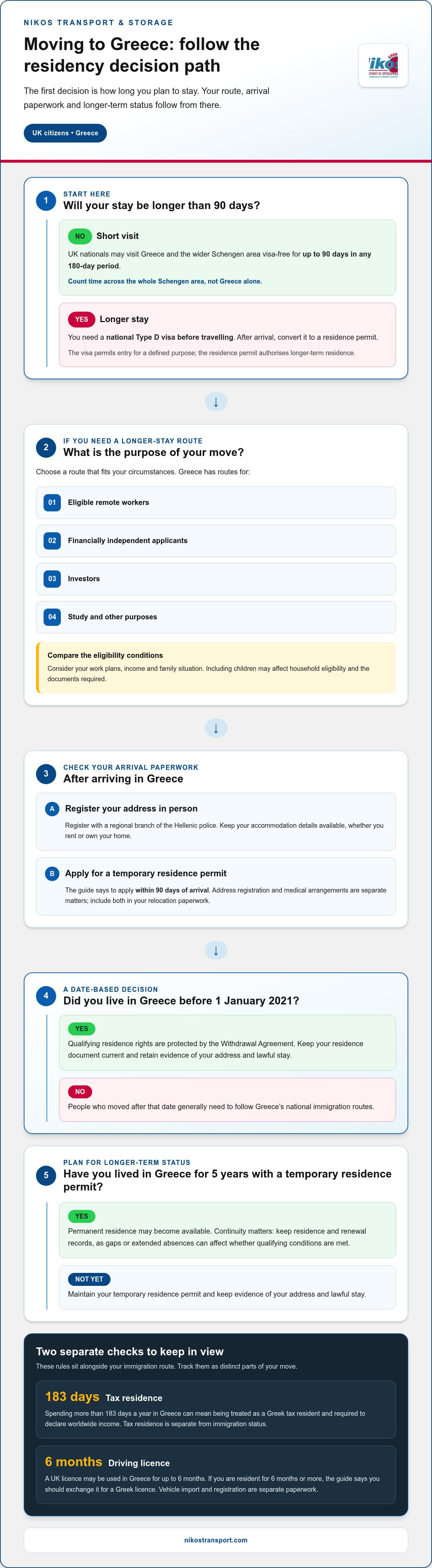
Yes, UK citizens can move to Greece after Brexit, but a stay of more than 90 days requires a national Type D visa before travel, according to the Greek Ministry of Foreign Affairs. For shorter visits, UK nationals may stay in Greece and the wider Schengen area visa-free for up to 90 days in any 180-day period, according to the European Commission.
Leaving the EU changed the paperwork, not the possibility of making Greece home. It’s understandable to want clear answers before committing to a move, especially when residency, healthcare and everyday costs all need to fit together. This guide explains the main residency routes, healthcare and living costs, and how the Schengen limit applies.
You’ll also find a practical overview of the relocation steps, from planning your move and belongings to preparing for life in Greece. With the essentials set out in order, you can make informed decisions and build a plan that suits your circumstances.
Key Takeaways
- Plan the right residency route before you travel: stays over 90 days require a Type D national visa before departure, according to the Greek Ministry of Foreign Affairs.
- Keep track of your time across the whole Schengen area, not just Greece: the European Commission allows UK nationals visa-free visits of up to 90 days in any 180-day period.
- Factor healthcare into your move by considering how your residency status affects access to care and whether private cover is needed.
- Compare everyday spending by location and lifestyle, then build a budget around housing, utilities, transport and food.
- Give your belongings move time to be organised by planning removal arrangements six to eight weeks before your moving date.
Healthcare and living considerations for UK movers
Healthcare, paperwork and everyday spending all shape the practical side of settling in Greece. Plan for them alongside your residency application, as your visa route, income and length of stay can affect what you need to arrange. Start by separating arrival administration from longer-term healthcare and household budgeting.
After arriving, people moving to Greece must register their address in person with a regional branch of the Hellenic police and apply for a temporary residence permit within 90 days. Keep accommodation details available for the registration process, whether you have chosen a rental home or bought real estate. These are distinct from medical arrangements, so include both in your relocation paperwork rather than assuming one application covers everything.
Healthcare access depends on your circumstances and the cover attached to your status. Private health insurance is commonly relevant to Greek visa applications, which typically require cover for medical expenses of at least €30,000. Because UK localisation requires monetary values in pounds, this guide avoids quoting that euro threshold. Check that the policy documentation meets the application requirement and keep evidence of cover with your other residence papers.
Prescription costs also deserve a place in your health budget. In Greece’s public healthcare system, prescription drugs require copayments of 10-25%. The amount varies by prescription, so regular medicines may affect monthly spending differently from occasional treatment. List ongoing prescriptions before departure, then make a plan for obtaining them after arrival. This gives you a clearer view of recurring healthcare needs, rather than focusing only on insurance premiums.
Social security arrangements involve both countries. The EU-UK Trade and Cooperation Agreement was due to provisionally enter into force on 1 January 2021 and sets out rules on mobility and social security rights. UK state pension payments abroad can be arranged at intervals ranging from 4 to 13 weeks. If pension income forms part of your budget, consider payment timing alongside rent and regular household bills. Spending more than 183 days a year in Greece can also mean being treated as a Greek tax resident, with worldwide income subject to declaration.
These figures offer a starting point, not a complete household budget. Location, property type and lifestyle affect the balance, so compare likely rent, transport and utility needs for your chosen area.
Residency options for people moving after the transition period
UK citizens planning a longer stay need the correct visa and residence permit, while tax residence follows separate rules. For driving, UK licences may be used in Greece for up to 6 months; a person resident for 6 months or more should exchange their licence for a Greek one. A driving licence does not itself settle the paperwork for importing a vehicle.
Visas and residence permits
A visa permits entry for a defined purpose, while a residence permit authorises longer-term residence. UK nationals intending to stay in Greece for more than 90 days must apply for a Type D national visa before travelling, then convert it to a residence permit after arrival, according to the Greek Ministry of Foreign Affairs.
The right route depends on why you’re moving. Greece has routes for eligible remote workers, financially independent applicants and investors, as well as permits for study and other purposes. Compare each route’s eligibility conditions with your work plans, income and family situation before choosing. Including children in an application may affect the household’s eligibility and required documents.
Permanent residence and continuity
Permanent residence is a longer-term status that may become available after 5 years living in Greece with a temporary residence permit. Continuity matters: keep records of residence and permit renewals, as gaps or extended absences can affect whether you meet the qualifying conditions.
For UK citizens who lived in Greece before 1 January 2021, the Withdrawal Agreement protects qualifying residence rights. People who moved after that date generally need to follow Greece’s national immigration routes instead. Keep your residence document current and retain evidence of your address and lawful stay.
Tax residence is separate from immigration status. Spending more than 183 days a year in Greece can mean being treated as a Greek tax resident and required to declare worldwide income. The UK-Greece tax treaty is relevant when considering income connected with both countries, but it doesn’t replace the need to establish where you are tax resident. Keep records of time spent in each country and the sources of your income.
Driving rules need careful attention during the move. Under Article 25 of Law 4850/2021, holders of a valid UK driving licence residing permanently or temporarily in Greece could drive in Greece without restrictions. The separate guidance says residents of 6 months or more should exchange a UK licence for a Greek one, so plan for the exchange if your stay becomes long-term. Vehicle import and registration are distinct from licence recognition; don’t assume permission to drive settles the vehicle’s paperwork.
Once your residence route and arrival plans are clear, organise the move of your belongings around your intended settling-in date. Transport to Greece can help with the practical transfer while you focus on your application and establishing residence.
Cost of living in Greece compared with the UK
Living costs vary across Greece, so compare the area and household routine you’re considering. Housing, transport and shopping needs can differ between urban centres, smaller towns and islands. If you’re planning a move from the UK, start with recurring essentials rather than holiday spending. List expected rent, food, utilities and local travel, then compare each category with your current budget.
Housing is often a major part of the calculation. These figures provide a benchmark, not a guarantee of what a particular rental will cost. The neighbourhood, property condition and whether the home is furnished all affect your options. Compare homes in your intended area and include housing costs beyond rent in your monthly plan.
Food costs present a more mixed picture than simply calling one country “cheaper”. Your shopping habits matter: regular meals at home and frequent restaurant visits lead to different monthly totals.
Small everyday purchases make a budget more realistic. Treat examples like these as reference points, then list the items your household buys most often. A family’s grocery basket may differ from a single person’s, while local availability and preferred brands also affect the weekly shop.
Transport and household bills also affect the Greece-UK comparison. Add these costs alongside rent and groceries rather than focusing only on accommodation. Your travel patterns, home size and energy use will influence the totals.
Greece’s standard VAT rate is 24%, a detail to keep in mind when comparing prices that include tax. A practical approach is to separate fixed monthly costs, such as rent and utilities, from variable spending, such as food and transport. Build a sample month using actual needs for your chosen location. Then review it against your UK spending before making decisions about income, savings or a move date.
A British passport is part of the paperwork for migration, but it doesn’t determine your day-to-day spending. The cost of living depends more on where you settle and how you use local services. Compare an urban rental with a home outside the centre, or consider how access to public transport affects your routine. These comparisons can show which trade-offs matter most to your household.
Schengen short-stay limits
UK nationals may stay in Greece without a visa for up to 90 days in any 180-day period across the Schengen area, according to the European Commission. The allowance applies across participating Schengen countries, not separately in each one. A stay in Greece followed by time in Italy therefore uses the same shared allowance. Keep a record of every trip so you can plan visits without accidentally exceeding the limit.
The 180-day period is rolling, rather than a fixed half-year block. For each day you plan to be in Greece or another Schengen country, consider the preceding 180 days and count days spent in the area. This helps you see how much of the 90-day allowance remains. A calendar or travel table can make multiple entries and exits easier to track.
For example, someone spending time in Greece and then visiting another Schengen country should combine both stays in one record. Leaving Greece for another Schengen destination doesn’t reset the count. A trip outside the Schengen area also doesn’t erase earlier days; those days remain relevant while they fall within the rolling 180-day window.
This short-stay rule is different from permission to live in Greece. UK citizens intending to stay beyond 90 days must apply for a Type D national visa before travelling, then convert it to a residence permit after arrival, according to the Greek Ministry of Foreign Affairs. Time spent in Greece on a long-stay visa or residence permit doesn’t count towards the visa-free 90-day allowance.
That distinction matters if you’re arranging a move in stages. A visit to view accommodation or prepare documents uses the short-stay allowance; a longer-term move requires the appropriate visa route. Greek visa applications can take about 15 calendar days to process, and applicants must appear in person to obtain the visa. Build the application and appointment into your timeline before booking a longer stay.
Your reason for travelling doesn’t create extra Schengen days. Looking for work, visiting family or receiving pension income doesn’t change the 90-day limit. If your plan is to live in Greece, base it on a residence route rather than repeated short visits. Keep your passport, travel dates and application documents together, then update your trip record whenever you cross a Schengen border.
Before each trip, review the days you’ve already spent across the Schengen area and the dates of your planned stay. If you’re moving permanently, distinguish short visits from the period covered by your Greek residence documents. This helps you organise travel while arranging your move, without treating Greece’s allowance as a separate quota.
Moving logistics and relocation checklist
The main risks are mistimed paperwork, incomplete shipment records and unplanned pet travel. Build your checklist around your residence route, belongings, pet arrangements and intended arrival date.
Relocation steps and risks
A relocation plan coordinates your residence application, travel and household arrangements. A delay in one area can affect the others, so book an international removal company six to eight weeks before moving and work backwards from your planned departure date. Keep your visa application, accommodation details and travel documents together, with digital copies stored separately.
Your chosen route can shape the order of preparations. A remote worker considering Greece’s Digital Nomad Visa has different application needs from an independent applicant or someone pursuing a Golden Visa through real estate. For a Golden Visa, qualifying property tiers depend on location, with thresholds of €400,000 outside high-demand regions and €800,000 in those regions. Match property, residence and moving timelines before committing to arrangements.
Households should also account for family requirements early. Greece’s Financially Independent Person visa requires 15% additional income for each child included in the application. That can affect which documents and income evidence you prepare. Create a household file with identity documents, residence paperwork, accommodation records and relevant financial evidence. Keep originals accessible during travel rather than packing them with household goods.
Importing belongings and pets
Moving belongings means organising an inventory, transport and the required shipment paperwork for goods travelling from the UK to Greece. A clear inventory helps you identify what’s going, what needs special handling and what should remain accessible. Separate essential items from packed belongings, and keep a copy of the inventory with your moving documents.
Pets need a separate travel plan from your household goods. Speak with your vet about your pet’s records and travel arrangements, then keep those documents accessible during the journey. Coordinate the travel date with your arrival and accommodation plans. Requirements depend on the animal and journey, so make pet paperwork a specific task on your relocation checklist.
Allow time to pack your belongings and coordinate collection and delivery. A move involving the contents of an entire property may need a more detailed inventory than a small household shipment. Identify fragile items, label boxes by room and note anything you’ll need immediately after arrival. This helps keep unloading and settling into your Greek home organised.
Before departure, check your list against three dates: your travel date, planned collection and accommodation start. Keep digital and printed copies of key documents, and make sure your pet’s records travel with you. If your residence application, property purchase or rental arrangements change, update the moving timeline so your paperwork and transport remain aligned.
Nikos Transport & Storage: Transport To/From Greece
Nikos Transport & Storage arranges transport for belongings between the UK and Greece as part of your relocation. Once your destination and moving date are taking shape, decide what needs to travel, whether you need packing, and if storage would help while arrangements are finalised.
Keeping these decisions together can make it easier to coordinate your household move with your arrival and accommodation plans. Nikos Transport & Storage also provides UK removals and storage, useful when your move involves a UK property alongside arrangements at your destination.
For support with transporting your belongings to or from Greece, contact Nikos Transport & Storage to discuss your move.
Turn your relocation plans into practical steps
Once your residence arrangements and arrival date are taking shape, include your belongings in the plan. Decide what needs to travel with you, what can follow later and whether a gap between homes makes storage useful. A room-by-room list can help you prioritise what you’ll need first and what can wait, making the move easier to organise around the life you’re preparing to build.
Moving to Greece after Brexit is more than a change of address; it’s the start of a new routine. Nikos Transport & Storage provides transport to or from Greece, storage and transport to Cyprus if your plans involve more than one destination. Discuss your moving requirements and arrange a plan around your household’s needs.
Contact Nikos Transport & Storage to talk through your move and the belongings you plan to take. With the practical arrangements taking shape, you can look ahead to making Greece feel like home.
Frequently Asked Questions
Can UK Citizens Move to Greece After Brexit?
Yes, UK citizens can move to Greece, but a long-term move requires the appropriate Greek visa and residence status. People who established residence before the end of the transition period may have rights under the Withdrawal Agreement; later arrivals follow Greece’s immigration routes. First decide whether you’re moving for retirement, remote work, study, investment or employment. Your reason for moving helps identify a suitable application route.
Can I take my pet with me when I move abroad?
Yes, you can plan to move with your pet, but treat its journey as a separate part of the relocation. Keep veterinary records and travel documents together, and coordinate your pet’s arrangements with your departure and accommodation dates. If your pet travels separately from your household belongings, plan how it will be collected and cared for after arrival. Include pet arrangements in your moving timeline.
How far in advance should I book an international removal company?
Book an international removal company six to eight weeks before your intended moving date. This gives you time to prepare an inventory, decide what needs packing and coordinate collection with access to your home. If your Greek accommodation begins after you leave the UK, factor the gap into your belongings plan. Keep essential documents and items you’ll need immediately separate from goods travelling with the main household shipment.
What are my residency options after 1 January 2021 as a pensioner or holiday maker?
Holidaymakers can make visa-free short stays, while pensioners planning to live in Greece need a long-stay visa route and residence permit. A financially independent route may suit retirees with qualifying passive income; the right application depends on eligibility and supporting evidence. UK nationals who lived in Greece before the transition period ended may have rights under the Withdrawal Agreement. Later arrivals cannot rely on those protections and need a route suited to their plans.
What UK citizens need to know before moving to Greece?
Plan beyond your visa: consider housing, healthcare arrangements, tax residence, schooling and daily administration. In Greece, children aged 6 to 15 must attend school, so families should consider how a move date fits with enrolment and accommodation. Keep identity and residence documents accessible during the move, rather than packing them with household goods. Also make a list of regular medicines and ongoing care needs to support continuity after arrival.
What are the visa and residence permit options for UK citizens moving to Greece after Brexit?
Options include routes for financially independent applicants, remote workers, investors, students and people moving for other qualifying purposes. UK nationals intending to stay longer than 90 days must apply for a Type D national visa before travelling, then convert it to a residence permit after arrival, according to the Greek Ministry of Foreign Affairs. Applicants must attend in person for a Greek visa. Choose the route that matches your purpose and evidence.
Can UK citizens stay in Greece for more than 90 days in any 180-day period?
Yes, but not by relying only on visa-free visitor status. UK nationals may stay visa-free for up to 90 days in any 180-day period across the Schengen area, according to the European Commission. For a longer stay, arrange the relevant Greek national visa and residence permit. Time spent in Greece on a long-stay visa or residence permit does not count towards the visa-free Schengen allowance.
Can UK citizens move to Greece to work, and what work permits or visas are required?
UK citizens can move to Greece for work, but a short visit does not itself grant permission for a long-term stay. During a visa-free stay, UK nationals can look for work and attend interviews; longer residence requires the appropriate national visa and residence permit. Eligible remote employees may consider Greece’s Digital Nomad Visa. Choose an immigration route that matches your work arrangement before planning a permanent move.


