
A UK forwarding address can make forwarding UK purchases to Cyprus possible when a retailer accepts delivery within the UK but not to Cyprus. It gives your parcel a UK delivery destination, but it doesn’t override the retailer’s rules on which cards or payment methods it accepts. Cyprus applies 19% VAT to imports, and customs duty may also be due, so the final cost can be higher than the checkout total.
If a shop won’t deliver overseas, it’s natural to look for a local address as the missing piece. This guide explains what a forwarding address can and can’t do, what to expect from Cyprus customs, and how road-and-ferry freight commonly takes 10 to 14 days door to door. It also covers the temporary €3 customs duty on qualifying low-value e-commerce imports, how import charges may be collected, and why your parcel’s route and contents matter. With those details in mind, you can plan the journey from UK checkout to delivery in Cyprus more clearly.
Key Takeaways
- A UK delivery address can help when a retailer only delivers within the UK, but it won’t change which payment methods the retailer accepts.
- Import VAT and possible customs duty can affect the final cost of an order; the goods’ classification and origin matter.
- Personal-effects relief has eligibility and timing conditions, so distinguish used belongings from new purchases before planning a shipment.
- Road-and-ferry freight commonly takes 10 to 14 days door to door, while the route and shipment type affect transit time.
- Secure palletisation and strapping can help reduce damage risk on multi-leg journeys; contents and customs documents also shape the process.
Cyprus customs duty and tax relief for personal effects
Personal belongings moved to Cyprus may qualify for duty and tax relief when you transfer your residence from outside the EU. To qualify, you must have lived outside the EU for at least 12 months, and owned and used the belongings for at least 6 months before leaving your UK home. The goods must enter Cyprus during the period starting 6 months before and ending 12 months after your residence transfer.
Relief applies to eligible used belongings, not new purchases. New items imported as personal effects are dutiable, and customs duty must be paid before Customs releases the shipment. Keep a clear inventory and documents supporting the goods’ use and ownership. A copy of the receiver’s passport or ID card must be supplied before a shipment to Cyprus.
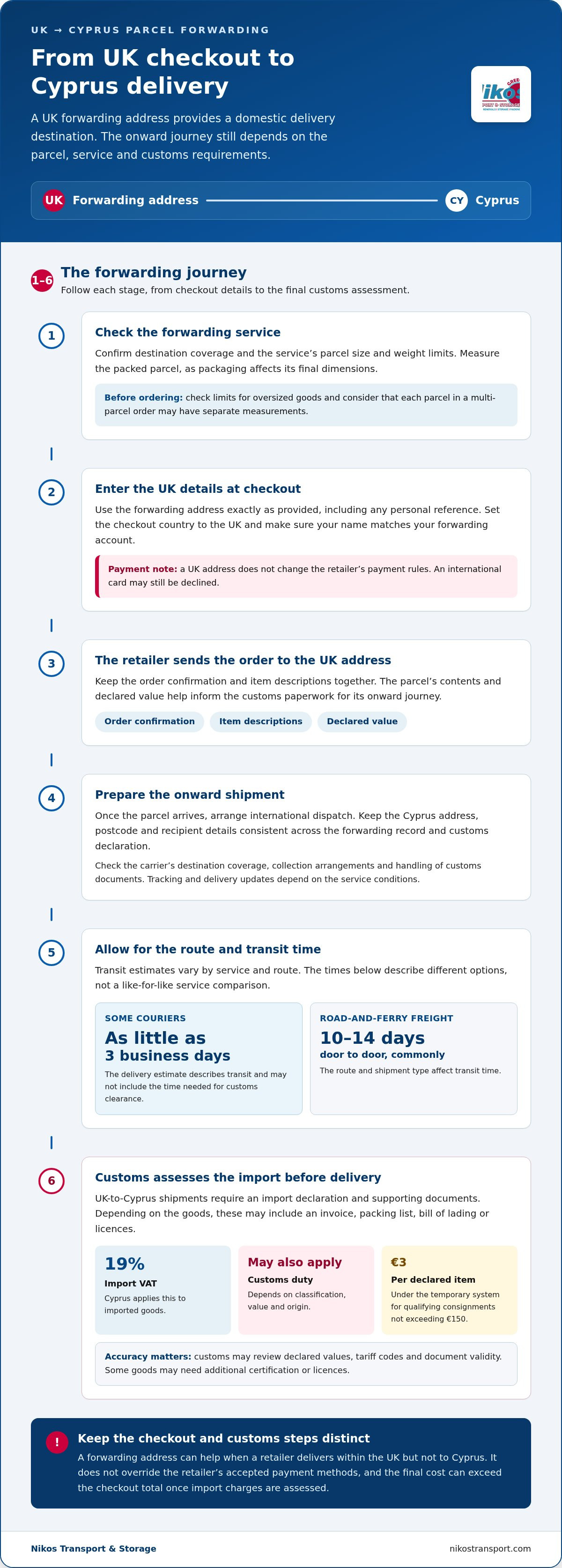
For ordinary imports, Cyprus applies 19% VAT to imported goods. Customs duty depends on the goods’ classification, value and origin. The previous duty exemption for many non-EU e-commerce consignments up to €150 ended on 1 July 2026. Under the temporary system, qualifying low-value consignments not exceeding €150 incur €3 per declared item. Above that threshold, the applicable tariff depends on the product and its customs classification.
UK-origin goods can qualify for zero tariffs under the EU-UK Trade and Cooperation Agreement when they meet the rules of origin. The importer needs proof of origin, such as an exporter’s statement on origin or the importer’s knowledge that the goods qualify. Goods that don’t qualify may face the EU Common External Tariff. Cyprus uses the EU TARIC classification, which requires the full 10-digit commodity code. A tariff calculator is only useful when the product description, code, origin and customs value are accurate.
Shipments entering Cyprus from the UK require an import declaration and supporting documents. Depending on the goods, these may include an invoice, packing list, bill of lading or licences. Customs can review declared values, tariff codes and document validity, and may carry out safety, health or environmental checks. Some food products and plants also require additional certification or licences.
UK customs authorisations and single authorisations are no longer valid in the EU. UK-issued binding tariff information also no longer applies there, so it cannot determine a Cyprus import’s classification. Customs inspections are possible, and shipments from non-EU countries are usually physically inspected after 3pm. If an inspection delays clearance, goods may remain in a warehouse and incur storage costs.
Prepare the commodity code, origin evidence and shipment documents before dispatch. Accurate paperwork helps customs assess the declaration and determine whether relief or a preferential tariff applies. For household goods, separate used belongings eligible for relief from new purchases, which remain subject to import charges.
Using a UK parcel-forwarding address for Cyprus deliveries
A UK forwarding address gives an online order a domestic delivery destination before its onward journey to Cyprus. The process has several stages, from entering checkout details to declaring the parcel’s contents and arranging final delivery.
The UK-to-Cyprus forwarding process
Parcel forwarding means sending a purchase first to a UK address, then arranging onward delivery to Cyprus. At checkout, enter the forwarding address exactly as provided, including any personal reference needed to identify your parcel. The retailer sends the order there, and after it arrives, the parcel is prepared for international dispatch. Its contents and declared value inform the customs paperwork for the journey.
This arrangement can help when a shop accepts UK delivery but excludes Cyprus from its delivery countries. It doesn’t change the retailer’s payment rules, so an international card may still be declined. Set the checkout’s country field to the UK, not Germany or Cyprus, and ensure your name matches the forwarding account. Keep the order confirmation and item descriptions together for the onward shipment.
Carriers and delivery options
Carriers move parcels from the UK forwarding address to the recipient in Cyprus, with service options varying by route and parcel. Some couriers offer delivery in as little as three business days. Express services can suit time-sensitive orders, whilst slower options may better suit purchases without a firm arrival date. The delivery estimate describes transit, not necessarily the time required for customs clearance.
Compare the service’s destination coverage, collection arrangements and handling of customs documents before choosing an option. An order travelling outside the UK first still needs to reach the forwarding address successfully. Once dispatched, the carrier’s service conditions determine what tracking or delivery updates are available. Keep the Cyprus address, postcode and recipient details consistent across the forwarding record and customs declaration.
Parcel size and weight restrictions
Parcel size and weight restrictions are set by the forwarding service and the carrier handling the international leg. They matter because a bulky, light parcel may be assessed differently from a compact parcel of the same weight. Measure the packed parcel rather than relying only on the retailer’s product dimensions. Check the limits before ordering oversized goods, as a parcel that cannot travel may need different arrangements.
Packaging also affects the final dimensions: a coat in a compact mailer takes up less space than the same item in a large box. If a retailer dispatches several parcels, each may have its own measurements and handling requirements. Restricted goods can face additional carrier rules; alcohol, tobacco, dairy and meat products are restricted for shipment to Cyprus. Check the contents category and declaration carefully before dispatch.
Parcel consolidation and repacking
Consolidation means combining eligible parcels into one outbound shipment; repacking means changing their packaging before dispatch. These options can help when several UK retailers send orders to the same forwarding address. Consider whether combining the parcels could make the final package too large or heavy, and ensure the service allows consolidation.
Repacking can remove excess outer packaging, but the goods still need protection for their journey. Keep receipts and item descriptions for each purchase, so the combined shipment’s contents and declared values remain clear. For a larger shipment that needs organised transport to Cyprus, transport to Cyprus may be a more suitable route than parcel forwarding.
Road, ferry, container and air freight transit times
UK-to-Cyprus transit time depends on the route and shipment type. Road-plus-ferry freight generally takes 10 to 14 days door to door, while full-container sea freight typically takes 3 to 5 weeks.
Road and ferry: Freight commonly travels by road through mainland Europe, then continues by sea to Cyprus. The 10-to-14-day estimate covers the door-to-door journey, rather than only the ferry crossing. Allow time for collection at the UK origin, road transit, port handling and delivery at the Cyprus destination. Packing and shipment readiness also affect when the journey can begin.
Full-container sea freight: A full-container shipment typically takes 3 to 5 weeks from the UK to Cyprus. This option suits a shipment that fills a container, rather than a small online order. The transit estimate covers a longer sea-freight journey, so plan around the arrival window rather than a particular delivery day. Customs clearance and final handling are separate parts of the overall process.
Air freight: Air freight can take 2 to 4 days from the UK to Cyprus. That shorter transit can suit time-sensitive consignments, but it is a distinct freight mode from road-and-ferry or full-container sea transport. The transit figure is not a door-to-door estimate. Collection, handling, customs processing and onward delivery can add stages around the air journey.
Route matters. A typical UK-to-Cyprus freight journey crosses mainland Europe by road before reaching the island by sea. The shipment therefore involves several transport stages and handling at transfer points. Goods must be ready at their origin before collection, and destination details must be complete for onward delivery. A transit estimate helps with planning, but it should not be treated as the entire preparation and clearance period.
For road-plus-ferry freight, businesses are advised to book one to two weeks in advance, particularly during peak summer months. This gives time to organise the shipment before the planned departure. Set your required arrival date first, then work backwards from the relevant transit estimate. For a 10-to-14-day road-and-ferry journey, include time for packing and collection before transit begins.
Compare the modes by shipment size, timing and handling needs. Air freight offers the shortest stated transit, full-container sea freight takes longer, and road-plus-ferry provides a door-to-door estimate. Those differences help you choose a route that fits the goods and delivery plan, rather than judging by transit time alone.
Using a UK forwarding address for purchases delivered to Cyprus
A UK forwarding address gives a retailer a domestic destination for delivery, then sends the parcel onwards to Cyprus. It can help when a shop excludes Cyprus from its delivery countries, but it does not change the retailer’s payment rules. A UK delivery address cannot make an international card acceptable if the retailer restricts payment by card-issuing country.
Keep delivery and billing details accurate at checkout. The retailer may need the billing address associated with your payment method, even when the parcel is sent elsewhere. If a payment is declined, changing the delivery destination alone won’t resolve a payment restriction. Before ordering, distinguish the shop’s delivery policy from its payment policy.
Cyprus is an EU member state, while the United Kingdom is outside the EU customs union. A parcel sent from a UK forwarding address therefore still enters Cyprus through customs. The address changes the parcel’s first destination, not its import status. Customs charges and duties depend on the goods and their declaration, not the forwarding address.
Also distinguish the place of dispatch from the goods’ origin. A product made outside the United Kingdom does not become UK-origin simply because a retailer sends it to a UK address. This distinction matters for preferential tariffs under the EU-UK Trade and Cooperation Agreement. Origin evidence concerns where the product qualifies as originating, not the address printed on the retailer’s parcel.
For qualifying imported goods in consignments up to €150, IOSS allows participating sellers and marketplaces to collect VAT at checkout. Review the order summary to see whether VAT appears as a separate payment. If the sale uses IOSS, retain the confirmation alongside the invoice. This helps distinguish checkout tax from charges requested during import clearance.
Before forwarding, keep each retailer’s invoice, order confirmation and item description. If several purchases travel together, their contents and values still need to be declared accurately. Customs paperwork should reflect the goods inside, not just the outer parcel or the total payment shown on one receipt. This is particularly useful when orders contain products with different origins or classifications.
Plan payment and delivery separately: first confirm that the shop accepts your payment method, then use the UK address for delivery. After dispatch, keep the forwarding reference and purchase documents together for the onward journey. This makes it easier to identify the parcel and explain its contents if Cyprus customs requests supporting information.
What risks, insurance, and tracking options should I consider when forwarding purchases to Cyprus?
A UK-to-Cyprus parcel can pass through several handling points, from collection to onward delivery. Every transfer creates an opportunity for delay, damage or a missed scan. When forwarding UK purchases to Cyprus, keep the retailer’s order confirmation, forwarding reference and final tracking number together. These records help identify the parcel if its progress stops or its outer packaging arrives damaged.
Packaging is a practical first safeguard. Use a strong outer box, protect fragile items inside and prevent the contents from shifting during transit. For larger consignments, robust palletisation and secure strapping help reduce damage risk on multi-leg road and sea journeys. A single small parcel may not need palletisation, but it still benefits from internal cushioning and sealed seams. Photograph the parcel before dispatch to record its condition.
Insurance terms vary, so read the policy wording before the parcel leaves the UK. Check what the cover applies to, how the insured value is calculated, and which exclusions or claim conditions apply. Don’t assume a carrier’s standard liability equals the item’s full replacement value. Follow the policy’s claim process if loss or damage occurs.
Use each tracking reference at the relevant stage: the retailer’s reference for UK delivery, then the onward carrier’s reference for Cyprus. Tracking scans can show recorded events such as acceptance, a depot arrival or delivery. A gap between scans doesn’t, by itself, establish that a parcel is lost. Check the latest recorded event and retain screenshots or emails showing dates, reference numbers and delivery details.
Customs can also affect progress. Shipments to or from EU countries are subject to random customs inspections, and any resulting fees are charged to the client. A declaration that clearly describes the contents and value helps explain what is being sent. Keep invoices and the packing list accessible rather than relying on the parcel label alone. Customs checks and carrier handling are separate from insurance cover and tracking updates.
If the parcel arrives with visible damage, photograph the packaging before opening it, then photograph the contents and retain the box. Report the issue through the relevant carrier or insurance claim process, using the order record and tracking history. For a larger consignment where secure packing and coordinated transport matter, arrange transport to Cyprus with the shipment’s handling needs in mind.
Nikos Transport & Storage: Transport To/From Greece
Nikos Transport & Storage provides transport to Cyprus for people who need to move goods beyond individual forwarded parcels when **forwarding UK purchases to Cyprus**. It can suit a larger shipment, household belongings or purchases requiring coordinated transport to a Cyprus destination. The storage service can help when goods need to be kept before delivery. The right option depends on whether you're sending online orders, moving belongings or arranging a broader transport plan. Clear item and destination details help prepare for the next stage, including customs documentation for international shipments. If you need transport between the UK and Cyprus rather than parcel forwarding alone, contact Nikos Transport & Storage to discuss your requirements.
Plan the next step with confidence
Once you’ve chosen how to place your order, consider the whole journey from retailer to recipient. A forwarding address can solve a delivery-location problem, while a larger consignment may call for a different transport arrangement. Keeping your purchase details, customs paperwork and delivery plans organised gives you a clearer starting point.
For support with a shipment to Cyprus, Nikos Transport & Storage offers Transport To Cyprus, alongside Transport To/From Greece and Storage Service. These options can suit people whose needs extend beyond forwarding individual online purchases. If you’re arranging the forwarding UK purchases to Cyprus and want to discuss transport or storage for a wider move, contact Nikos Transport & Storage to talk through your requirements. Take the next step when you’re ready, with a plan that fits your shipment and destination.
Frequently Asked Questions
How do I order from UK companies who do not accept payment from international customers?
A UK forwarding address can solve a delivery restriction, but it can’t change which payment methods a retailer accepts. Enter the forwarding address as the delivery destination, then provide billing details that match your payment method. Before ordering, read the shop’s payment rules and check whether it accepts your card or account. If payment is declined, changing the delivery address alone won’t resolve the restriction.
What documents are required?
For an import into Cyprus, prepare an import declaration and documents describing the shipment. These can include the retailer’s invoice, a packing list, a bill of lading or any required licences. A copy of the receiver’s passport or ID card must also be supplied before a shipment to Cyprus. Keep item descriptions and declared values consistent across the paperwork, particularly if separate orders are combined.
If I order several items, will they be shipped separately or packaged together?
That depends on how the retailer dispatches each item and whether the forwarding arrangement includes consolidation. For example, a retailer might send a coat and shoes in separate parcels, even as part of one order. Keep each tracking reference until all parcels have arrived. If parcels are consolidated, ensure the combined contents and declared values are recorded accurately for customs and that the final parcel meets size and weight limits.
Is there anything else I should know?
Yes. A UK delivery address doesn’t change the goods’ country of origin or remove Cyprus import charges. Keep proof of purchase and accurate product descriptions, especially for items bought from a retailer but made elsewhere. Some goods, such as plants and certain food products, may need licences or additional certification. Check whether an item has special shipping restrictions before ordering, as customs rules and carrier acceptance are separate considerations.
Can I ship more than a parcel?
Yes. For several boxes, household belongings or a larger consignment, transport arranged for a shipment may be more suitable than forwarding individual parcels. Nikos Transport & Storage offers Transport To Cyprus, Packing Service and Customs Declaration. These services can support a wider move or shipment where packing and customs paperwork need coordination. Storage Service can also help organise goods that aren’t ready to travel with the rest.
What items are prohibited from being imported into Cyprus?
Items listed as prohibited include cash and bonds, explosive or flammable gases, aerosol cans, and ink or printer cartridges. Some food products may face shipping restrictions, so check the requirements before sending them. New electrical appliances without CE markings are also listed as prohibited imports. Alcohol, tobacco, dairy and meat products are restricted rather than treated as ordinary parcels, so distinguish restrictions from outright bans when reviewing a shipment’s contents.
Which parcel forwarding services ship UK purchases to Cyprus?
For online orders, Nikos Transport & Storage offers Amazon & Online Orders, alongside Transport To Cyprus and Customs Declaration. These services bring order handling together with onward transport and paperwork for international shipments. They can be useful when purchases need more than a shop’s standard delivery. Keep order invoices and item details together so the goods and declared information can be identified during handling.
How does UK-to-Cyprus parcel forwarding work step by step?
First, check that the retailer accepts your payment method and enter the UK forwarding address as the delivery destination. Next, retain the order confirmation and tracking details while the retailer sends the parcel there. Once it arrives, arrange onward dispatch and provide accurate information about the contents and value for the customs declaration. Finally, follow the onward carrier’s tracking updates and keep the paperwork available through delivery and clearance.


