
Dedicated or part-load removals from the UK to Greece typically take 1-4 weeks. For commercial removals to Greece, the transport method and the business’s move schedule both matter. An exclusive container is dedicated to your shipment, while groupage combines it with other consignments.
A business move involves more than transporting goods between countries. You’ll need to plan packing, customs paperwork and delivery while minimising disruption to staff, stock and equipment.
This guide explains how container transport works and what can affect the journey. You’ll learn how dedicated and groupage services differ, what to consider when arranging packing and preparing furniture, and how customs clearance and delivery fit into the process. Understanding each stage helps you plan the move and see how a removals service can support your business from collection in the UK to delivery in Greece.
Key Takeaways
- Match an exclusive container or groupage service to your shipment size and how your business needs to plan its move.
- Plan packing, wrapping and furniture dismantling around the items being moved and your preferred level of support.
- Prepare a detailed inventory and customs paperwork to help organise the shipment’s clearance in Greece.
- Coordinate collection, transit and final delivery with your business schedule to keep the relocation organised.
- Consider storage or UK removals as part of the wider plan when your move involves more than international transport.
Packing, wrapping and furniture dismantling
A clear packing plan helps protect business equipment and keeps essential items identifiable after the move. Start by separating items into categories: desks and chairs, IT equipment, files, stock, and anything needed to keep the UK workplace running until collection. Mark each box with its destination room or department, contents, and handling instructions. A box labelled “accounts, office 2” is easier to place than one marked only “miscellaneous”.
Professional packers usually take 2-4 days to pack and load a container for a removal to Greece. The time depends on the shipment’s contents and the preparation needed for furniture and equipment. Packing can include wrapping, boxing, and preparing larger items for transport. Agree which items must remain accessible until collection, such as staff laptops or active project files, so they aren’t packed too early.
If your team packs its own boxes, separate fragile or valuable items and use sturdy cartons suited to their contents. Self-packing may affect insurance cover, so check the policy wording rather than assuming the contents are insured. Keep an inventory as you pack, with a clear description of each item and its box reference. This helps match items to their destination during delivery.
Plan commercial packing around working hours by dividing the premises into zones. For example, pack a meeting room after its last scheduled use, then move on to storage areas or departments that can close first. Keep walkways, exits and workstations clear while packing is under way. Set aside a clearly marked area for items staff still need, and tell the packing team which equipment must remain connected until the agreed handover.
- Remove loose contents from desks and cabinets before wrapping furniture.
- Label dismantled furniture parts and keep fixings together in a marked bag.
- Protect screens and delicate equipment separately from heavy boxes.
- Identify items requiring careful handling on the inventory and their packaging.
Dismantling bulky furniture can make it easier to handle and pack. Before taking apart a desk, shelving unit or conference table, photograph how it is assembled and group its components. Protect edges and surfaces with suitable wrapping, then secure loose parts so they don’t shift in transit. Keep fittings with the relevant item instead of combining every screw and bracket in an unlabelled box.
Plan loading as the next step after packing. Group boxes by department or destination room, then load them so the inventory and labels remain useful at delivery. If some items won’t be needed immediately, separate them from priority equipment before packing. Storage can bridge a gap between collection and the date the new premises are ready, keeping those items apart from goods needed for the move to Greece.
How long does it take to transport a container from the UK to Greece?
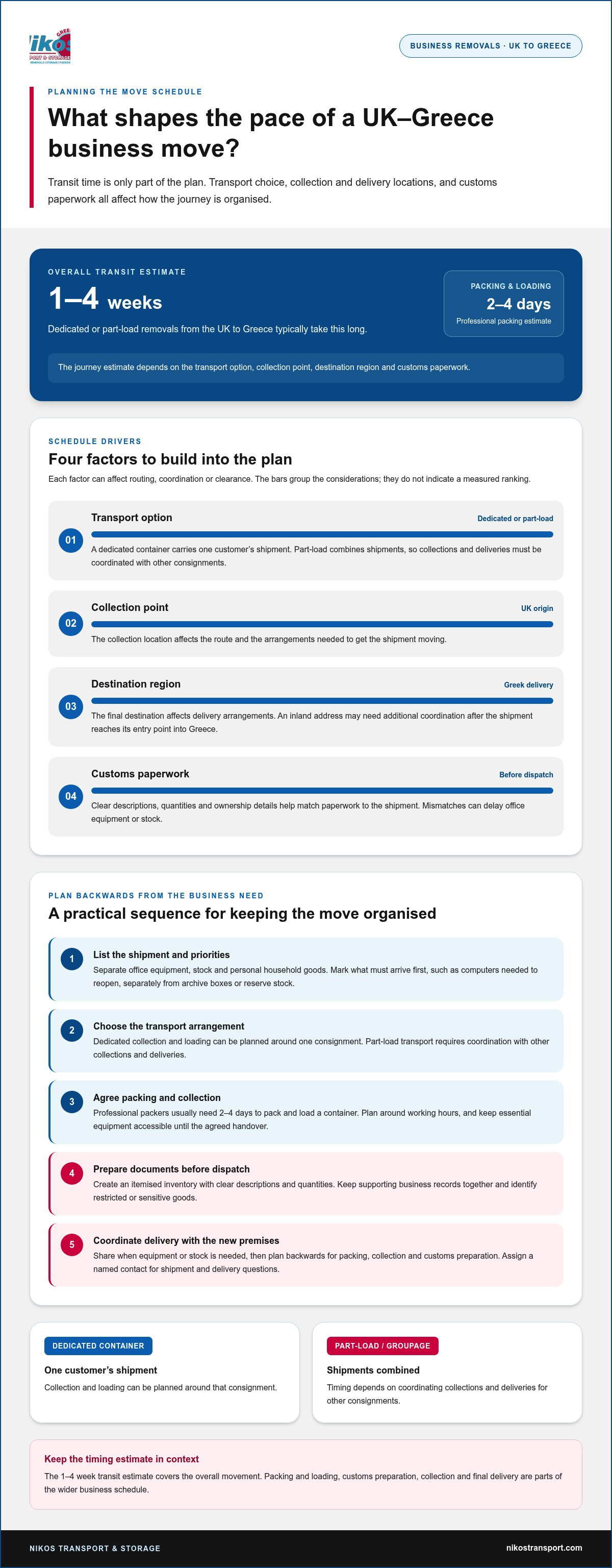
Dedicated or part-load removals from the UK to Greece typically take 1-4 weeks. The schedule depends on the transport option, collection point, destination region and customs paperwork.
Planning Transport and Customs Documents
Start by listing what the business is moving, where each item is going and when it must arrive. Separate office equipment, stock and personal household goods in the inventory. This distinction matters because transfer-of-residence relief concerns household goods, not a company’s commercial stock. Clear descriptions also help match the paperwork to the shipment at customs.
For household goods, the European Commission states that the standard EU condition for transfer-of-residence relief when moving to Greece is at least 12 months of continuous residence outside the EU. The goods must also have been owned and used for at least six months before the move. These conditions do not establish relief for business equipment or stock.
Office equipment and stock can face delays if descriptions, quantities or ownership details don’t match the shipment. List items clearly, distinguish used equipment from goods intended for sale, and keep supporting business records together. Identify restricted or sensitive goods in the inventory and customs documents before packing.
To arrange an international commercial removal, prepare an itemised inventory and identify the collection and delivery addresses. Then choose dedicated or part-load transport, agree the collection plan and organise customs documents before dispatch. Assign a named contact to handle questions about the shipment and delivery.
Estimated Door-to-Door Transit Times
Dedicated and part-load transport from the UK to Greece typically takes 1-4 weeks. That estimate covers the overall movement, but the collection location and final destination affect the route and delivery arrangements. A shipment going to an inland address may need additional coordination after reaching its entry point into Greece.
A dedicated container carries one customer’s shipment, so collection and loading can be planned around that consignment. Part-load transport combines shipments, making the journey dependent on coordinating collections and deliveries for other consignments. Share the date your premises need equipment or stock, then plan backwards for packing, collection and customs preparation.
Goods-in-transit insurance and public liability cover address different risks. Goods-in-transit cover relates to the shipment, while public liability concerns liability connected with injury or damage to another party. Read the policy wording to understand which goods, handling and parts of the journey are covered. Don’t assume one type of cover replaces the other.
For a practical schedule, group the inventory by priority. Mark equipment needed first at the Greek premises, such as computers required to reopen, separately from archive boxes or reserve stock. A transport plan for Greece can help connect the shipment method, collection arrangements and delivery sequence.
Exclusive container and groupage services
Choosing between an exclusive container and groupage depends on shipment volume, timing and how your business needs its goods to arrive. Start by comparing the space required with the delivery sequence at the Greek premises.
Shared-Load and Part-Load Services
Groupage combines your consignment with other shipments travelling to Greece. It can suit a business moving selected items, such as boxed files, stock or furniture from a small office, rather than a full premises. Part-load means using only part of the available vehicle or container space. Clarify which belongings are included and how they’ll be identified within the shared load.
Shared transport requires collections and deliveries to be coordinated across consignments. Organise your inventory by destination room or department, then label each packed item consistently. Keep urgent equipment, such as a reception computer, separate from items that can wait. This makes the delivery plan easier to follow when the shipment is unloaded and distributed.
UK-to-Greece Removal Services
A UK-to-Greece removal can cover a complete business relocation or selected goods moving between premises. Before choosing a service, list the furniture, equipment, stock and records to be moved. Note which items must arrive first, which can travel together, and whether the Greek delivery address has suitable access for unloading.
Dedicated transport reserves the container for one shipment. This gives the business greater control over how its goods are grouped and loaded, which can help when equipment must be unloaded in a planned order. It may suit a larger office move or a shipment with a firm operational schedule. Groupage is an alternative when the consignment uses only part of the available space.
Compare the methods against your practical needs, rather than relying on the labels alone:
- Shipment volume: estimate how much furniture, equipment and stock must travel.
- Arrival priorities: identify the items needed to reopen or begin work in Greece.
- Loading order: group items by room, team or intended use at the destination.
- Collection arrangements: plan access to the UK premises and prepare goods for collection.
Specialist moving requirements also shape the plan. For example, identify shelving, delicate display pieces or bulky office furniture in the inventory. Their size, shape and handling needs can influence how the shipment is arranged, wrapped and positioned alongside other belongings.
For a mixed shipment, separate business stock from office equipment and household belongings before packing. This gives the transport plan a clear structure and helps ensure each category is listed and delivered appropriately. Once the inventory is organised, match the load type to the volume being moved and the order in which teams need items to arrive.
Customs clearance and destination delivery
For a UK-to-Greece business shipment, plan customs paperwork and delivery arrangements alongside transport. The inventory, shipment details and access at the destination all help shape the handover.
For deliveries in Athens and other Greek cities, plan for vehicle access, parking, the building entrance and unloading space at the destination. Share these details before collection, particularly if a large vehicle cannot reach the premises or goods must be carried from an authorised stopping point.
A Greek tax number, known as an AFM, is normally needed for removals to Greece. A detailed, valued inventory is also normally required, so describe each item clearly and record its value. For a business shipment, distinguish office equipment from stock and state the intended use of the goods.
Post-Brexit, shipments from the UK to Greece require customs clearance, so organise the paperwork before dispatch. Match the inventory to the goods being moved and keep copies of relevant business records with the shipment documents. Clear descriptions help explain whether an item is, for example, a used office desk or new stock intended for sale.
Items older than 100 years count as items of historical significance. Declare them, as they may require approval by Greek authorities. Identify such goods before packing, then include a precise description in the inventory rather than grouping them under a broad label such as “office contents”.
- Prepare the inventory: describe goods individually and include their values.
- Separate categories: distinguish equipment, stock and any household belongings.
- Flag special items: identify goods over 100 years old for declaration.
- Plan delivery: record the Greek address, vehicle access and unloading arrangements.
Customs clearance and delivery at the destination are connected, but require different preparation. Customs documents describe the goods and support their entry; delivery planning determines how the shipment reaches its final address and is unloaded. Confirm current Greek customs requirements with Greek Customs (AADE), and organise the paperwork before the goods leave the UK.
At the destination, an accurate inventory helps staff direct items to the right departments or rooms. Mark priority equipment separately, such as the computers needed to reopen an office, and identify items intended for storage or later installation. This gives the receiving team a practical sequence for unloading and checking the consignment.
For commercial removals to Greece, coordinate the customs file with the delivery plan. Give the Greek contact the shipment inventory, access information and handling notes before arrival. This helps avoid confusion at handover, particularly when several departments share the delivery or the vehicle needs to unload in stages.
Business relocations from the UK to Greece
A business relocation works best when the plan reflects the company’s operating priorities. Start with the date the Greek premises must be ready, then map each team, asset and task against that milestone. For example, a design studio may need its computers and sample materials before the meeting-room furniture.
Name one move coordinator in the UK and one receiving contact in Greece. Give both the same working schedule, contact list and asset register. The UK coordinator can track what is ready for collection, while the Greek contact prepares rooms and directs deliveries. A shared plan helps teams respond to changes without relying on separate email threads.
Sort assets into three practical groups: items needed to keep trading, items required to set up the new site, and items that can follow later. A retailer, for instance, may prioritise point-of-sale equipment and opening stock, while sending archive material later. This sequence helps determine which goods should travel together and which need a different collection or delivery arrangement.
Plan business continuity between the UK handover and the Greek opening. List essential functions, such as customer support, payroll and order processing, then record what each needs to operate. If a team depends on a particular server or specialist machine, assign it a named owner and include its setup requirements in the relocation plan. Staff can then prepare workarounds for functions that pause during the move.
- Set the operational date: work back from the planned opening of the Greek premises.
- Map teams and assets: connect each department with the equipment it needs first.
- Assign owners: give each priority item a responsible person in the UK and Greece.
- Plan the handover: record delivery destinations and who will receive each group of goods.
Smaller relocations need the same clear sequence, even if they involve only one department or a limited shipment. A consultancy moving desks, screens and client files can still create a simple floor plan for the new office. Mark where each item belongs, identify what staff need on their first working day, and keep the sequence consistent from collection to arrival.
For a larger operation, a dedicated shipment may help keep one business’s goods together. A smaller consignment may suit a shared-load arrangement, depending on volume and timing. Compare those choices against your opening schedule, priority assets and receiving arrangements, rather than shipment size alone. To plan transport for your UK-to-Greece business move, bring your asset groups, collection details and destination priorities together.
Nikos Transport & Storage: Transport To/From Greece
Nikos Transport & Storage provides transport to and from Greece for businesses relocating between the UK and Greece. Share your collection and delivery details, shipment priorities and preferred schedule to help shape a practical transport plan.
If there’s a gap between leaving the UK premises and using the new site, storage can form part of the wider plan. UK removals can also support the domestic stage of a business move before goods travel overseas. These services help bring separate parts of a relocation together.
For a business move to Greece, outline the goods being moved and the order your teams need them at the destination. Contact Nikos Transport & Storage to discuss your transport requirements.
Turn your relocation plan into a clear next step
A move to Greece is also an opportunity to plan how your business will operate from its new base. Before setting dates, agree who will make decisions, who will receive the shipment and which teams need to be ready first. A shared plan helps staff stay focused on their responsibilities as the relocation progresses.
For commercial removals to Greece, Nikos Transport & Storage can arrange transport between the UK and Greece, with storage available when there’s a gap between collection and use. A clear outline of your priorities makes it easier to discuss how these services fit your plans.
Prepare your collection and delivery details, a broad inventory and the operational priorities you’ve identified. Then contact Nikos Transport & Storage to discuss transport for your business move. A well-organised next step can help you approach the transition with greater confidence.
Frequently Asked Questions
Is It Cheaper to Ship Everything or Buy Again in Greece?
Compare the cost of replacing items with their value and usefulness in the shipment. Specialist machinery, fitted office equipment or branded display materials, for example, may be harder to replace than standard desks. Consider whether each item suits the new premises and is still in working order. A selective shipment can avoid transporting low-value, redundant or easily replaced goods alongside essential business assets.
Are There Additional Charges?
Additional costs can depend on what the move requires, including packing, customs declarations, storage and delivery arrangements. A business shipping fragile equipment may need different preparation from one moving boxed stock. Destination access and shipment contents can also affect the arrangements. The price depends on the case and is given after a quote request. Shipment volume, service requirements and delivery details inform the quote.
How Long Do Removals to Greece from the UK Take?
Use that transit window when setting internal deadlines, but distinguish the journey from the time your business needs to prepare goods and premises. For example, staff may need to finish an equipment handover before collection, while the receiving team should be ready to accept and distribute the shipment on arrival.
How Long Does It Take?
The move takes longer than the transport journey if preparation is still under way. Allow time for packing, collection, customs paperwork and access arrangements at the destination. Start with the date your Greek premises must be operational, then set deadlines for packing, document preparation and staff handover. This gives each team a clear sequence to follow.
Need Help Finding the Right Mover?
Choose a service that suits the shipment and the practical requirements of the move. A business relocating from the UK to Greece can consider whether it needs transport for a full premises or selected goods, as well as packing, storage or customs declaration support. Nikos Transport & Storage provides transport to and from Greece. Prepare a shipment outline, collection and delivery details, and any important operational dates before discussing the move.
What Affects the Cost?
The cost depends on the quantity and type of goods, transport arrangement, packing needs, collection and delivery details, and any storage required. Bulky furniture and delicate equipment, for example, may need different handling from boxed documents. A detailed inventory helps describe the shipment clearly. The price depends on the case and is given after a quote request, based on the contents and arrangements required.
What Documentation Is Required?
Prepare a detailed, valued inventory and include a Greek tax number, known as an AFM. Describe goods clearly, separating business equipment from stock rather than using broad labels such as “office contents”. Items older than 100 years must be declared and may require approval by Greek authorities. Keep the inventory aligned with the goods being shipped, so the descriptions and values reflect the actual consignment.
What Do Commercial Removals to Greece Include?
Commercial removals can bring together transport, packing, customs declarations and delivery planning for business goods moving between the UK and Greece. The arrangement depends on what the company needs to move and how its teams will receive it. For example, a business may arrange packing for office contents, transport for its shipment and storage if the new premises aren’t ready. Nikos Transport & Storage offers these services.


