

For most UK nationals relocating to Greece from the UK, a stay beyond 90 days in any 180-day period requires a Greek long-stay national D visa, followed by a residence permit. A short visa-free visit doesn’t by itself give you permission to make Greece your home. The right documents and preparations depend on your reason for moving and how long you plan to stay.
It’s natural to focus on finding a home and arranging the journey, but getting your paperwork in order early can make relocating to Greece from the UK feel more manageable. You’ll also want to compare everyday costs, which vary depending on where you settle and your housing choices.
This guide covers the post-Brexit stay limit, key documents to prepare and practical arrangements to consider before and after arrival. It also looks at living costs and moving your household belongings, helping you plan each part of the transition.
Key Takeaways
- Plan your visa route before moving: stays over 90 days in any 180-day period generally require a Greek long-stay visa and residence permit.
- Prepare for arrival by organising your move in advance and understanding the registration and customs steps for household belongings.
- Gather visa paperwork around your circumstances, including evidence of income or savings, accommodation and healthcare insurance.
- Use your UK driving licence for up to 6 months in Greece; longer-term residents should plan to exchange it for a Greek licence.
Post-Brexit long-stay rules and Schengen limits
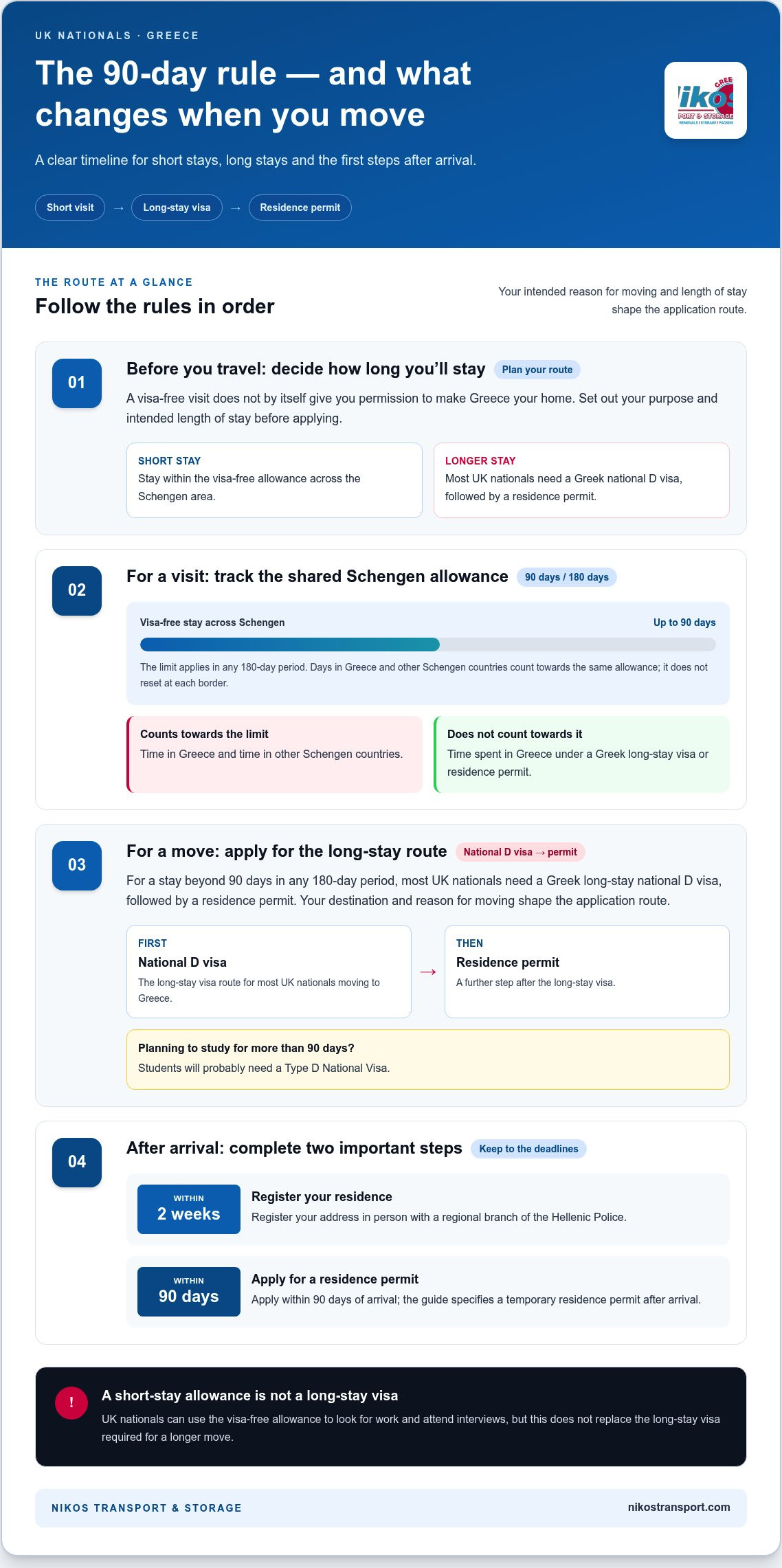
For UK nationals, a visit to Greece and a move there follow different rules. You can stay visa-free for up to 90 days in any 180-day period across the Schengen area. For a longer stay, most UK nationals need a Greek long-stay national D visa, followed by a residence permit. The intended destination and reason for moving shape the application route.
The 90-day limit is shared across Schengen, not reset at each border. Days spent in Greece and other Schengen countries count towards the same allowance. For example, time in Athens followed by a holiday elsewhere in the Schengen area still uses days from that 90-day total. Plan travel across the region as well as your stay in Greece.
A Greek long-stay visa or residence permit changes how your time is counted. Time spent in Greece under either document does not count towards the 90-day visa-free allowance for the Schengen area. This distinction matters if you plan to travel to other Schengen destinations during your residence in Greece.
- For a short stay: Keep within 90 days in any 180-day period across Schengen.
- For a longer stay: Most UK nationals need a national D visa and then a residence permit.
- After arrival: Register your residence within two weeks and apply for a residence permit within 90 days.
Students planning to study in Greece for more than 90 days will probably need a Type D National Visa. UK nationals can use the 90-day visa-free stay to look for work and attend interviews, but that short-stay allowance is not a long-stay visa. Set out your purpose and intended length of stay before you submit an application, so the route matches your plans.
Moving preparations and arrival procedures
A move from the UK to Greece involves travel arrangements, household belongings and tax planning. Your destination, whether Athens or Thessaloniki, also shapes what you organise before departure.
Moving pets and belongings
Plan your pet’s journey separately from the shipment of your belongings. Household goods shipped from the UK must clear customs on arrival in Greece. Keep identity and ownership documents accessible, and prepare an inventory that links each box to a room. Coordinate your pet’s travel with your own itinerary, keeping its travel records close to hand.
Arrival and UK tax planning
After arriving, register your address in person with a regional branch of the Hellenic Police. Apply for a temporary residence permit within 90 days of arrival. Spending more than 183 days in Greece in a tax year can make you Greek tax resident, with worldwide income to declare. Include UK tax affairs in your departure planning, alongside Greek application and accommodation documents.
Moving costs and checklist
List transport and setup expenses before departure to help avoid oversights. Removal costs depend on the shipment size and route, so consider both when planning household transport. As a general guide, book an international removal company six to eight weeks before moving day.
Use a checklist: confirm travel dates, gather application documents, list belongings, arrange pet travel and reserve funds for arrival. Include first-week essentials for living in Greece, and allow time to settle into local culture in Athens or Thessaloniki. Keep receipts and a simple spending record as you settle into daily life. For household transport planning, explore transport to Greece as one part of your moving preparations.
Documents required for moving to Greece
If you’re relocating to Greece from the UK, the documents you need depend on your reason for residence and visa route. Start with the application requirements, then gather evidence of your identity, finances, accommodation and healthcare to support your plans.
UK citizens applying for a Greek visa are advised to provide proof of income and/or savings, accommodation details and healthcare insurance. These documents help show how you’ll support yourself and where you plan to live. If you’ll rely on employment income, prepare relevant evidence; if you’ll use savings, organise proof of funds. Tailor your paperwork to your circumstances rather than assembling a generic file.
- Identity: Keep your passport ready for the visa application and international travel.
- Finances: Gather evidence of income, savings or both, according to your circumstances.
- Accommodation: Prepare details of where you plan to live in Greece.
- Healthcare: Include evidence of healthcare insurance with the visa application.
Visa applications require an in-person appointment, and processing can take about 15 calendar days. Allow for the appointment when planning travel and transport. A well-organised file also connects your intended residence with your destination, whether you’re considering Athens or another part of Greece.
If you’re relocating to Greece from the UK, keep post-arrival tax paperwork separate from your visa documents. Register for a Greek Tax Identification Number, known as an AFM, and submit a yearly tax return once you have one. Keep relevant records, including evidence of income and residence, together to help manage your finances and living costs. Your chosen area and living arrangements may shape your plans, but they don’t replace the core visa documents.
Can UK driving licences be used or exchanged in Greece, and what are the rules for registering and insuring a car?
A UK driving licence can be used to drive in Greece for up to 6 months. If you become resident and remain there for 6 months or more, you should exchange it for a Greek licence. Keep your UK licence accessible while arranging the exchange, and plan for the change around your residence and driving needs.
Bringing a car is a separate decision from using your driving licence. Importing a motor vehicle into Greece involves compliance requirements, and duty and tax are likely to apply. Before making plans, gather the vehicle’s registration and ownership documents, and note its make, model and registration details. These records will help you provide accurate information when arranging registration and insurance.
Registration and insurance are related but distinct tasks. Registration records the vehicle for use in Greece; insurance covers driving it. Gather the vehicle details and ownership documents, then use them to manage each process in turn. Requirements can depend on the vehicle and your circumstances, so keep any paperwork you receive with the original documents.
For a practical file, bring together:
- Your UK driving licence and identity documents.
- The vehicle’s registration and proof-of-ownership records.
- Correspondence and paperwork relating to Greek registration and insurance.
Don’t assume your UK licence and vehicle papers address every requirement for a car in Greece. A licence exchange concerns your permission to drive; it doesn’t register the vehicle or arrange insurance. Keep these tasks separate in your moving plans, especially if you’ll need a car after settling in Athens or elsewhere. If you’re also moving household belongings, arrange transport to Greece for your move separately from any plans for your vehicle.
Nikos Transport & Storage: Transport To/From Greece
Nikos Transport & Storage can help move household belongings between the UK and Greece when your residence plans are in place and you’re preparing for the practical move. Its Transport To/From Greece service gives you a route for arranging the shipment of your belongings, while the Packing Service can support preparation before they travel.
If your moving dates and new home aren’t aligned, the Storage Service can help bridge the gap. If you need to move to another UK address before departure, UK Removals can support that part of the transition. Choose arrangements that fit your timeline, destination and belongings, and plan around your arrival and customs preparations.
To discuss your move to Greece, contact Nikos Transport & Storage for a quote.
Make your next move feel more manageable
Once your plans for living in Greece take shape, give the practical move its own timeline. Decide what needs to travel with you, what can wait and whether there will be a gap between your arrival and moving into your new home. These choices can help you organise the transition around your circumstances instead of trying to arrange everything at once.
For anyone relocating to Greece from the UK, Nikos Transport & Storage can support the household move with Transport To/From Greece. Its Storage Service can help when belongings and arrival dates don’t align, and Transport To Cyprus is available for moves involving that destination. Choose the support that fits your plans, then take the next step at a pace that works for you.
Contact Nikos Transport & Storage to discuss your move. With the arrangements taking shape, you can look ahead to settling into your new home in Greece.
Frequently Asked Questions
How do I move to Greece?
Start by matching your intended length of stay and reason for moving to the appropriate visa route. Organise your application, accommodation plans and healthcare arrangements around your expected arrival. Plan separately for household belongings, as shipments entering Greece must clear customs. Once settled, work through local administration, including getting an AFM tax number, and keep copies of important documents together.
Can I take my pet with me when I move abroad?
Yes, you can plan to move with your pet, but arrange its journey as a distinct part of your relocation. Keep its identification, health and travel records together, and coordinate its travel dates with your accommodation and arrival plans. If your pet will arrive after you, plan who will care for it and how it will reach your new home.
How do I choose between a full load and a part load removal service?
Choose a transport arrangement based on the amount you’re moving and how your preferred dates fit the schedule. A full load suits a larger consignment, while a part load means your belongings travel as part of a shared load. Make an inventory, note bulky furniture and estimate the number of boxes. This will help you identify which arrangement best fits your move.
How far in advance should I book an international removal company?
As a general guide, book six to eight weeks before moving day. This gives you time to finalise what’s travelling, prepare an inventory and coordinate collection with your departure plans. If your accommodation handover and travel dates differ, work backwards from when your belongings need to be collected. Keep visa appointments and customs paperwork in the same planning calendar.
Is moving to Greece worth it?
It depends on what you want from daily life and how your plans fit your finances, work and family needs. Compare likely housing and everyday spending with your income, and consider whether your chosen destination suits your lifestyle. Look beyond the climate: healthcare arrangements, language, local services and travel back to the UK can all influence whether Greece feels right for the long term.
What should I do with belongings I do not want to take abroad?
Sort your belongings into items to keep, store or part with. This helps you avoid packing things that won’t suit your new home while keeping meaningful or seasonal possessions safe for later. For example, hold on to furniture until you know the layout of your Greek home, then decide what to take and what to let go.


