

Trade associations give you a practical benchmark when choosing a reliable removals company in the UK. The British Association of Removers is one example: its members are audited regularly and follow a Trading Standards-approved Code of Practice. A house removal typically takes 6 to 12 hours, depending on the home and the move.
It’s understandable to look for a badge or recommendation when trusting a team with your belongings, but neither tells the whole story. Even if an estate agent or solicitor recommends a mover, compare independent reviews and written quotations. You’ll also want to understand what the service covers, what can affect the schedule and what to look for in a clear, dependable quote.
This guide explains the removal services available, what can affect how long a move takes, and how to assess a mover’s reliability, including the role of trade associations. You’ll have a clearer basis for planning your move and deciding what support suits your circumstances.
Key Takeaways
- Match the removal service to your move, from a household relocation to storage or an international shipment.
- Allow for a typical removal day of 6 to 12 hours, with the size of the home and access affecting the timing.
- Prepare for a more accurate quotation by listing your belongings and explaining access arrangements at both properties.
- Compare written quotations and independent reviews, and look for clear payment terms and a recognised trade association’s standards.
What types of removal services are available?
UK removal services range from transport-only moves to support with packing, storage and international paperwork. A household moving locally may only need belongings transported, while someone moving abroad may also need customs declarations. Packing help can be useful for fragile items such as glassware, artwork or electronics. The right service depends on what you need moved and which tasks you want help managing.
Customer reviews can show how a mover handles practical details, not just whether a customer felt satisfied. A displayed Google review score labelled “EXCELLENT” is based on 52 reviews. Read individual testimonials for examples involving punctuality, careful handling, communication and resolving problems. Look for details that resemble your move, such as packing a kitchen or carrying furniture through narrow access.
A recommendation from an estate agent, solicitor, friend or relative can be a useful starting point. Still, make your own comparison: read independent customer reviews and compare written quotations, even when a property professional recommends a particular mover. Check what each quote includes, its payment terms and how clearly the company explains its arrangements.
Credit checks and customer reviews answer different questions. A credit check can provide financial information, while reviews describe customers’ experiences; neither shows on its own how a move will be managed. Companies House does not check the accuracy of information filed with it, so a company record is not a quality endorsement. Consider it alongside reviews, a clear quotation and the mover’s responses to your questions.
Use a simple review process: read several recent testimonials, look for recurring comments, then compare the same service details across quotations. For example, check whether packing, storage and furniture handling are included in each proposal. Specific, consistent examples are more useful than brief ratings because they help you judge whether the service suits your belongings and moving plans.
How long does it take for removals to empty a house?
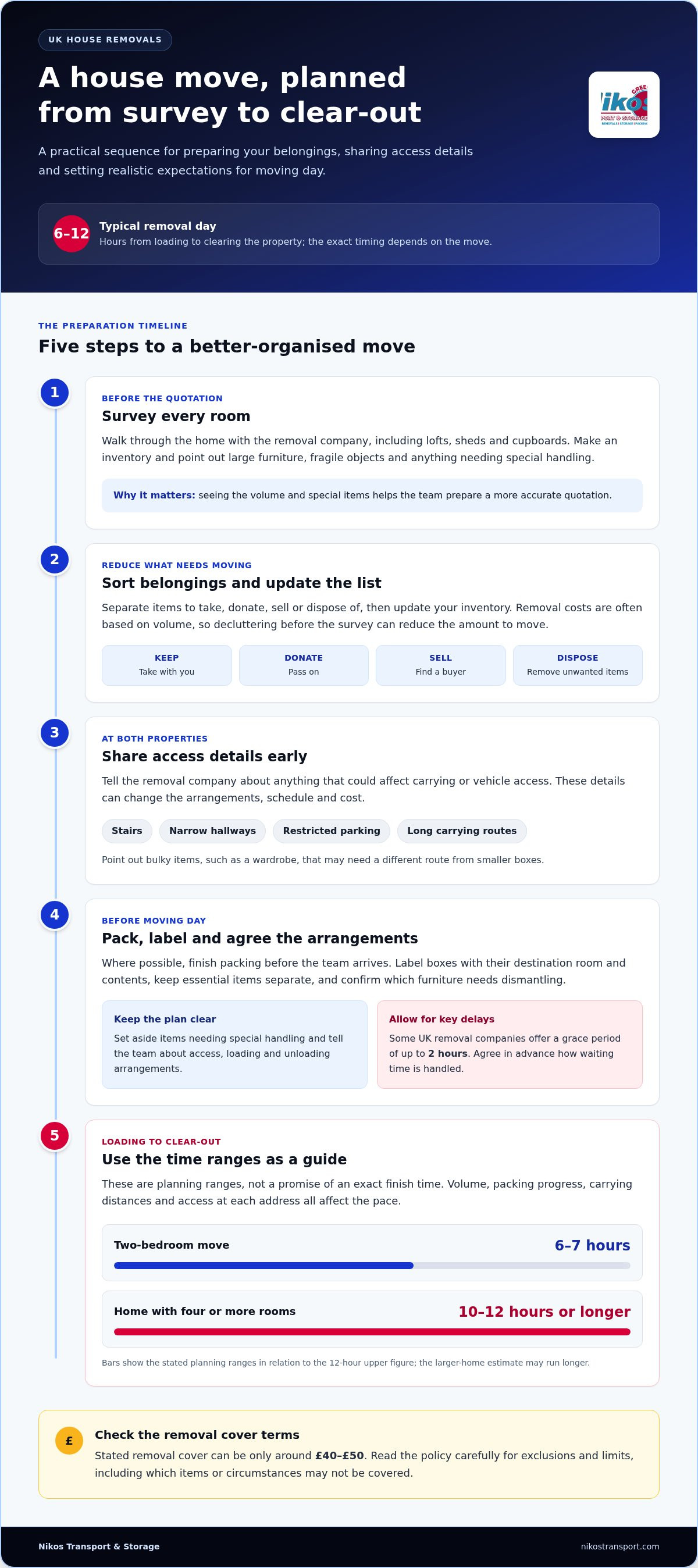
A UK house removal typically takes 6 to 12 hours from loading to clearing the property. A two-bedroom move may take 6 to 7 hours, whilst a home with four or more rooms may take 10 to 12 hours or longer. These are useful planning ranges, not a promise of an exact finish time. The volume of belongings, packing progress, carrying distances and access at each address all affect the day’s pace.
Residential moves focus on household belongings, furniture and personal items. Commercial and office relocations need different planning: desks, equipment, files and shared spaces may require careful sequencing. For example, moving workstations in stages can help a business plan around its day-to-day operations. The time required depends on the volume of items, access at both properties, distance between sites and how much packing is ready before loading.
For insurance, removal cover may protect belongings against loss or damage, but the stated cover can be only around £40-£50. The policy terms set the exclusions and limits, so read them carefully to understand which items or circumstances aren’t covered.
To help the move run smoothly, make a room-by-room inventory and set aside items that need special handling. Label boxes by room and contents, and finish packing before the team arrives where possible. For an office move, identify the essential equipment and files staff will need first at the new premises. This helps the team load in an organised order instead of searching through mixed boxes.
Moving dates can also shape the schedule. Build in time for access arrangements, loading and unloading, and tell the removal team about stairs, restricted parking or long carrying routes. Compare quotations on the same service details to judge competitive value, rather than focusing on a headline alone. For practical support with a move, explore UK removal arrangements.
House removals
A household move starts with understanding what needs to be transported between the properties. A pre-move survey lets the removal company assess the volume of belongings and prepare a more accurate quotation. Walk through every room together, including lofts, sheds and cupboards. Point out large furniture, fragile objects and items needing special handling. This gives the team a clearer picture than a short list can.
Decluttering before the survey can reduce the volume to move, and removal costs are often based on volume. Sort belongings into items to take, donate, sell or dispose of, then update your inventory. Booking in advance, using second-hand boxes and checking for discounts can also help manage costs. The final quote depends on factors such as volume, distance and access, and is given after a quote request.
Consider access at both addresses. Tell the removal company about stairs, narrow hallways, restricted parking or a long distance from the vehicle to the door. A bulky wardrobe, for instance, may need a different route from smaller boxes. These details can affect the arrangements and cost, so raise them during the survey rather than on moving day.
Key collection can change the schedule. Some UK removal companies offer a grace period of up to 2 hours for key delays. Agree how waiting time is handled in advance, and keep your solicitor or estate agent informed about the expected handover.
Before moving day, label boxes with their destination room and keep essential items separate. Confirm which furniture needs dismantling and whether packing is complete. A simple checklist can help you track keys, meter readings and final property checks separately from the loading plan. With your inventory, access notes and timings organised, the team can work through the household in a clear sequence.
Choosing a reliable removal company
Compare evidence, written terms and the services included, not just a company’s headline rating. Four checks can help you choose removal services with less stress.
Comparing removals quotes fairly
Quotes depend on the volume of belongings, travel distance, access, packing, storage and furniture dismantling. Compare written quotations for the same tasks, then check payment schedules, cancellation terms and charges for access problems or date changes. A lower total may exclude work included elsewhere, so compare each item and the proposed service before deciding.
Booking a removal company in advance
Once your moving date is clear enough to plan around, start arranging quotations as soon as possible. The time needed depends on how flexible your date is, the size of the move and the preparation involved. A fixed completion date leaves less room to adjust, so share timing and access details early rather than waiting until every box is packed.
Getting a quote and booking a move
Start with an inventory or pre-move survey, covering bulky furniture, packing needs, storage and access at both addresses. Then request a written quotation that sets out the service, payment schedule and cancellation policy. Before paying a deposit, read the terms and ask about additional charges for difficult access, dismantling or short-notice changes. Keep the quotation and booking confirmation together.
Handling cancellations, damage and claim disputes
If a mover cancels, ask for written details and keep the booking terms and messages. If an item is damaged, photograph it and its packaging, note when you discovered the damage, then submit a dated complaint with supporting evidence. Follow the company’s stated complaints process. British Association of Removers members are audited regularly and follow a Trading Standards-approved Code of Practice; unresolved disputes can be referred to an independent ombudsman service.
For a written quotation based on your moving requirements, request a removals quote.
Nikos Transport & Storage: Transport To/From Greece
Nikos Transport & Storage provides transport to and from Greece for people moving between the UK and Greece. This service can suit a household relocation or a move involving belongings travelling between the two countries. The company also provides transport to Cyprus and UK removals for moves within the UK or to these destinations. Its storage service can help when belongings need to be kept before, during or after a move, while its packing service helps prepare items for transport.
For a move to Greece, consider the route, which belongings need moving and whether storage or packing support would help organise the transition. These details provide a practical starting point for planning your household move.
Contact Nikos Transport & Storage to discuss your move.
Plan the next stage of your move
Turn your moving plans into a clear brief: note your destination, the belongings involved and any support that would make the transition easier. This is a practical starting point for discussing arrangements with a reliable removals company in the UK, especially when your move crosses borders or involves storage between stages.
For moves involving Greece, Nikos Transport & Storage provides transport to and from Greece, as well as transport to Cyprus. Its storage service can support moves where belongings need to be kept between stages. Choose the service that matches your route and circumstances, then share the details of your move directly with the team.
When you’re ready to discuss your requirements, contact Nikos Transport & Storage. A considered plan can make the next steps feel more manageable, and you can begin with the arrangements that matter most to you.
Frequently Asked Questions
Are there Trade Associations for movers?
Yes. The British Association of Removers (BAR) is a UK trade association for removal companies. Its members are audited regularly and follow a Trading Standards-approved Code of Practice. Membership can provide a useful standard to consider, but it’s still sensible to read the company’s terms and assess how it handles complaints. BAR members provide access to an independent ombudsman service if a dispute remains unresolved.
Do you pay upfront for removals?
Some removal companies require a deposit to secure your booking, with the balance due on moving day. Before paying, read the written quotation and cancellation policy, and make sure you understand when each payment is due. Keep the booking confirmation and payment records together. The amount and schedule depend on the company’s terms.
How to keep removal costs down?
You can reduce the work included in your move by packing suitable items yourself and arranging boxes by room so they’re ready to load. Keep a clear inventory and flag items that need specialist handling, as unexpected work can affect the final arrangements. If your moving date is flexible, compare available dates as part of your planning. Don’t skip essential packing or handling support for fragile belongings just to reduce the quote.
How can I check whether a UK removals company is reputable and reliable?
Look for consistent, specific customer feedback about communication, care and problem-solving rather than relying on a single star rating. A reliable removals company in the UK should provide clear written terms and explain its complaints process. Check whether it offers access to an independent dispute resolution scheme. A Companies House entry alone isn’t proof of service quality, as the organisation does not check filed information for accuracy.
What accreditations and insurance should a UK removals company have?
Consider membership of the British Association of Removers, whose members follow its Trading Standards-approved Code of Practice and are audited regularly. Ask what insurance covers, its limits and exclusions, and how to report damage. Removal insurance may cover belongings only up to around £40-£50, so read the policy terms carefully. Don’t assume a trade association membership automatically means every item has comprehensive cover.
What is included in a UK removals company’s standard service?
There isn’t one standard package across all UK movers. A quotation may cover transporting belongings between addresses, while packing, storage and furniture dismantling may be separate services. Read the itemised scope to see what the team will do, what you’ll prepare and how items needing special handling will be managed. For example, check whether boxes are supplied or whether you need to pack them yourself.


