
What if the greatest hurdle to moving overseas isn't the distance travelled, but a single missing border declaration? If you're feeling overwhelmed by post-Brexit paperwork, worried about transit damage, or wondering whether road transport or sea freight fits your timeline, you aren't alone. Packing up your home for another country brings genuine emotional and logistical weight. Choosing dependable international relocation services should lift that burden, transforming a daunting process into an orderly, predictable transition.
We know you want clear answers rather than detached corporate talk. Successful overseas moving always balances rigorous customs compliance with dedicated, personal transit care. In this guide, you'll discover how professional international relocation services work from collection to delivery, including the exact steps to secure Transfer of Residence relief so you avoid unexpected UK import duties or VAT. We'll examine freight options, protective packing standards, and practical scheduling methods to help you select an experienced moving partner with complete confidence.
Key Takeaways
- Understand the full door-to-door journey managed by professional international relocation services, from initial packing to border clearance and final overseas placement.
- Compare scheduled road transport with maritime sea freight to select the ideal mode for your timeline, volume, and European destination.
- Master post-Brexit customs procedures, including how to secure Transfer of Residence relief to eliminate unnecessary import taxes on your personal belongings.
- Discover the packing techniques, crate standards, and secure storage options that keep household treasures protected against transit movement.
- Learn the essential criteria for selecting a dedicated, family-owned moving specialist that prioritises personal communication over rigid corporate automation.
What Are International Relocation Services and How Do They Work?
Moving across borders involves far more than simply loading a van and driving onto a ferry. True international relocation services manage the complete chain of physical transit and international trade compliance, linking export collection in the UK directly to final placement inside your new overseas residence. Rather than passing your life's possessions through detached corporate freight networks, a dedicated moving specialist synchronises every phase of the journey, ensuring your personal belongings remain accounted for at every frontier.
The entire operation relies on methodical coordination. When you partner with an experienced provider, the process moves forward through transparent, well-planned steps rather than rushed reactions:
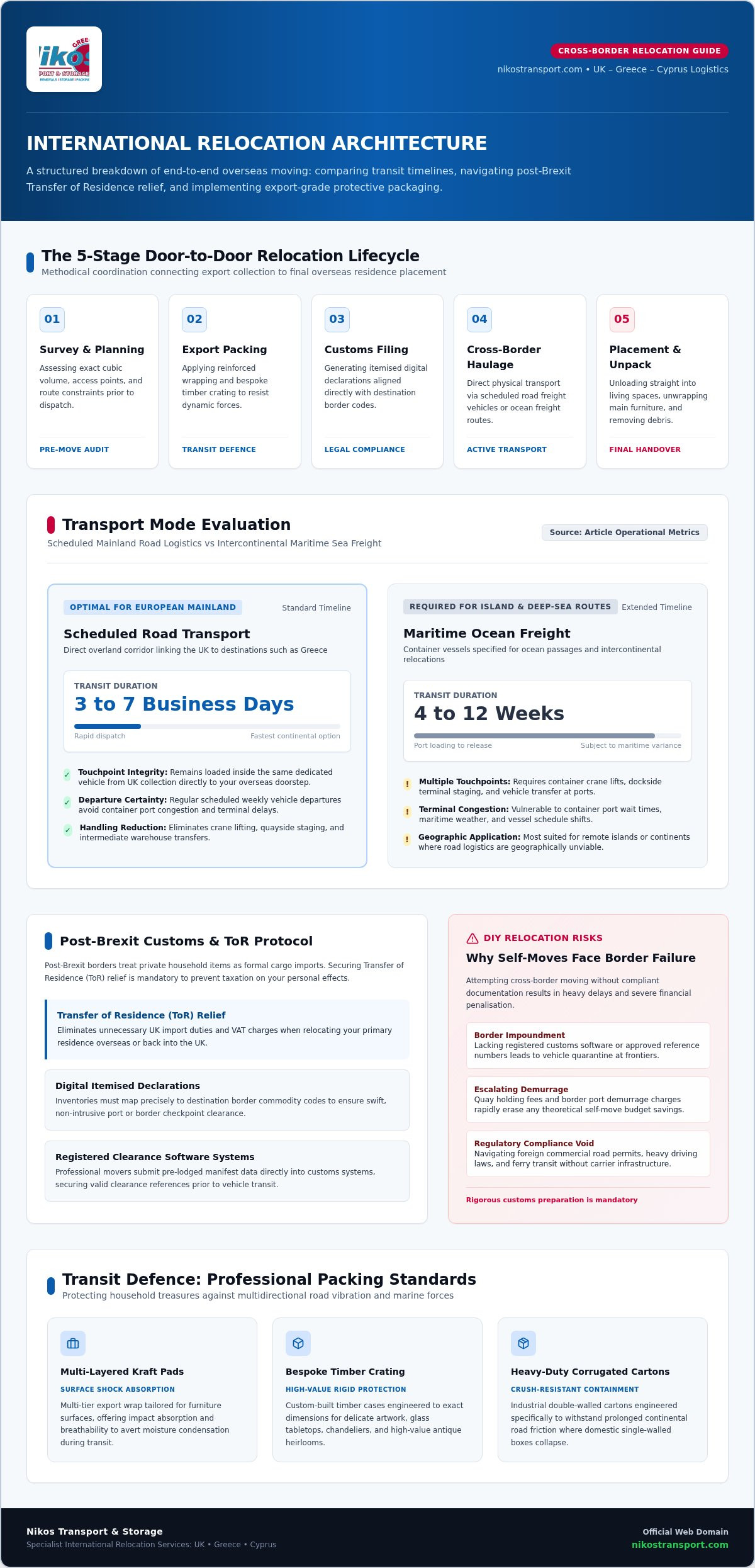
- Pre-move survey and planning: Assessing exact cubic volume, access points, and route requirements before transit begins.
- Export packing: Applying reinforced export wrapping and bespoke timber crating to withstand multidirectional road or maritime transit forces.
- Customs compliance: Generating compliant itemised declarations and filing documentation with border authorities.
- Cross-border haulage: Transporting your shipment via scheduled vehicle runs or ocean freight.
- Destination delivery: Safely bringing items into your overseas rooms, unwrapping primary furniture, and removing transit debris.
The Core Components of Door-to-Door Moving
End-to-end relocation protects you from coordinating disparate local subcontractors in different countries. Professional export wrapping forms the physical baseline, utilising multi-layered kraft paper pads and heavy-duty corrugated cartons designed for long journeys. Behind the scenes, customs specialists prepare digital inventories that align directly with destination border codes. Once the vehicle arrives overseas, the crew unloads items straight into your designated living spaces, turning an empty building into an immediate home.
Why Self-Managed Moves Fail Cross-Border Standards
Attempting a self-directed move overseas regularly runs into severe regulatory barriers. Post-Brexit border controls treat private household goods as formal cargo imports. Lacking registered customs clearance software or an approved reference number means vehicles face border impoundment, accompanied by mounting demurrage charges that quickly wipe out any DIY savings.
Domestic packaging materials simply aren't built for international transit. Thin, single-walled boxes collapse under prolonged road vibration, resulting in crushed heirlooms and cracked tabletops. Navigating unfamiliar foreign road permits, ferry bookings, and heavy driving regulations without an established carrier turns an exciting life milestone into an exhausting logistical trap.
Selecting the Optimal Transport Mode: Scheduled Road Logistics vs Sea Freight
Choosing the right transport method determines how smoothly your overseas move unfolds. Rather than defaulting to one-size-fits-all shipping, reputable international relocation services evaluate your destination geography, total household volume, and desired delivery schedule. While global logistics networks frequently push complicated maritime arrangements for every journey, mainland European relocations benefit substantially from direct road transport, leaving container shipping for island passages and intercontinental relocations.
Understanding the operational differences between these two modes prevents unnecessary handling and keeps your relocation on schedule:
- Transit duration: Road transport across European routes typically completes in 3 to 7 business days, whereas deep-sea shipping routes often require 4 to 12 weeks from port departure to final customs release.
- Handling touchpoints: Road freight keeps furniture loaded inside the same dedicated vehicle from collection to doorstep, whereas sea containers face crane lifts, port terminal transfers, and quay staging.
- Schedule reliability: Scheduled road departures avoid port congestion and vessel delays, offering predictable arrival dates.
The Benefits of Scheduled Road Transport Runs
For mainland routes linking the UK to destinations such as Greece, scheduled road transport provides unmatched predictability. Weekly departures mean you can align moving dates with tenancy starts or completion days without holding patterns. Because your possessions remain safely secured inside specialised removal vehicles throughout the journey, transit vibration is minimised, protecting delicate finishes. If you are planning an overseas transition across Europe, exploring scheduled runs with Nikos Transport & Storage offers a reliable, personal way to coordinate your moving timetable.
When Containerised Sea Freight Is the Sensible Solution
Island relocations, such as moves to Cyprus, naturally require maritime logistics. Container shipping provides the physical capacity needed to transport substantial multi-bedroom homes across deep-sea corridors. Depending on your load size, you can choose Full Container Load (FCL) to reserve an exclusive 20-foot or 40-foot steel container, or opt for shared container space (LCL / groupage) to move smaller consignments economically.
Sea freight requires earlier booking windows and rigorous inventory documentation. Because containers undergo terminal inspections, making sure your paperwork aligns with HMRC Transfer of Residence relief guidance ensures customs officers release your container promptly once it arrives at port, avoiding costly demurrage fees.
Navigating Post-Brexit Customs Declarations and Transfer of Residence
Crossing international borders with your personal effects changed permanently after the UK departed the European Union. Household removals between the UK and continental Europe now constitute formal trade imports and exports, requiring structured customs entries. When you enlist seasoned international relocation services, you don't need to tackle these regulatory hurdles alone. An experienced partner walks you through each customs declaration, securing statutory tax exemptions so you avoid unnecessary levies on items you already own.
Securing Duty-Free Relief on Personal Effects
Relief schemes exist on both sides of the border to ensure qualifying movers bypass import VAT (typically 20% in the UK) and customs duties. For moves into Great Britain, HM Revenue & Customs administers Transfer of Residence (ToR1) relief, while moves to the EU follow Council Regulation (EC) No 1186/2009. Qualifying requires meeting three primary criteria:
- Prior residency: You must have lived outside your destination territory for at least 12 consecutive months.
- Prior possession: You must have owned and used your belongings for at least six months before transit.
- Import deadline: Belongings must arrive within 12 months of establishing your new residence, and you cannot sell, hire out, or lend them for 12 months following clearance.
Submitting tenancy agreements, employment contracts, or property title deeds establishes legitimate relocation intent in the eyes of border officials.
Preparing Compliant International Packing Inventories
Border authorities inspect manifests with microscopic scrutiny. Vague line items such as "miscellaneous items" or "box of kitchenware" invite immediate vehicle holds and costly physical inspections. Compliant declarations require itemised packing inventories that list item types alongside approximate values, serial numbers, and purchase dates for major electrical appliances. Professional export crews label every carton with matching numeric references, giving border officers complete visibility.
How Customs Brokerage Support Eliminates Border Stress
Direct electronic submission into national customs platforms makes all the difference. For UK entries, customs specialists upload declarations into the Customs Declaration Service (CDS) using the approved Unique Reference Number (URN) from your ToR1 relief application. This digital coordination ensures clearance is granted before the vehicle reaches the terminal, preventing frustrating holding bay delays.
Consumer vetting resources such as the FMCSA Protect Your Move guidelines highlight how vital it is to work with verifiable movers rather than unaccountable booking brokers. Dedicated international relocation services handle declarations directly, giving you complete clarity and true peace of mind at every border crossing.
Essential Relocation Preparation: Professional Packing and Secure Storage
Safe overseas transit relies on physical preparation long before a vehicle pulls away from your kerb. High-calibre international relocation services treat export packing as structural engineering rather than simple boxing. Whether your items travel via cross-country road networks or marine container vessels, belongings endure prolonged vibration, atmospheric shifts, and directional braking forces. Investing in specialised preparation and strategic warehousing ensures your goods emerge at your destination in the exact condition they departed.
Export Packing Standards for Long-Distance Transit
Standard domestic packaging materials are wholly inadequate for international transport. Moving abroad requires heavy-duty protection built to withstand continuous transit pressures:
- Bubble-blanket multi-wrapping: High-grade poly-fabric blankets cushion polished timber dining tables, vintage sideboards, and leather suites, repelling moisture whilst dampening road shocks.
- Double-walled corrugated cartons: Rigid, reinforced cardboard prevents stack crush inside vehicles, protecting chinaware, books, and fine kitchenware.
- Custom-built timber crates: Fragile mirrors, delicate chandeliers, and large flat-screen displays receive tailor-made crating built from heat-treated ISPM 15 certified timber, satisfying strict international phytosanitary rules.
Every carton is sealed with heavy-duty vinyl tape and cross-referenced against your master inventory, guaranteeing full visibility at border inspections.
Using Secure UK Warehouse Facilities as a Strategic Bridge
Moving timelines rarely align like clockwork. Tenancy agreements finish, property completions drag out, or overseas renovations hit brief hold-ups. Instead of rushing into temporary leases abroad or risking delayed collections, nationwide storage facilities act as an indispensable logistical buffer.
Purpose-built, CCTV-monitored warehouse facilities safeguard your packed home securely until your destination premises are ready for occupation. This storage bridge also allows you to consolidate overseas shipments efficiently, combining existing furniture with newly purchased appliances or online deliveries before departure. When you're coordinating complex international moving dates, you can secure nationwide storage and export packing with an experienced moving partner to keep every stage entirely under control.
How to Choose the Right International Moving Partner for Your Move
Entrusting your home's contents to an overseas carrier is a deeply personal decision. While large corporate freight forwarders often treat consignments as volume metrics inside an automated system, selecting the right international relocation services requires looking beyond flashy marketing claims. You need a dedicated mover who understands your specific corridor, respects the sentimental value of your possessions, and maintains continuous, direct contact from start to finish.
Key Criteria to Assess When Comparing Relocation Companies
Before committing to a provider, look closely at how they operate on the ground:
- Route specialisation: Check whether the carrier operates regular, scheduled departures along your specific route or relies on unpredictable third-party networks.
- In-house customs expertise: Ensure the company manages customs declarations directly rather than passing your sensitive personal paperwork to detached third parties.
- Comprehensive service scope: Verify that one unified team coordinates export wrapping, secure UK storage, freight transport, and final overseas placement.
- Authentic client feedback: Look for verified reviews demonstrating punctuality, careful handling of fragile possessions, and supportive communication during transit.
The Value of Personalised Care from a Family-Operated Specialist
Major corporate logistics networks frequently isolate clients behind automated ticketing portals and rotating call centre agents. When completion dates shift or access to your overseas home presents unexpected parking hurdles, waiting days for an email reply creates immense anxiety.
Partnering with an established, family-operated specialist replaces corporate detachment with genuine human connection. You work directly with experienced logistical coordinators who know your itinerary by name and adapt flexibly to unforeseen schedule adjustments. Established in 2003, Nikos Transport & Storage supports your move with decades of dedicated international transit expertise, combining scheduled weekly road runs and scheduled sea freight routes with hands-on, end-to-end care. Having a trusted team safeguarding your belongings gives you the reassurance you need to focus on your exciting overseas journey.
Take the First Step Towards Your Overseas Move
Relocating abroad represents an exciting life chapter, but success always depends on combining thorough regulatory preparation with attentive transit care. From securing duty exemptions through compliant Transfer of Residence filings to choosing between scheduled road transport and maritime freight, each stage demands careful coordination. Professional international relocation services transform what could be an overwhelming journey into an orderly, predictable transition.
With over two decades of international transport experience since 2003, we understand how much your treasured possessions mean to you. Whether you need reliable weekly scheduled road transit connecting the UK with Europe, complete customs declaration support, or secure nationwide warehouse storage bridging gaps between moving dates, our family-run team treats your move with individual dedication. Speak with our friendly relocation specialists today to plan your seamless international move and step into your new life overseas with genuine peace of mind.
Frequently Asked Questions
How far in advance should I book professional international relocation services?
You should book your mover at least two to three months before your desired moving date. This window allows sufficient time to complete home volume surveys, prepare compliant customs documentation, and schedule vehicle or shipping capacity. If you're relocating during busy summer periods, booking early prevents scheduling bottlenecks and gives customs authorities ample time to process statutory relief applications before your items depart.
What is Transfer of Residence (ToR) and how does it affect my international move?
Transfer of Residence is a customs relief framework that waives standard import VAT and customs duty on personal belongings when relocating internationally. Without approved ToR relief, your used furniture, appliances, and personal possessions face standard commercial border tariffs. Obtaining approval requires demonstrating that you've lived outside your destination country for at least 12 months and owned your items for at least six months prior to transit.
Can I pack my own belongings for an international relocation overseas?
You can pack non-fragile items yourself, but professional export packing is strongly advised for international transit. Self-packed boxes are labelled by customs authorities as "Owner Packed", which routinely triggers intrusive physical border inspections and delays. Professional packers apply export-grade materials, build compliant timber crates, and generate numbered manifests that satisfy international customs officials whilst safeguarding fragile items against prolonged road or ocean transit movement.
What is the difference between scheduled road transport and containerised sea freight?
Scheduled road transport carries goods directly from door to door inside specialised removal vehicles, making it ideal for continuous European mainland corridors. It offers predictable weekly runs and avoids intermediate port handling. In contrast, containerised sea freight transports large household volumes or island shipments across deep-sea waters using 20-foot or 40-foot steel shipping containers, which require longer maritime transit schedules and port clearance management.
What happens if my new overseas home is not ready when my belongings arrive?
Your possessions can be transferred into secure warehouse facilities until your overseas property is accessible. Rather than paying costly demurrage fees at border clearance depots or port quays, professional international relocation services coordinate safe short-term or long-term storage in modern, alarmed UK facilities. Once your foreign tenancy starts or renovations finish, your consignment is dispatched on a scheduled departure directly to your new address.
How are customs declarations handled for personal goods moving from the UK?
Customs declarations are submitted digitally through statutory border portals like the UK Customs Declaration Service (CDS) and equivalent destination platforms. An experienced moving specialist translates your itemised inventory into compliant customs entries, attaching your unique relief reference number. This pre-arrival filing ensures that border agents clear the transport vehicle before or upon arrival, avoiding impoundment bays and administrative fines.
Are my household goods protected against damage during international transit?
Possessions receive multilayered protection through export-grade wrapping, structural crating, and specialised vehicle loading techniques designed for long journeys. Dedicated removal vehicles use internal tie-rails and cushioned strapping to prevent load shifting during transit across European motorways. Reputable movers also outline comprehensive transit cover options, giving you financial protection and reassurance for your high-value items and treasured family heirlooms throughout the entire cross-border journey.
