
If your commercial shipment is currently sitting in a queue at the border whilst your customers wait, you aren't just losing time; you're losing their trust. We know that navigating customs clearance for business goods to Greece has become a significant hurdle for many, especially with the July 2026 abolition of the €150 duty exemption and new flat-rate fees. It feels like every time you get comfortable with the paperwork, the regulations shift once more, leaving you to worry about goods being held at the Greek border or unexpected costs eating into your margins.
We've created this guide to help you master the complexities of post-Brexit trade, offering a clear path to compliance with the latest 2026 Greek import regulations. You'll learn exactly how to handle EORI registration, navigate the 24% standard VAT rate, and organise your documentation for a predictable shipping timeline. By the end of this article, you'll have the knowledge to reduce your administrative burden and ensure your goods reach their destination with the care and precision your business deserves.
Key Takeaways
- Learn how to organise precise commercial invoices and packing lists to satisfy Greek border inspections and prevent costly delays.
- Discover a methodical approach to customs clearance for business goods to Greece, including the digitisation of pre-shipment documents for smoother UK export declarations.
- Understand your financial obligations by mastering Greek VAT calculations and choosing the right Incoterms to determine liability for duties.
- Gain a competitive edge by integrating professional customs declaration services with weekly scheduled road transport to maintain a steady inventory flow.
- Ensure long-term compliance by staying informed about 2026 regulatory shifts, such as mandatory B2B e-invoicing via the myDATA platform.
Navigating the 2026 Landscape: UK to Greece Commercial Shipping
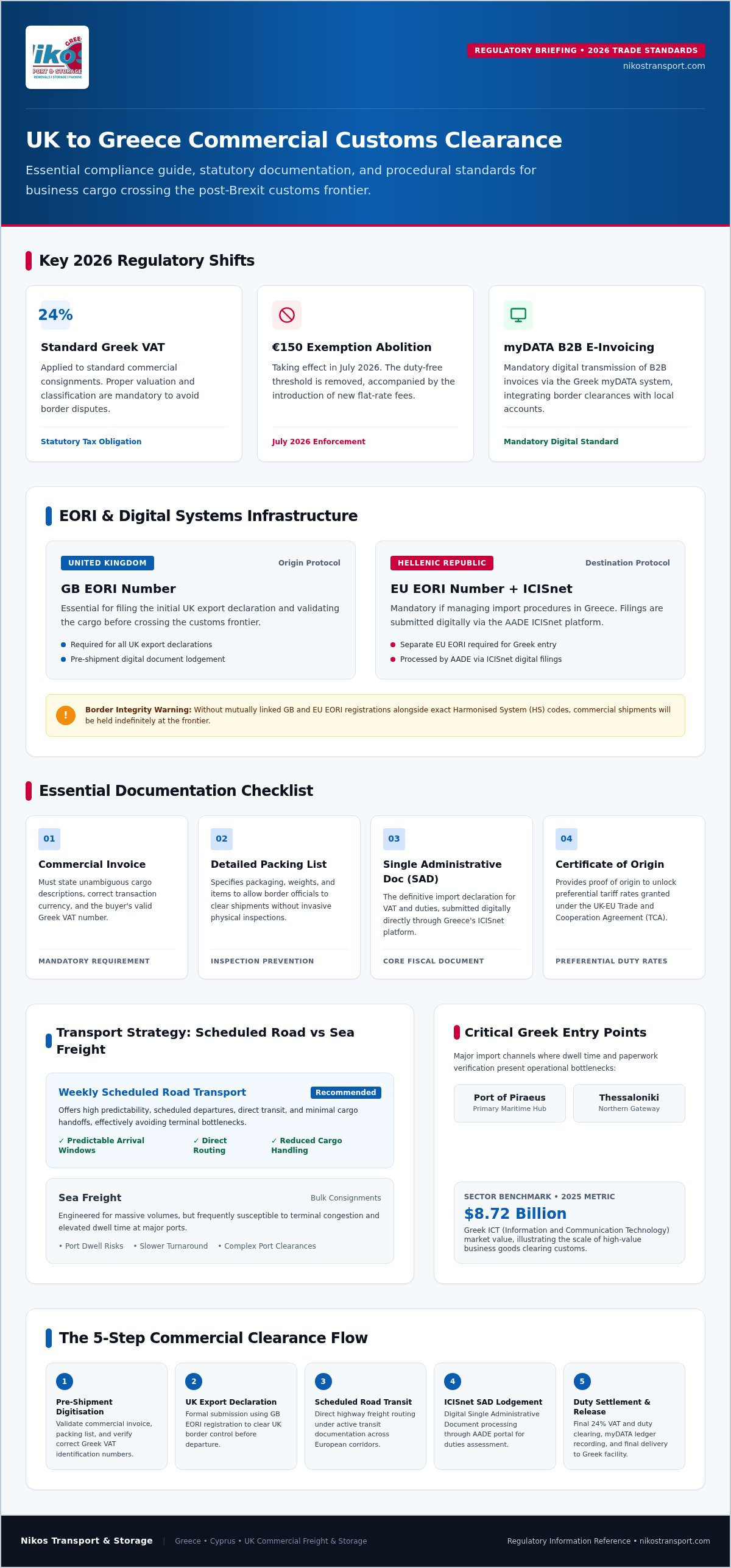
Effective customs clearance for business goods to Greece is no longer just a checkbox; it's a strategic pillar for any UK firm trading with the Mediterranean. In the 2026 trade environment, this process involves the formal declaration of commercial cargo to ensure all Greek import regulations are met and correct duties are settled. Since the UK's departure from the European Union Customs Union, every shipment must cross a "Customs Frontier." This boundary represents a significant shift in your business timeline, as goods are now subject to full border controls that didn't exist a few years ago.
Success depends heavily on your chosen transport mode. Whilst sea freight handles massive volumes, our weekly scheduled road transport provides the reliability and speed required for modern inventory cycles. Road transport allows for tighter control over the schedule, helping you avoid the bottlenecks often found at massive shipping terminals. We understand that for a growing business, a predictable arrival date is worth its weight in gold. By choosing road freight, you gain a more direct route to your Greek partners, reducing the number of hands your goods pass through.
The Evolving Relationship Between UK and Greek Trade
Trade in 2026 is defined by a mature understanding of post-Brexit agreements. We've seen significant growth in sectors like Information and Communication Technology (ICT), which reached a market value of $8.72 billion in 2025. It's crucial to recognise that "business goods" face much stricter requirements than personal items. Authorities require exact EORI registrations and precise HS codes to prevent safety risks and ensure fair market competition. We help you bridge this gap, treating your commercial shipments with the specific attention they require to pass through Greek customs without a hitch.
Why Professional Customs Handling is Non-Negotiable
The risks of getting it wrong are simply too high for most businesses to ignore. Inaccurate declarations can lead to steep fines, or in extreme cases, the permanent seizure of your goods. Expert handling is essential to minimise "dwell time" at major entry points like the Port of Piraeus or Thessaloniki. By acting as a direct liaison with Greek authorities, a specialist partner manages the complex paperwork and Logistics and Customs Documentation Fees on your behalf. We pride ourselves on this level of care, acting as an extension of your team to ensure your supply chain remains resilient and compliant. This personal touch ensures that no detail is overlooked, protecting both your reputation and your bottom line.
Essential Documentation for Greek Customs: A Business Checklist
Precision is your best ally when preparing for customs clearance for business goods to Greece. Greek authorities, specifically the Independent Authority for Public Revenue (AADE), require documentation that leaves no room for ambiguity. Your commercial invoice must include clear descriptions, the correct currency, and reference the buyer's Greek VAT number. For more detailed guidance on specific local forms, you can consult the Greek Government Customs Portal. A detailed packing list is equally vital. It helps border officials verify your cargo without unnecessary physical inspections, which keeps your shipment moving and reduces the risk of damage during handling.
Obtaining the correct EORI numbers is a non-negotiable step for 2026 trade. You'll need a "GB" EORI number to export from the UK, but if your business is also managing the import process within Greece, a separate EU EORI number is mandatory. Without these linked registrations, your goods will be held at the border indefinitely. Additionally, providing a Certificate of Origin allows you to benefit from preferential tariff rates under the UK-EU Trade and Cooperation Agreement (TCA). If you're feeling overwhelmed by these administrative demands, our team can help you manage your customs declarations with the personal care your business deserves.
The Single Administrative Document (SAD)
The SAD is the core document for Greek imports, serving as the official declaration for VAT and duties. While the exporter provides the data, a customs agent usually completes the filing on your behalf to ensure technical compliance. In 2026, Greece has fully transitioned to digital customs filings. All SAD submissions must now be processed through the Integrated Customs Information System (ICISnet). This shift speeds up the process, but it requires absolute data accuracy from the outset to avoid automated flags.
Commodity Codes and HS Classification
Identifying the correct Harmonised System (HS) code is the only way to ensure you don't overpay duties. Greek audits are thorough. If an inspector finds a mis-classification, your business could face retrospective duty charges and significant penalties. We recommend using the UK Trade Tariff tool for initial research, but always double-check against the EU's TARIC database. Getting this right from day one prevents the stress of unexpected financial hits during a Greek tax audit and ensures you only pay what is legally required.
The Step-by-Step Customs Clearance Process for Greek Imports
Achieving smooth customs clearance for business goods to Greece requires a methodical, chronological approach. It's not just about having the right papers; it's about the timing of each submission. We've found that a structured workflow reduces the stress of border crossings and keeps your supply chain moving without unnecessary pauses. Mastering the customs clearance for business goods to Greece is simpler when you break it down into these manageable steps:
- Step 1: Pre-shipment Digitisation. Before the lorry even arrives at your warehouse, ensure all invoices and packing lists are digitised. Digital accuracy prevents manual entry errors later.
- Step 2: UK Export Declaration. Your goods must be formally exported using the Customs Declaration Service (CDS). This generates a Movement Reference Number (MRN) which is essential for the next stage.
- Step 3: Transit and EU Entry. As your shipment moves across the Continent, it must adhere to the EU Customs Regulations for Greece. This ensures your cargo is tracked for security purposes until it reaches the Greek border.
- Step 4: Greek Import Declaration. Upon arrival, your customs agent triggers an "Arrival Notification" in the Greek ICISnet system. This formally starts the import process.
- Step 5: Settlement and Release. Once duties and VAT are calculated and paid, authorities issue a release note. Your goods are then free to travel to their final destination in Greece.
Managing the "Entry Summary Declaration" (ENS)
The ENS is a mandatory security filing for any goods entering the EU from a third country. It's the carrier's responsibility to submit this data electronically. For road transport, the timeline is strict; the ENS must be lodged at least one hour before the vehicle arrives at the first EU customs office. This allows authorities to perform a risk assessment before the goods physically enter their territory. We handle these technicalities as part of our transport service, so you don't have to worry about the logistics of security filings.
Physical Inspections and Customs Holds
Sometimes, a shipment is flagged for a "Red Channel" inspection. This means a Greek customs officer will physically examine the cargo to verify it matches your declaration. To avoid delays, ensure your packing allows for easy access. If items are buried or poorly labelled, the inspection will take longer. Having a local Greek representative is invaluable here. They can answer immediate questions from the AADE, often resolving minor queries on the spot. We act as your eyes and ears on the ground, ensuring that even if a hold occurs, it's managed with professional care and speed.
Understanding Duties, VAT, and Financial Obligations in Greece
Financial clarity is the bedrock of a successful export strategy. When you're navigating customs clearance for business goods to Greece, the financial landscape involves more than just the price of transport. It requires a precise understanding of how Greek authorities calculate taxes and who holds the liability for payment. Since the abolition of the €150 customs duty exemption in July 2026, even smaller commercial consignments now attract scrutiny and potential charges. We believe that by preparing for these costs upfront, you can maintain healthy margins and avoid the stress of unexpected invoices at the border.
Import VAT in Greece is generally calculated on the total value of the goods, including insurance and freight costs (the CIF value), plus any applicable customs duties. Whilst the standard rate is 24%, certain items like food or medical equipment may qualify for reduced rates of 13% or 6%. It's also worth noting that as of January 2026, specific Greek islands with low populations benefit from a 30% reduction on these rates, resulting in island-specific VAT of 17%, 9%, or 4%. Understanding these nuances ensures you don't overcharge your customers or under-budget for your own tax liabilities when managing customs clearance for business goods to Greece.
Navigating Greek VAT (ΦΠΑ)
If your business is registered for VAT in Greece, you can typically reclaim the import VAT paid through your periodic tax returns. However, for most UK exporters, the VAT must be settled at the point of entry before the goods are released. Greece has also introduced mandatory B2B e-invoicing via the myDATA platform during 2026, which streamlines how tax data is reported to the AADE. This digital shift makes it easier to track your obligations, provided your records are organised from the start.
Choosing the Right Incoterms for Your Contract
The choice between Delivered Duty Paid (DDP) and Delivered At Place (DAP) significantly impacts your cash flow and administrative burden. Under DDP, you as the exporter take full responsibility for all costs, including the 24% Greek VAT and any duties. Whilst this offers a seamless experience for your Greek buyer, it requires you to handle complex local tax filings. Conversely, many UK firms prefer DAP. This allows the buyer to pay the taxes locally, which often simplifies the process for the exporter and ensures the buyer can use their own VAT deferment accounts if available.
To ensure your shipment moves without a hitch, we recommend you get a professional quote for your customs declaration to see how we can simplify these financial hurdles for you. Clearly stating your chosen Incoterms on your commercial invoice is the best way to prevent disputes and ensure everyone knows exactly who is paying what from the outset.
Expert Logistics: Streamlining Your Business Supply Chain with Nikos Transport
Logistics is more than moving pallets; it's about moving your business forward with confidence. We understand that the complexities of 2026 trade can feel cold and detached, which is why we prioritise a supportive, family-run approach that treats you as a partner rather than just a transaction. By integrating our specialist customs clearance for business goods to Greece directly with our physical haulage, we ensure that your documentation is handled by the same team that manages the steering wheel. This end-to-end oversight removes the communication gaps where errors usually occur, giving you a single, reliable point of contact for the entire journey.
Our weekly scheduled road service is designed to give your inventory management a steady, dependable rhythm. Instead of waiting for a ship to dock or a plane to clear, you can plan your Greek distribution around a predictable weekly departure. This reliability is backed by our UK-based warehousing, which serves as a vital hub for businesses needing to consolidate multiple orders before they cross the border. You can send your goods to our storage facility at your own pace, and we'll organise them for the final Greek leg. This consolidation service is a strategic advantage for firms looking to reduce their Logistics and Customs Documentation Fees by shipping larger, unified loads.
End-to-End Support from UK to Greece
We believe in a door-to-door philosophy that takes the weight off your shoulders. From the moment we collect your cargo, we take responsibility for its safety and compliance. Our specialist packing services are specifically designed for the rigours of international transit, protecting your investment from the vibrations and handling of a long-haul journey. We also have extensive experience with Amazon order forwarding and commercial consolidation, helping online sellers navigate the specific requirements of EU fulfilment centres without the usual administrative headaches or border delays.
Get Started with Your Greek Export Strategy
Building a resilient supply chain starts with a conversation. We don't believe in one-size-fits-all solutions, so we take the time to understand your specific cargo, volume, and timeline. To provide an accurate logistical assessment, we simply need a few details about your goods, their origin, and your target destination in Greece. This allows us to calculate potential duties accurately and give you a clear, predictable timeline for your deliveries. If you're ready to secure your trade route for 2026, you can Contact Nikos Transport for a professional customs consultation. Let's work together to ensure your business goods reach Greece with the care and precision they deserve.
Securing Your Supply Chain for 2026 and Beyond
Managing the complexities of modern trade doesn't have to be a source of constant stress for your business. By focusing on precise documentation and staying ahead of the digital myDATA shifts, you've already taken the most important steps toward a resilient supply chain. Success in customs clearance for business goods to Greece relies on the synergy between technical knowledge and physical execution. It's about ensuring every detail is correct before the wheels start turning.
With decades of experience since our founding in 2003, we've refined our weekly road transport service to provide the reliability your inventory management requires. Our specialist customs declaration team acts as your dedicated partner, treating every shipment with the personal care it deserves to ensure compliance and speed. We're here to help you grow your Mediterranean trade with absolute confidence and ease. Ready to simplify your next shipment? Request a Business Customs & Transport Quote today and let us handle the heavy lifting for you.
Frequently Asked Questions
Do I need a Greek VAT number to ship business goods from the UK?
You don't necessarily need a Greek VAT number yourself if your Greek customer acts as the importer of record. However, if your business is handling the import process directly, a Greek VAT registration is essential. This allows you to settle the 24% standard VAT rate and reclaim it through your tax returns. Most firms choose their Incoterms carefully to decide who carries this administrative and financial weight during the shipping process.
How long does customs clearance typically take at the Greek border in 2026?
Most shipments clear within 24 to 48 hours, provided all digital filings in the ICISnet system are accurate. Delays usually occur if there's a discrepancy in the HS codes or if authorities select the cargo for a physical inspection. We use our decades of experience to ensure your paperwork is flawless before the vehicle arrives, which helps maintain a steady, predictable timeline for all your commercial deliveries to Greece.
What are the most common reasons for business goods being delayed in Greece?
Delays often stem from minor clerical errors on the commercial invoice or an incorrect EORI number registration. Since the 2026 abolition of the €150 duty exemption, authorities have increased scrutiny on low-value imports to ensure compliance. Inaccurate commodity codes are another frequent culprit, as they lead to disputes over duty calculations. Ensuring your packing list is precise helps officials verify cargo quickly during routine border checks at the frontier.
Can Nikos Transport handle the customs paperwork if I arrange my own transport?
We can certainly assist with your paperwork through our dedicated customs declaration service. Whilst we specialise in end-to-end transport, we understand that some businesses only require help with the administrative burden of post-Brexit regulations. Our specialist team handles the technical filings and documentation fees, acting as your liaison with Greek authorities to ensure your supply chain remains compliant and your goods move without any unnecessary or costly pauses.
Are there specific labelling requirements for commercial goods entering Greece?
Commercial goods must meet strict EU labelling standards, which often include Greek language translations for consumer instructions or safety warnings. Items like electronics or machinery require the CE mark to prove they meet health and safety regulations. We recommend verifying these details early, as over 60% of targeted EU inspections in 2025 failed due to non-compliance. Correct labelling is a vital part of customs clearance for business goods to Greece.
What is the difference between an EORI number and a VAT number for exports?
An EORI number is a unique identification code required for all customs interactions when moving goods between the UK and the EU. It's strictly for border control and security purposes. In contrast, a VAT number is used by tax authorities to track and collect value-added tax on sales. You'll need both a "GB" EORI for the UK export and an EU EORI for the Greek import to ensure a smooth transition.
How much does customs clearance for business goods to Greece cost?
The total cost depends on several factors, including the value of your goods, their specific HS classification, and the applicable duty rates. You'll also need to account for the standard 24% Greek VAT and our Logistics and Customs Documentation Fees. Since every business shipment is unique, we provide tailored assessments rather than flat rates. This ensures you only pay for the specific expertise and transport your inventory actually requires for safe arrival.
What happens if my business goods are rejected by Greek customs?
If your goods are rejected, they are typically held at a secure customs facility whilst the discrepancy is investigated. You may be asked to provide corrected documentation or pay additional duties and penalties. In extreme cases of non-compliance, goods can be seized or returned to the UK at your expense. We work closely with the AADE to resolve queries quickly, using our specialist knowledge to prevent these stressful scenarios from occurring.
