

Does a UK to Greece customs declaration mean you’ll automatically pay duty? No. It records what’s being sent and gives customs authorities information to assess the shipment. Declaring goods and deciding whether charges apply are separate steps.
If you’re moving household belongings, it’s understandable to worry that a missing detail could lead to unexpected costs or hold-ups. A declaration is still essential, and accurate information helps the process run more smoothly. Any duty or tax relief depends on the circumstances and applicable requirements, so submitting a declaration doesn’t guarantee relief.
This guide explains what a declaration does, what it doesn’t promise and which shipment details to gather before arranging your move. It also clarifies how declarations relate to possible charges and household-goods relief. With practical preparation and coordinated transport, including door-to-door support from Nikos Transport & Storage, you can approach the paperwork with greater confidence.
Key Takeaways
- A UK to Greece customs declaration describes goods crossing the customs border. It is part of the shipment process, not a decision on charges.
- Prepare clear item descriptions, quantities and values where required, then follow the current instructions for your shipment.
- Identify whether your belongings are part of a household move or being sent for another purpose. This can affect which rules and supporting evidence apply.
- Before arranging transport, prepare an inventory and compare names, addresses and item descriptions across your paperwork.
- Customs declaration support can be arranged alongside UK to Greece transport, helping you prepare paperwork as part of a coordinated move.
UK to Greece customs declaration: what it is and why it matters
A customs declaration describes goods moving across a customs border. It gives the relevant authorities information about what is being sent, such as the type and value of the goods, so they can be assessed under the applicable rules. A UK to Greece customs declaration is customs paperwork, not a transport booking, a complete packing inventory or a decision that charges are due.
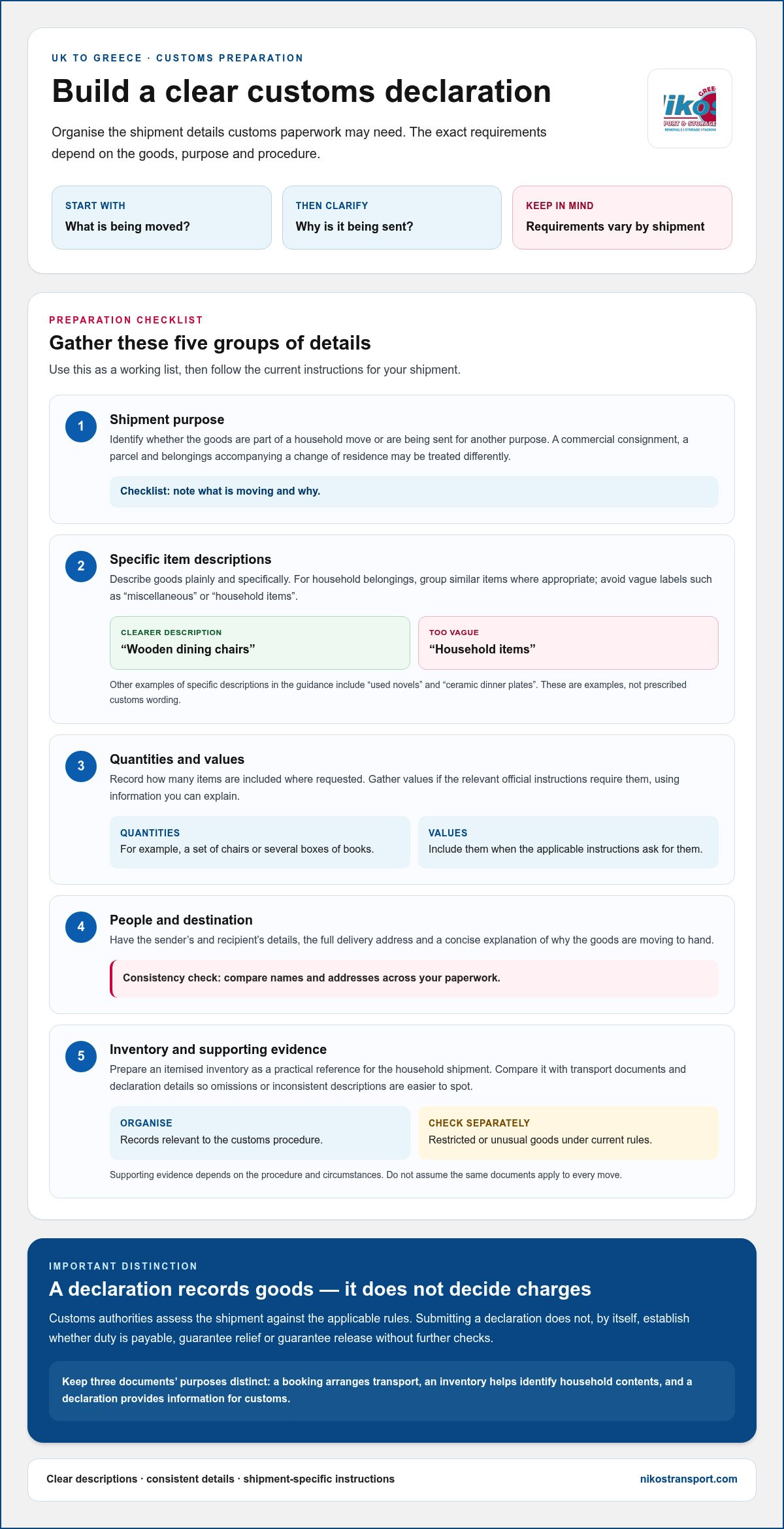
These documents have different purposes. A booking arranges transport, an inventory helps identify the contents of a household shipment, and a declaration provides information for customs. Customs authorities assess the details against the rules that apply to the goods and shipment. As Understanding Customs Declarations explains, declarations are used in different customs processes, so the paperwork depends on the circumstances.
Submitting a declaration records information about the goods; it does not, by itself, establish whether duty is payable. Nor does submission guarantee that a particular relief applies or that customs will release a shipment without further checks. Keeping these distinctions clear helps you prepare without assuming either that charges are automatic or that paperwork alone settles the outcome.
Why a shipment from the UK to Greece involves customs formalities
Following the UK’s departure from the EU customs framework, goods moving between the UK and Greece cross a customs border. A shipment may therefore involve export formalities in the UK and import formalities in Greece. The precise steps and documents depend on the current requirements for the shipment, so a single description of the process won’t fit every consignment.
The goods, route and purpose all matter. A commercial consignment, a parcel sent to a recipient and belongings accompanying a change of residence may be treated differently. Start by identifying what is being moved and why, then organise the paperwork around the shipment rather than relying on a generic parcel checklist.
Household belongings are not the same as an ordinary parcel
A consumer parcel might contain a small number of items sent to another person. A relocation shipment can include furniture, kitchenware, books and personal effects accumulated over time. Describing that load simply as “personal belongings” may not give a clear enough picture. An itemised inventory helps distinguish the goods and gives the paperwork a practical reference point.
Use plain descriptions, grouping similar belongings where appropriate instead of relying on vague labels such as “miscellaneous”. For example, “wooden dining chairs” is more informative than “household items”. Include quantities and values where required by the relevant instructions, and keep descriptions consistent across the inventory and declaration. This preparation is one useful part of international removals planning, connecting customs paperwork with the wider move.
What information supports a UK to Greece customs declaration?
Good preparation starts with a clear picture of the shipment, not an assumption that every move uses the same form or document set. The information required for a UK to Greece customs declaration depends on the goods, the shipment’s purpose and the customs procedure. Use the points below as a working preparation list, then follow the current instructions for your shipment.
Useful information to organise may include:
- Item descriptions: name goods plainly and specifically rather than labelling boxes only as “miscellaneous”.
- Quantities: record how many items are included where requested, such as a set of dining chairs or several boxes of books.
- Values: gather values for goods if the relevant official instructions require them, using information you can explain.
- People and destination: have the sender’s and recipient’s details, the delivery address and the shipment’s purpose to hand.
- Supporting evidence: organise records relevant to the procedure, without assuming the same set applies to every move.
Specific, accurate descriptions are more useful than vague labels because they help others understand what each consignment contains. For example, “used novels” or “ceramic dinner plates” gives a clearer picture than “personal effects”. These examples show how to be clear; they are not prescribed customs wording.
Build a clear inventory of personal effects
For a household move, group belongings into sensible categories, then describe each box or group in plain language. This makes it easier to compare the inventory with shipping documents and spot omissions before arranging the shipment. Don’t use the inventory to assume that every item qualifies for duty relief. Eligibility depends on the applicable procedure and supporting evidence.
Set aside restricted or unusual goods for separate checks under current rules. GOV.UK’s guidance on customs rules for Greece covers entry requirements for travellers. It provides useful context, but shipment-specific instructions should guide paperwork for transported belongings.
Gather the details that may be requested
Before completing paperwork, collect consistent sender and recipient details, the full destination address and a concise explanation of why the goods are moving. Supporting evidence depends on the customs procedure and the circumstances of the shipment, so don’t assume that a particular form or identifier applies to every move.
Compare the inventory with the transport documents before submission. Check that names and addresses are consistent, descriptions refer to the same goods, and quantities or values match wherever requested. A careful review can help prevent avoidable questions.
Once the information is organised, customs paperwork can be prepared alongside the transport plan. Nikos Transport & Storage provides customs declaration support as part of UK to Greece transport, bringing the documentation and move together. Explore UK to Greece transport and customs support as you plan the next steps.
UK to Greece customs declaration myths: duty, relief and delays
Customs paperwork can prompt an understandable question: if you declare your belongings, does that mean you owe duty? No. A declaration supplies information for customs assessment; it does not, by itself, establish that a charge is due. Whether duty or other charges apply depends on the goods, the shipment’s purpose and the rules in force for the relevant procedure.
Customs authorities may assess both the items being moved and whether the shipment meets the conditions for any applicable relief. Those decisions are separate from arranging transport. Requirements can change and depend on individual circumstances, so use current Greek customs guidance for your situation rather than relying on a general promise of a particular outcome.
Myth: every declared household item automatically attracts import duty
Fact: declaring goods and determining liability are separate steps. A declaration provides shipment information; customs assessment considers it under the applicable rules. A declaration alone neither proves that duty is payable nor means a household shipment automatically qualifies for relief.
Relief for household belongings may be available in qualifying circumstances, but eligibility and required evidence depend on the current procedure. Moving to Greece does not, by itself, prove that every item meets the conditions. Keep relevant supporting records together, and don’t describe goods as exempt unless the applicable rules and your evidence support that position.
This distinction helps set realistic expectations. A careful declaration supports the assessment, but it cannot guarantee a zero charge, approval of relief or release without further questions. Customs authorities make the decision by applying the rules to the shipment.
Myth: a broad description is good enough
Labels such as “miscellaneous items” or “personal effects” may not explain what a box contains. A more useful description identifies the goods plainly, for example, “used books and kitchen utensils” or “wooden bedside tables”. The aim isn’t to add unnecessary detail, but to make the contents understandable and consistent across the inventory and shipping paperwork.
Describe items honestly and use values where the relevant instructions request them. Don’t undervalue goods or use a misleading label to influence the assessment. If a description or value differs between documents, customs authorities or those handling the paperwork may ask for clarification. Discrepancies can prompt questions, though they don’t necessarily mean a delay will occur.
Keep customs checks distinct from transport timing. A request for clarification or further assessment may affect the customs process, but it doesn’t allow anyone to predict a clearance duration. Keep your records organised and respond accurately to any request, while treating customs clearance and the transport schedule as related but separate parts of the move.
Preparing Belongings for Travel from UK to Greece
An organised preparation process makes it easier to spot missing details before arranging transport. Start by identifying the shipment’s purpose: is it a household move, or are you sending online purchases? The answer shapes which paperwork and supporting evidence may be relevant, so don’t assume a parcel process and a household-removal process are interchangeable.
A practical preparation sequence for household shipments
Work through the move in stages, keeping the information together as you go:
- Identify the purpose. Note whether the goods are personal belongings moving with a change of residence or items being sent for another reason.
- Build the inventory. Group items by category and describe them clearly. Set aside restricted, unusual or potentially sensitive goods so you can check the rules that apply to them.
- Gather relevant evidence. Collect ownership, residence or shipment records where they relate to the customs procedure. Don’t assume one type of evidence is required for every shipment.
- Review and retain. Compare the inventory and transport paperwork, then keep copies of submitted details and correspondence together.
This sequence takes you from an outline of the shipment to a careful final review. If you’re relying on household-goods relief, check the current eligibility conditions and required evidence through official guidance. Don’t assume that a move automatically qualifies.
Common paperwork mistakes to avoid
Small inconsistencies are easier to resolve before submission than after a query. Check that sender and recipient names, the destination address and item descriptions match across the documents. Avoid vague labels such as “miscellaneous”, unsupported values and descriptions that could misrepresent what is in a box. If you’re unsure how to describe an item, use plain, accurate language rather than guessing at a technical term.
Restricted goods need particular care. Rules can depend on the item and circumstances, so review current official instructions before packing or declaring them. Don’t rely on a general list copied from another shipment: requirements may differ according to the goods and procedure. For the same reason, don’t treat a UK to Greece customs declaration for a household move as if it were simply paperwork for an online parcel.
Online purchases are different from a household relocation. If you’re sending items bought from a retailer rather than moving personal belongings, the process may require different shipment information. The UK parcel forwarding to Greece guide covers that context.
Once your documents are consistent and organised, customs information can be coordinated with transport planning. Nikos Transport & Storage provides UK to Greece transport and customs declaration support, including help planning your Greece move and paperwork.
How Nikos Transport supports UK to Greece customs declarations
Moving belongings internationally involves more than arranging a vehicle. Customs information and transport planning need to work together, so clear shipment details help everyone involved understand what is being moved and prepare the relevant paperwork. Nikos Transport & Storage provides UK to Greece transport alongside customs declaration support, bringing these connected parts of your move into one coordinated process.
As a family-owned business founded in 2003, Nikos Transport & Storage understands that every move has its own practical details. Support with a UK to Greece customs declaration helps you organise shipment information and understand how it fits into the wider transport plan. Customs authorities make their own assessments, however, so paperwork support cannot guarantee clearance, a particular duty decision or a delivery date.
A more organised route from preparation to transport
Once you have an initial inventory and shipment outline, clear descriptions and consistent destination details give the paperwork and transport arrangements a shared reference. Nikos Transport & Storage provides practical customs declaration support alongside international transport, including door-to-door solutions. This helps coordinate preparation and movement while keeping the separate steps clear.
You remain responsible for the accuracy of the information supplied about your goods. Review descriptions, quantities, values where requested, names and addresses before they are used. If circumstances or shipment details change, keep the paperwork aligned with the goods to maintain a clear record. Customs decisions remain with the relevant authorities.
What to have ready when arranging your move
You don’t need every detail finalised to start organising. Having a few essentials to hand can make the first planning conversation more focused:
- Destination details: the intended delivery address in Greece and the recipient’s details.
- A shipment outline: whether you’re moving household belongings or sending goods for another purpose.
- An initial inventory: a useful overview of the main items and anything that may need separate consideration.
- Relevant records: documents about residence, ownership or the shipment where they apply to your circumstances.
Nikos Transport & Storage provides transport and customs declaration support for international shipments, helping bring these preparations together without suggesting a particular customs outcome. For a broader view of planning your move, the guide to international removal planning can help you consider the practical steps around the paperwork.
When you’re ready to discuss your move, start a conversation about UK to Greece transport. A clear outline of your destination and belongings is a helpful place to begin.
Take the next step with confidence
Use the time before transport is finalised to get the paperwork in order. Keep shipment details and official guidance together, and revisit them if your plans or belongings change. This gives you a clear starting point for understanding how a UK to Greece customs declaration fits your move, without assuming in advance what customs will decide.
Nikos Transport & Storage brings customs declaration support together with UK to Greece transport and door-to-door international solutions. As a family-owned business founded in 2003, we understand that a move is personal, and practical guidance can make planning more manageable.
Plan your UK to Greece transport with Nikos and take the next step towards an organised move. With the right details gathered and support alongside your transport plans, you can prepare for the journey with greater confidence.
Frequently Asked Questions
Is a customs declaration required when moving belongings from the UK to Greece?
A move from the UK to Greece may require customs declarations or supporting paperwork, depending on the goods, the shipment’s purpose and current procedures. There isn’t one process for every household move. Before packing, note whether your shipment includes anything beyond personal belongings, such as goods being sent to someone else. Then check current official guidance and ensure the information used to prepare your paperwork reflects the actual shipment.
Does declaring household goods mean I will have to pay import duty in Greece?
No. Declaring your belongings doesn’t, by itself, mean import duty is payable. Customs treatment depends on the goods, the applicable rules and whether you qualify for relevant relief. For example, a change of residence may be relevant to a relief application, but it doesn’t establish eligibility on its own. Check current Greek requirements and gather evidence that supports your circumstances rather than assuming a charge or exemption in advance.
Can I use one customs declaration for all my belongings?
Not necessarily. The paperwork depends on how your shipment is organised and which customs procedure applies. If belongings are split between consignments or shipped at different times, the documents may need to reflect those arrangements rather than treating everything as one load. Keep a clear record of what is included in each part of the shipment and follow the instructions that apply to it. Don’t assume that one standard declaration fits every move.
What information should I prepare for a UK to Greece customs declaration?
Prepare the sender’s and recipient’s details, the Greek destination, the reason for shipping and an initial inventory. For example, note whether a box contains books, kitchen equipment or clothing rather than recording only “personal items”. Other information or evidence may be needed under the procedure being used. This isn’t a definitive form checklist, so check current official instructions and ensure the details accurately describe the goods before submitting paperwork.
Do I need an EORI number to send household goods from the UK to Greece?
Whether an EORI number is needed depends on who makes the declaration and how the shipment is arranged. Don’t assume that a requirement for a business or a particular customs process applies in the same way to every individual household move. Before entering an identifier on paperwork, establish which party is making the declaration and check current UK and Greek procedures for that arrangement. This helps avoid using an irrelevant or incorrect identifier.
What happens if information on my customs declaration is incomplete or inaccurate?
Customs authorities may ask for clarification or supporting information if details are missing or don’t match other paperwork. For instance, a different destination address or a description that doesn’t explain a box’s contents may need attention. The effect depends on the shipment and the issue, so a delay isn’t inevitable. Review each document against your inventory, use truthful descriptions and values, and correct any known error through the appropriate process rather than guessing.
Are customs declarations for online purchases the same as declarations for a house move?
Not necessarily. An online order sent to a recipient differs in purpose and contents from personal belongings moving as part of a household relocation, and the relevant paperwork can differ too. Don’t assume instructions for a consumer parcel apply to a removal shipment. If you’re arranging delivery of online purchases to Greece, the UK parcel forwarding guide covers that separate context.


