

Warehouse security depends on several layers, not a single camera. For secure storage in a UK warehouse, assess access controls, CCTV and whether the storage arrangement suits your goods. Mesh cages allow visibility and ventilation, which can make them suitable for gas cylinders by helping prevent flammable gases or fumes from building up.
When stock, equipment or personal belongings are out of sight, it is natural to prioritise security. Look for a clear explanation of how entry is managed, how CCTV is monitored and whether the space suits what you are storing, rather than relying on a reassuring label alone. This guide explains what those safeguards mean in practice and how to estimate the capacity you need. It also covers how warehouse storage can accommodate changing volumes, what affects the cost and when storage might form part of a wider move or logistics plan. This helps you weigh security and flexibility before choosing a storage arrangement in the UK.
Key Takeaways
- Assess how site entry is controlled, including gatehouse arrangements, permissions and visitor procedures.
- Match outsourced storage capacity to the volume and type of goods you need to store, and consider how your requirements may change.
- Look at how internal and external CCTV supports oversight across the warehouse, alongside other security measures.
- Explore how storage can fit into a wider UK move or transport plan, including journeys to Greece or Cyprus.
How secure is the warehouse?
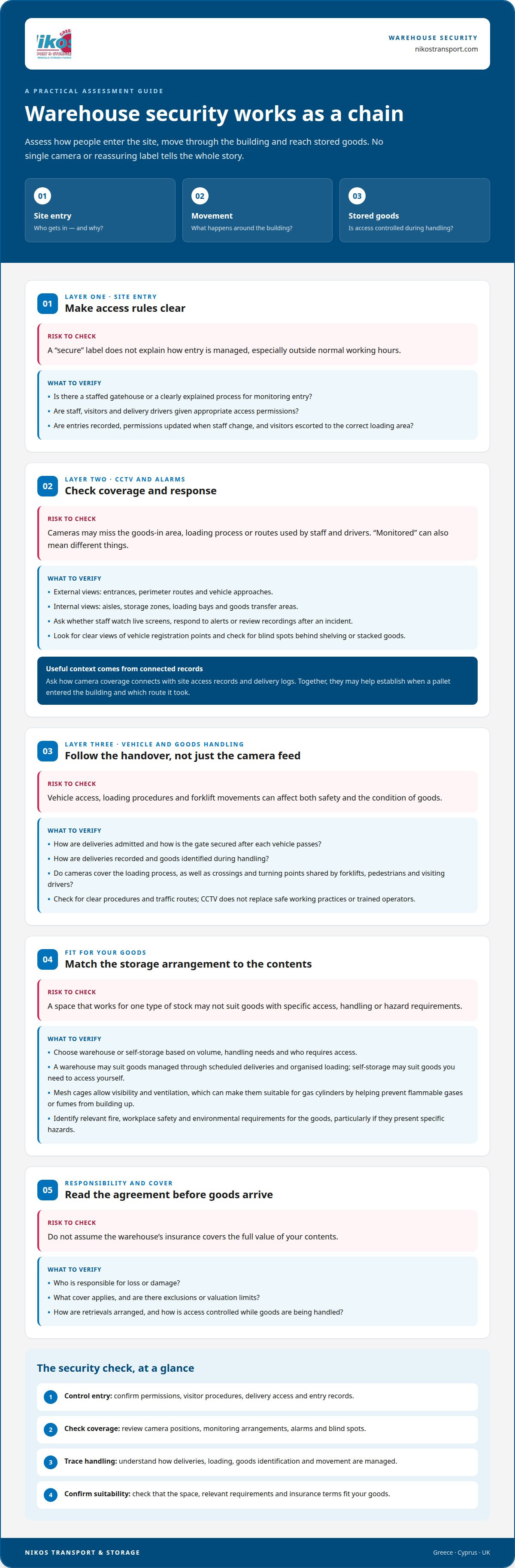
Assess security as a chain: site entry, movement around the building and access to stored goods. A gatehouse, monitored systems and clear delivery procedures each address a different point of risk.
Monitored Security and Restricted Access
For coverage outside normal working hours, look for a staffed gatehouse or a clearly explained process for monitoring entry. Access controls should distinguish authorised staff, visitors and delivery drivers, with a record of who enters and why. Ask how permissions are updated when staff change and how visitors are escorted from the entrance to the correct loading area. These details help you compare practical controls, not just reassuring labels.
CCTV, Alarms and Gated Entry
CCTV can monitor entrances, loading areas and internal routes, while alarms can alert staff to unauthorised entry. Check whether cameras cover the areas where goods are received and handled, and whether monitoring continues outside staffed hours. Gated access adds another layer at the site boundary; consider how deliveries are admitted and how the gate is secured after each vehicle passes. These measures are most effective when they work together.
Choose between warehouse storage and self-storage based on the volume, handling and access your goods require. A warehouse may suit stock or belongings managed through scheduled deliveries and organised loading. Self-storage may be more suitable if you need to access the goods yourself.
UK requirements depend on the goods and the storage activity. Before arranging storage, identify the relevant fire, workplace safety and environmental requirements for your items, particularly if they present specific hazards.
Insurance depends on the storage agreement and the policy covering the goods. Read who is responsible for loss or damage, what cover applies and whether there are exclusions or valuation limits. Do not assume the warehouse’s insurance covers the full value of your contents.
Consider risks at each handover: vehicle access, loading procedures and forklift movements can affect safety and the condition of your goods. Check how deliveries are recorded, how goods are identified and how access is controlled during handling. Clear procedures make it easier to spot where damage, loss or unauthorised entry could occur.
Outsourced secure storage and flexible capacity
Outsourced storage can provide space without requiring you to dedicate your own premises to stock. Choose an arrangement based on your goods, inventory records and likely changes in volume.
Short- and Long-Term Storage
Short-term storage can bridge a move or renovation, or accommodate a seasonal increase in stock. Longer-term arrangements may suit reserve inventory or belongings kept between property changes. Before choosing, estimate how much space your goods occupy and identify which items you will need to retrieve often. A storage unit may suit a small, fixed quantity, while larger or changing volumes need capacity planned around the stock.
Monthly Storage Plans
A monthly plan can help you align storage with changing requirements. Review how the agreement handles billing periods, notice and changes to the amount of space used. These details matter if stock levels rise before a busy trading period or fall after a clearance. Match the plan’s terms to your expected storage period instead of assuming a monthly arrangement allows immediate changes.
For a flexible arrangement, record what you are storing, when it may need to move and how often you will need access. An inventory listing item descriptions and quantities helps you plan retrievals and track changes in volume. For example, separate goods you need regularly from cartons intended to remain in storage. This makes it easier to judge whether the space still suits your needs.
Read the contract before your goods arrive. Note the minimum term, how to give notice, the notice period and the process for increasing or reducing capacity. Establish how retrievals are arranged and whether the agreement changes when your inventory does. A clear written record helps prevent a short-term requirement becoming a longer commitment than you intended.
If you’re comparing options for belongings or stock, explore storage support as part of your wider space plan.
Monitored internal and external CCTV
Treat CCTV coverage as one part of a warehouse’s security, not proof of security by itself. Review camera locations across the facility: external views may cover entrances, perimeter routes and vehicle approaches, while internal views may show aisles, storage zones and loading bays. For example, a camera aimed only at a warehouse door may miss activity around a separate goods-in area.
Clarify what “monitored” means in practice. Live monitoring and recorded footage serve different purposes, so find out whether staff watch screens, respond to alerts or review recordings after an incident. Ask how camera coverage connects with site access records and delivery logs. If a pallet goes missing, those records may help establish when it entered the building and which route it took.
Image quality and positioning matter as much as the number of cameras. Look for clear views of entrances, vehicle registration points and transfer areas, without obvious blind spots behind shelving or stacked goods. During a site tour, compare camera positions with the routes staff and delivery drivers actually use. A camera that does not cover the loading process may offer little useful context about handling.
Internal monitoring should support safe movement as well as security. Forklifts, pedestrians and visiting drivers may share busy loading areas, so coverage of crossings and turning points can help clarify how those spaces are used. CCTV does not replace safe working procedures, trained operators or clear traffic routes. It gives a storage provider another way to review an incident and identify where processes need attention.
Before choosing a warehouse, review the route from the outside approach to the goods-in point, storage aisles and dispatch area. Then ask how footage can be accessed after an incident, who can review it and how it supports an investigation. These details help you judge whether monitored CCTV forms part of daily site procedures, rather than simply being installed around the building.
UK warehouse storage services
UK warehouse storage can meet a range of needs, from keeping household belongings between moves to holding business stock for later distribution. The right facility depends on what you store, how often goods need handling and whether storage needs to connect with fulfilment.
Common options include general warehouse space for boxed goods, pallet storage for bulk stock and fulfilment facilities that prepare orders for dispatch. For example, a retailer may store seasonal stock and arrange regular collections, while a household may need belongings kept during a move. Match the service to the handling required, not just the available floor area.
Space pressure can influence that choice. Just under half of UK business operators cite a lack of operational space as their biggest bottleneck. A warehouse can provide room for overflow stock without using valuable workspace for cartons or pallets. Consider an East London industrial warehouse listing measuring 1,300 sq ft: its size illustrates why you should compare usable capacity with your own inventory, rather than relying on a headline description.
To find warehouse space that is practical for you, start with your postcode and consider which locations make collections, deliveries or fulfilment convenient. Compare access routes and the distance goods need to travel between the warehouse, your premises and your customers. A nearby facility may simplify regular movements, while a wider regional network may better suit stock distributed across the UK.
Before choosing, write down the goods, storage format and expected handling pattern. Then compare those needs with the warehouse’s service scope, capacity and delivery arrangements. This gives you a clear basis for discussing a suitable storage plan. Discuss UK warehouse storage as a next step for your requirements.
Nikos Transport & Storage: Transport To/From Greece
Nikos Transport & Storage can help when storage forms part of a move between the UK and Greece. Its Transport To/From Greece can support a relocation involving belongings travelling between the countries, while its Storage Service provides space for items during a change of plans or property. For moves within the UK, UK Removals may suit households relocating between towns or cities. Transport To Cyprus is also available for moves involving Cyprus. Consider which goods need storing, where they need to go and whether transport and storage should form one plan. To discuss your move or storage needs, contact Nikos Transport & Storage.
Plan your next move with confidence
Before deciding, map out the journey your goods will take. Note when they need to leave their current location, how long they may need to stay in storage and when they should be ready for collection or onward transport. A clear timeline helps you explain your priorities and identify which arrangements matter most.
Use that outline to guide a focused conversation about secure storage in a UK warehouse. Include the types of goods, any changes you expect and dates that could affect access or onward movement. Preparing these details helps you discuss a practical arrangement rather than making a general enquiry.
Nikos Transport & Storage can discuss storage as part of your wider requirements. Contact Nikos Transport & Storage to talk through your plans and take a considered next step.
Frequently Asked Questions
Can I book a unit for just seasonal demand, and when should I book?
Short-term storage can accommodate seasonal stock without keeping the extra inventory on your premises all year. Plan ahead of the stock increase so you have time to estimate the space needed and arrange the movement of goods. For example, separate seasonal cartons from regular stock to organise retrievals and onward deliveries around your trading cycle.
Can you store sensitive or high-value stock?
Nikos Transport & Storage provides warehouse storage, and all goods are insured under the terms and conditions of the Road Haulage Association. For sensitive or high-value items, prepare a detailed inventory with descriptions and condition notes before storage. Read the applicable RHA terms to understand how the stated cover applies to your goods.
How much does commercial warehouse space cost per week?
There is no standard weekly rate for commercial warehouse space. Nikos Transport & Storage uses quote-based pricing, with costs depending on distance, volume and extra services. A business storing a few cartons has different requirements from one holding bulky stock that needs additional handling. When requesting a quote, describe your goods, storage period and expected movements.
Is there a minimum or maximum storage period?
Short-term and long-term storage are available, so the arrangement can suit a move, a stock cycle or another temporary need for space. Set out your expected start and end dates, then review the agreement’s term and notice provisions before arranging collection. If your plans change, the written terms explain how to manage the storage period.
How much does secure warehouse storage cost in the UK?
Cost depends on distance, volume, and extra services; request a quote for an accurate estimate. For example, explain whether you need storage alone or also need goods collected, packed or moved onwards. Include the type and amount of goods, your expected storage period and any planned retrievals. These details help shape a quote around your requirements.
What security features should a UK secure storage warehouse have?
Look for controlled site entry, monitored CCTV, alarms and clear procedures for deliveries and loading. During a site review, trace how goods move from the vehicle entrance to their storage area, noting who can enter each space. Ask how access records, camera coverage and incident reports work together. This practical walkthrough can reveal gaps that a feature list alone may miss.


