
The most suitable transport option is not always the one that looks quickest or simplest on paper. When planning business relocation services UK to Greece, consider the cargo, the timing and how to keep operations on track throughout the move.
It’s understandable to be concerned about disruption, transport choices and paperwork. Customs formalities are part of planning an international shipment to Greece, alongside packing and coordinating collection and delivery.
This guide explains which service elements to consider, how scheduled road transport and sea freight may suit different shipments, and how to plan for packing, storage and customs documentation. The right approach depends on what you’re moving and when it needs to arrive, so clear coordination matters as much as the journey itself.
Nikos Transport & Storage is a family-owned business founded in 2003, providing transport, packing, UK storage and customs declaration services for commercial cargo moving between the UK and Greece. Bringing these services together can help organise the relocation around your shipment and business priorities.
Key Takeaways
- Define the move around business goods and operational needs. Employee relocation and immigration planning are separate considerations.
- Assess cargo type, volume, handling requirements and arrival sequence to decide what support the move needs.
- Compare scheduled road transport and sea freight against your shipment and timing, rather than assuming one option suits every business.
- Start with an inventory, handling priorities and an estimate of shipment volume, then coordinate collection and destination readiness.
- Business relocation services UK to Greece can bring transport, packing, customs declarations and storage into a joined-up plan.
Business relocation services UK to Greece: what does the move involve?
A business relocation is the planned movement of commercial goods from one operating location to another. For a UK-to-Greece move, this may include stock, office contents or equipment, with packing, customs declarations, collection and delivery arranged around the business’s needs. In this guide, business relocation services UK to Greece means practical support for moving physical cargo, not managing every part of a company’s expansion or transfer.
“Relocation” can also describe the broader process of moving a business or its people. For a general overview, see Understanding Business Relocation. Here, the focus is the goods: what needs to travel, how it should be handled and how the move fits around operations. Employee relocation, HR support, visas and immigration advice are separate matters, not part of a cargo plan.
Which business goods may need to move to Greece?
A shipment might include desks, chairs and files from an office, retail stock, tools, machinery or other commercial cargo. The right plan depends on the goods and their quantity. A small consignment of boxed stock has different packing and handling needs from bulky equipment or a mixed shipment of office contents and inventory.
Prepare a working inventory before planning the move. List what is travelling, approximate quantities, fragile or awkward items, and the goods needed first at the destination. This gives the transport and packing plan a useful starting point.
What makes a business move different from a household removal?
A business shipment needs to be planned around the work it supports. For example, moving essential stock before display equipment, or prioritising items needed to prepare a workspace, can help the receiving team organise its tasks. The shipment’s size, handling needs and arrival sequence all shape the plan, so coordinate timing rather than assuming it.
Physical cargo planning also has clear boundaries. Packing and transport organise the movement of equipment, but specialist disconnection, installation or commissioning work is a separate operational task. Identify these responsibilities early to avoid assuming that goods will be ready to use on arrival.
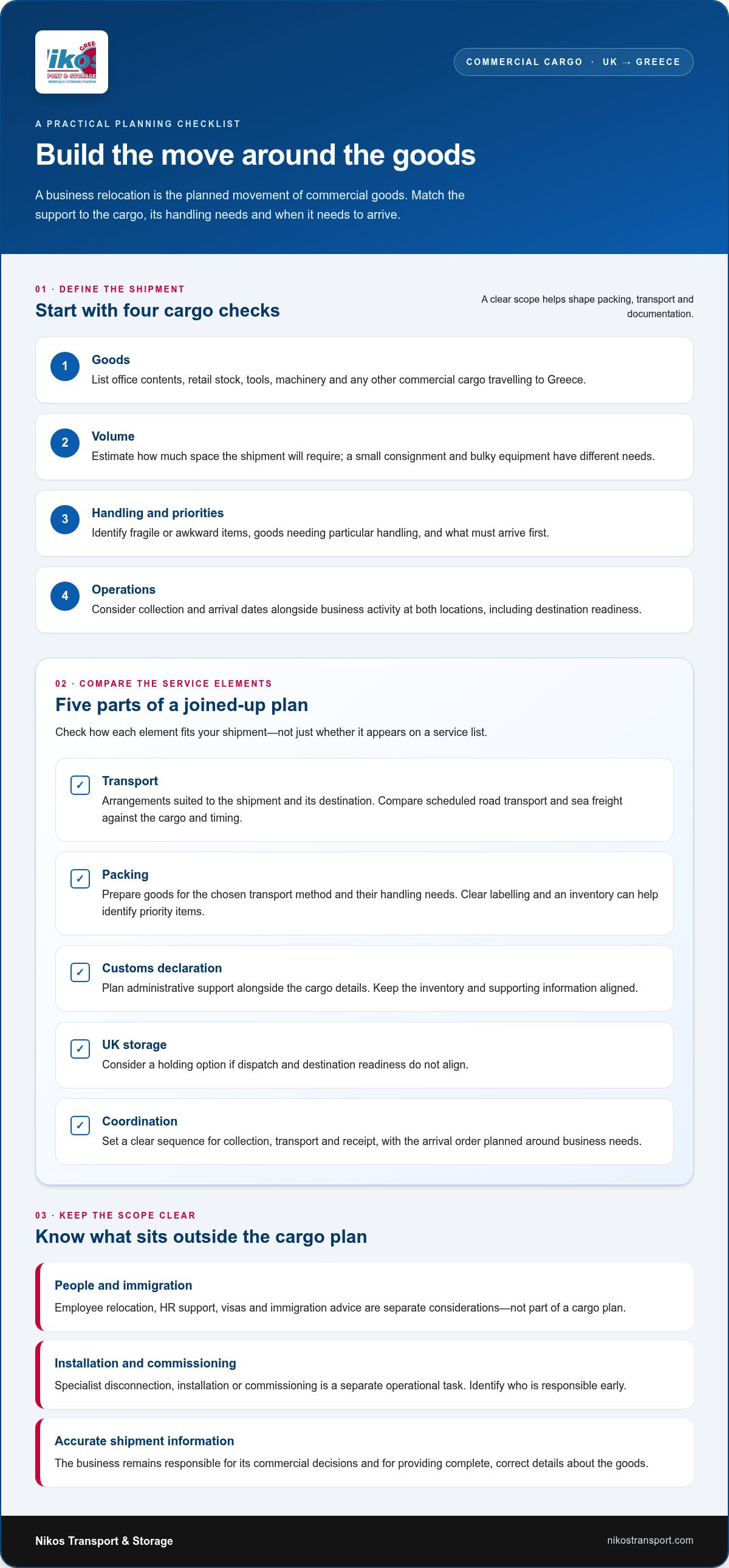
Before arranging the shipment, bring together the details that determine its scope:
- Goods: list office contents, stock, equipment and any other commercial cargo.
- Volume: estimate how much space the shipment will require.
- Priorities: identify fragile, bulky or time-sensitive items and what needs to arrive first.
- Operations: consider collection and arrival dates alongside business activity at both locations.
This keeps the project focused on the needs of business buyers: moving the right goods in a considered order, with practical coordination across the route. A clear cargo scope helps shape decisions about packing, transport and documentation, rather than treating a commercial relocation as simply a larger household move.
What should business relocation services from the UK to Greece include?
A well-organised commercial move brings together the main practical elements: preparing the goods, arranging transport, supporting the customs declaration and managing any gap between collection and the new premises being ready. When comparing business relocation services UK to Greece, consider how each element fits your shipment, not just whether it appears on a service list.
Start with the cargo. Its type, volume, handling needs and required arrival sequence help shape the plan. For example, a business may need essential equipment accessible before less urgent office contents, or stock grouped so it can be organised promptly at the destination. A clear scope helps identify the support needed at each stage.
Use this checklist to compare the components of a relocation plan:
- Transport: arrangements suited to the shipment and its destination.
- Packing: preparation of goods for the selected transport method and their handling needs.
- Customs declaration: administrative support for documenting the international shipment.
- Storage: a UK holding option if dispatch and destination readiness don’t align.
- Coordination: a clear sequence for collection, transport and receipt of the goods.
How packing, transport and customs documentation fit together
Packing prepares commercial goods for their journey. The approach should reflect what is being moved, how it will be handled and how the shipment is arranged for transport. Clear labelling and an inventory can help the receiving team identify priority items. Customs declaration support is a separate administrative part of an international move, so plan it alongside the cargo details rather than leaving it until collection day.
Your business remains responsible for its commercial decisions and for providing accurate information about the goods. A transport or declaration service can support the process, but it doesn’t remove the business’s responsibility to provide complete, correct shipment details. Keep the inventory and supporting information aligned so everyone is working from the same details.
When UK storage can help a business move
Collection and premises readiness don’t always happen at the same time. A lease may start later, a workspace may need preparation, or a business may prefer to send goods in stages. UK warehouse storage provides a practical holding point when dispatch plans and the readiness of the destination don’t align. Nikos offers UK storage as part of its relocation services, helping businesses plan around their operational sequence.
Decide which goods need to travel first and which can wait. This distinction can help you plan storage and avoid sending everything before the receiving space is ready. For more practical planning ideas, see storage in the UK while moving abroad.
Nikos Transport & Storage provides transport, packing, customs declaration support and UK storage for business cargo moving between the UK and Greece. Explore Nikos’s transport and storage support when shaping your shipment plan.
Scheduled road transport or sea freight: how to compare options for Greece
Choosing transport for a commercial shipment is a planning decision, not simply a contest between speed and price. Consider the cargo’s size and handling needs, when it is required, and how collection and receipt fit around your business operations. Both options need coordination, and the shipment details should guide the choice.
Nikos provides weekly scheduled road transport and sea freight logistics for moves between the UK and Greece. Use the comparison below to organise your decision. It outlines factors to consider, rather than suggesting one method will suit every consignment.
Comparison factor
Scheduled road transport
Sea freight logistics
Cargo volume
Consider whether the shipment’s size and handling requirements fit a scheduled road arrangement.
Assess whether the cargo is suitable for a sea freight plan, taking its volume and handling needs into account.
Timing needs
A weekly schedule gives you a regular transport rhythm to plan around. Organise the shipment to suit the service arrangements.
Plan sea freight around the project’s required sequence and coordination needs, without assuming a particular sailing or transit time.
Coordination
Plan collection and receipt in line with the scheduled road service and the readiness of the receiving premises.
Coordinate shipment preparation and handover around the sea freight arrangements and destination readiness.
Type of shipment
Consider this option for cargo that suits the scheduled road arrangement and your operational priorities.
Consider this option where the shipment’s characteristics and project plan suit sea freight logistics.
When scheduled road transport may suit a business shipment
A scheduled service can help a business organise its move around an established transport rhythm. Nikos’s weekly scheduled road transport provides a recurring structure for planning, while the right fit depends on the cargo and the dates your operation can accommodate. Consider which goods need to arrive first, how they’ll be prepared and whether the receiving team can accept them in the planned sequence.
When to consider sea freight logistics
Sea freight is another logistics approach for suitable commercial shipments. Assess it against the cargo’s volume, handling requirements, collection plans and the order in which goods are needed at the destination. Coordinate cargo preparation, transport arrangements and the readiness of the receiving premises. Avoid basing the decision on assumed cost savings or a particular sailing schedule.
For business relocation services UK to Greece, let the shipment and project requirements guide the choice. Compare the options against the same practical questions: what is moving, how it needs to be handled, when it is needed and how its arrival fits with business activity. This gives you a reasoned basis for choosing road transport or sea freight logistics, rather than treating either as a universal answer.
How to prepare a business relocation from the UK to Greece
A practical plan starts with a clear picture of the shipment and ends with both premises ready for the handover. Early shipment information helps tailor the relocation plan to your cargo, priorities and operational arrangements. Work through these steps with the people responsible for the goods in the UK and Greece, so decisions about packing, transport and arrival are coordinated.
- Define the scope. Decide which commercial goods are moving, what will remain in the UK and whether the relocation will happen in one shipment or in stages.
- Create an inventory. List each category of goods and approximate quantities. Include office contents, stock, equipment and other cargo, noting bulky, fragile or awkward items that may need particular handling.
- Set priorities and estimate volume. Identify which items are essential soon after arrival and which can follow later. Estimate the shipment’s overall volume to help plan transport and packing.
- Prepare shipment information. Organise accurate descriptions of the goods and the details needed for the customs declaration. Keep your records consistent with the final inventory, and allow time to address questions or changes before collection.
- Coordinate collection and destination readiness. Agree how goods will be accessed and packed at the UK premises, then plan for the receiving team and space in Greece to be ready for the delivery sequence.
Build a clear cargo and timing brief
Turn the inventory into a working brief for everyone involved. Include approximate quantities, collection requirements, handling priorities and the intended order of arrival. For instance, mark equipment needed to prepare a workspace separately from items that can be unpacked later. This gives the transport and packing plan practical context without assuming a fixed delivery date or sequence before the shipment is organised.
Share the brief with the staff coordinating the move at both ends. They can flag access constraints, planned business activity and changes that could affect collection or receiving arrangements. Keep one current version of the inventory so updates to the cargo scope are reflected consistently in the packing plan and shipment information.
Coordinate paperwork, packing and premises readiness
Gather shipment details and organise customs documentation early, using current guidance for the specific movement rather than relying on assumptions. Nikos provides customs declaration support, while your business remains responsible for supplying accurate information about its goods. For further Greece-focused preparation, consult this guide to UK to Greece customs preparation.
Also align packing with access at each premises. Set out when goods can be prepared for collection, who will coordinate access in Greece and whether the receiving space can accept items in the planned order. Nikos provides transport, packing and customs declaration support to help bring these elements into one plan. Plan your business move with Nikos Transport & Storage.
Plan your UK-to-Greece business move with Nikos Transport & Storage
A business move is easier to organise when the cargo, transport and practical details are considered together. Nikos Transport & Storage is a family-owned transport and storage business founded in 2003, providing services for commercial cargo movements between the UK and Greece. Its services help businesses plan around their shipment and operational priorities.
What Nikos can coordinate for a commercial move
Nikos provides transport between the UK and Greece for commercial cargo, with weekly scheduled road transport and sea freight logistics. The right arrangement depends on the shipment and project requirements, rather than a single method that suits every business.
Nikos’s packing service helps prepare goods for their planned journey, while customs declaration support covers the administrative side of an international shipment. Businesses remain responsible for providing accurate cargo information, so a clear inventory is a useful foundation for coordinating these elements. UK warehouse storage can also help when collection and the readiness of the new premises don’t line up, or when a business needs to plan a transition between stages of its move.
Together, these services support different parts of a relocation: preparing commercial goods, arranging their movement, organising declaration support and storing cargo in the UK where needed. The plan can be shaped around what is moving and how the business expects to receive it.
What to share when requesting a relocation plan
To start a useful conversation, outline the type of cargo, approximate volume and collection requirements. Include your intended timing, any access considerations at the premises and which goods are most important to have available first in Greece. These details clarify the shipment’s scope and the practical arrangements that matter to your operation.
It can also help to explain whether the move is happening in stages, whether some items may need UK storage, and what needs to be ready at the destination before delivery. For broader preparation ideas, see this guide to planning an international move from the UK. Bringing these operational details together gives the relocation plan a clearer starting point.
If you’re considering business relocation services UK to Greece, share your cargo outline and priorities with Nikos to begin shaping a plan around the move. Discuss your UK-to-Greece business transport needs with a team that provides transport, packing, customs declaration support and UK storage.
Set your business move in motion
A cross-border move is easier to manage when someone has a clear view of the decisions and keeps business priorities in focus. Before taking the next step, bring together the people responsible for dispatch in the UK and receiving the goods in Greece. Agree what a successful handover looks like for your team, and use that shared picture to guide your planning.
The right business relocation services UK to Greece should fit the work your company needs to keep moving, not force operations around a generic plan. A focused discussion about your cargo and priorities can turn a complex move into a sequence of practical decisions.
Nikos Transport & Storage provides services for planning commercial moves around the shipment. Discuss your business relocation from the UK to Greece with Nikos to start planning your move.
Frequently Asked Questions
Can a business relocation from the UK to Greece be split into separate shipments?
Yes, a move can be organised in stages if that better suits your operations. For example, a business might send core workspace equipment first and arrange remaining stock separately. Treat each consignment as its own planning unit: keep its inventory distinct, identify who will receive it and consider whether the destination can accept it at that stage. This makes phased movement easier to coordinate with the company’s working arrangements.
How can I estimate the volume of goods for a business move to Greece?
Make a list of items and measure the space they occupy, rather than relying only on a box count. For regular cartons, multiply length by width by height and add the measurements together, using the same units throughout. For furniture or irregular equipment, record approximate dimensions separately and note items that cannot be stacked. Photos can help clarify the estimate, while an on-site assessment may be useful for a complex load.
What information should I prepare for a business relocation quote?
Prepare a concise cargo summary, approximate volume, collection and delivery details, preferred timing, access information and any handling considerations. Note which items are business-critical and whether the shipment is part of a wider move. This gives the team preparing your business relocation services UK to Greece plan useful context, rather than just a goods count. Keep the inventory up to date so changes can be reflected in the planning.
Can business goods travel alongside household belongings?
Business goods and household belongings can be considered within a coordinated move, but keep them clearly distinguished in your inventory. For instance, label company-owned monitors separately from personal furniture, and identify stock apart from household effects. Clear ownership and item descriptions help everyone understand what is being moved and support accurate shipment information. Tell the relocation team which items belong to the business and which are personal when outlining the cargo.
Does a business relocation service move employees as well as commercial goods?
A cargo relocation service is concerned with moving physical goods, not relocating employees or arranging their HR and immigration requirements. Keep these workstreams separate: assign one person to coordinate the shipment and another to manage staff arrangements if employees are moving too. This distinction is useful when personal belongings and company assets are both involved, as each needs to be identified and planned according to its purpose and ownership.
What should a business keep accessible during an international relocation?
Keep items your team needs to continue working separate from cargo intended for the main shipment. This might include essential business records, contact lists, access credentials, a laptop and any small tools or supplies needed to support ongoing operations. Decide who is responsible for these items and where they’ll be kept during the move. Avoid packing critical resources into a consignment before the receiving team is ready to use them.


