

A full load isn’t always the right fit for a move or shipment to Greece. If you’re considering groupage shipping UK to Greece, compare the space your goods need, how flexible your timing is and how delivery can be coordinated when your consignment shares transport with others.
You may be wondering whether your items suit a shared load, how the schedule works and what paperwork to prepare. Groupage can suit smaller consignments, while a larger or time-sensitive shipment may call for a different transport arrangement. Nikos Transport & Storage is a family-owned business founded in 2003, supporting household and commercial shipments between the UK and Greece.
This guide explains how groupage works and what to weigh up against other transport options. You’ll find practical steps for describing and preparing your goods, organising customs documentation and planning delivery, so you can choose an approach that fits your shipment.
Key Takeaways
- Understand how groupage combines compatible consignments and whether shared transport suits your shipment.
- Compare groupage, part load and full load by considering volume, timing flexibility and delivery coordination.
- Follow the main steps for arranging groupage shipping UK to Greece, from describing your goods to planning delivery.
- Use a practical checklist to measure and package your consignment and prepare information for customs paperwork.
- See how Nikos Transport & Storage supports household and commercial shipments with weekly scheduled road transport and sea freight logistics.
What is UK to Greece groupage shipping and who is it for?
Groupage shipping UK to Greece combines compatible consignments in shared transport. Instead of booking a vehicle for your shipment alone, you use part of the available capacity alongside other goods travelling on a suitable route. Each consignment remains distinct, but shares the journey. This can be practical if your goods don’t need a dedicated vehicle and you can plan around the coordination involved.
Groupage is freight transport for shipments such as palletised business goods or larger household consignments. It is different from simply forwarding an individual online order. For example, a business sending a smaller quantity of stock may not need a full vehicle. A household shipment may also suit shared transport, depending on its contents, packing and collection or delivery arrangements.
When does a shared consignment make practical sense?
Start with three considerations: how much you’re sending, how flexible your schedule is and how straightforward delivery will be to coordinate. Shared capacity may suit a business sending a few pallets of stock if the shipment doesn’t need a dedicated vehicle and its arrival can fit around the transport schedule.
Household goods need more than a simple pallet count. Furniture, boxed belongings and unusually shaped items can have different packing and handling requirements. Make an inventory and note the size and nature of each item, so the transport plan reflects the actual consignment. If you have a fixed delivery date or goods requiring particular handling, account for that before choosing a shared load.
How does groupage differ from a full load or parcel service?
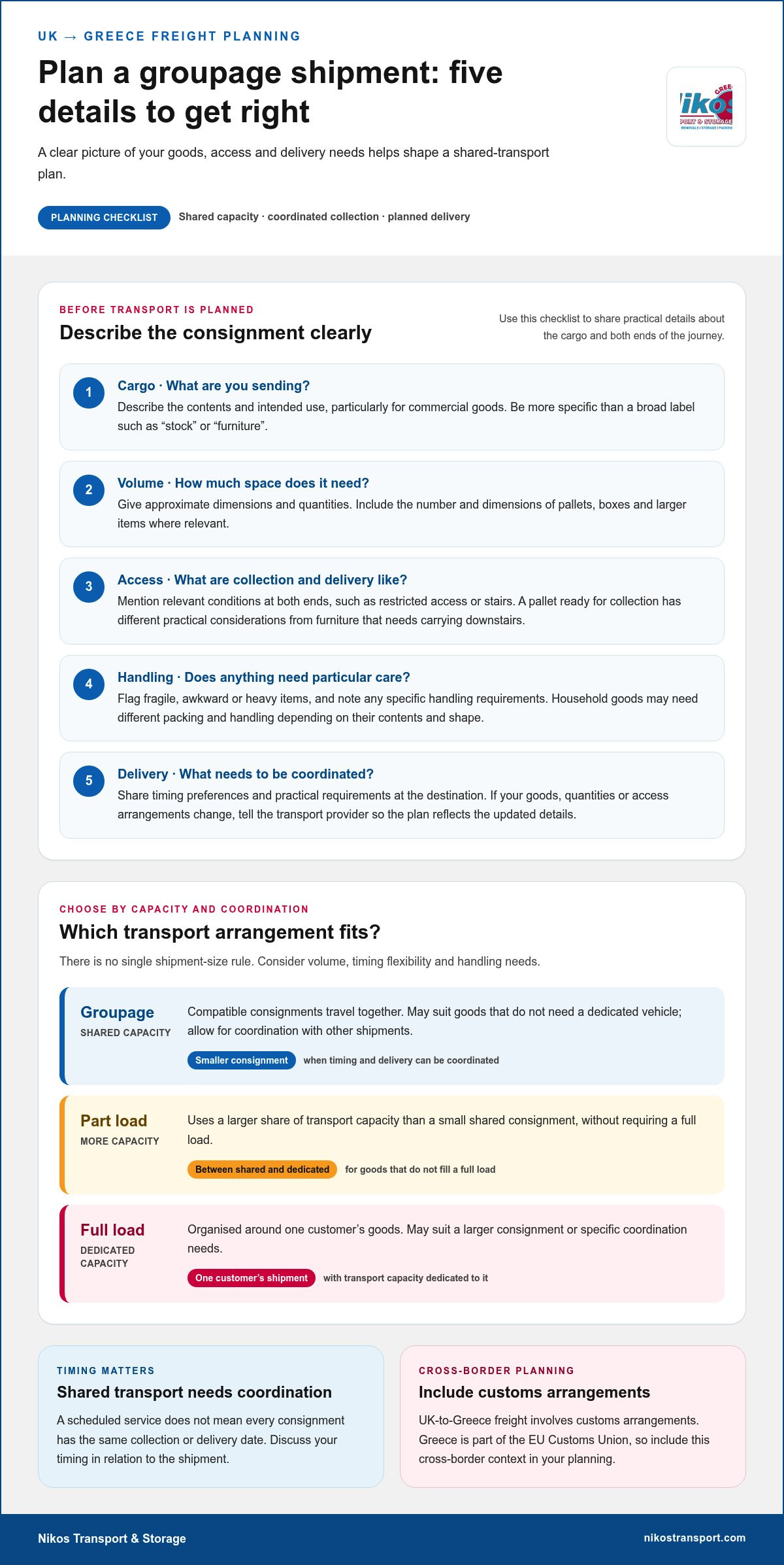
The main difference is how much transport capacity your shipment uses and how it fits into the journey. A full load is organised around one customer’s goods and uses dedicated capacity. Groupage combines compatible consignments, so the journey and delivery arrangements involve coordination with other shipments. A part load sits between these options, using more capacity than a small shared consignment without requiring a full load. The best fit depends on volume, timing flexibility and handling needs, rather than one fixed shipment-size rule.
- Groupage: shared transport for a consignment that doesn’t need a dedicated vehicle. Allow for coordinated delivery.
- Part load: a larger share of transport capacity for goods that don’t fill a full load.
- Full load: dedicated capacity for one customer’s shipment, which may suit a larger consignment or specific coordination needs.
Parcel forwarding serves a different purpose, usually moving individual parcels or online orders rather than freight planned by overall volume and handling needs. If you’re sending a parcel rather than palletised goods or household items, read the guide to UK parcel forwarding to Greece. Any UK-to-Greece freight shipment also involves customs arrangements. Greece is part of the EU Customs Union, so include this cross-border context in your planning.
Groupage shipping to Greece: collection to delivery
Start with a clear description of your goods. Groupage shipping UK to Greece involves matching your consignment to shared transport, preparing it for the journey and coordinating collection and delivery alongside other shipments. The cargo, access arrangements and preferred schedule all affect how transport can be planned.
Groupage is the transport of compatible consignments together in shared capacity, with each shipment planned and delivered according to its own requirements.
Nikos Transport & Storage provides weekly scheduled road transport between the UK and Greece, alongside sea freight logistics. These are different approaches to transport, and the suitable route depends on the shipment and its requirements. A scheduled service does not mean every consignment has the same collection or delivery date, so discuss timing in relation to your shipment.
What information helps plan a groupage shipment?
Describe what you’re sending, approximately how much space it takes up and where it needs to be collected and delivered. For commercial cargo, say whether it is palletised and provide the number and dimensions of the pallets. For household goods, list the main items and note whether they are boxed, bulky or unusually shaped. Specific details are more useful than broad labels such as “stock” or “furniture”.
- Cargo: explain the contents and intended use, particularly for commercial goods.
- Volume: give approximate dimensions and quantities, including pallets, boxes or larger items.
- Access: describe relevant collection or delivery conditions, such as restricted access or stairs.
- Handling: flag fragile, awkward or heavy items and any specific care they need.
- Delivery: share timing preferences and practical requirements at the destination.
Access affects how collection and delivery are arranged. A pallet ready for straightforward collection presents different practical considerations from furniture that needs to be carried down stairs. Share access details early so the transport plan reflects conditions at both ends.
What should you expect during transport coordination?
Once the shipment is described, its transport and delivery arrangements can be planned around the cargo and route. Because groupage brings multiple consignments together, coordination depends on keeping each shipment’s details and delivery requirements clear. Make sure the information you provide is consistent, and tell the transport provider if the goods, quantities or access arrangements change.
Schedules and transit estimates vary by service and consignment. Use current, shipment-specific details when planning a move or business delivery. Nikos Transport & Storage’s family-owned team supports transport between the UK and Greece. For a household move with wider planning needs, international removals planning can help organise practical steps alongside transport. Explore Nikos’s UK-to-Greece transport support as part of your planning.
Groupage or another shipping option: how to choose for Greece
Choose a transport format by matching it to your consignment. Compare the space your goods need, how flexible your delivery window is and whether the cargo requires particular handling. Groupage may suit a smaller shipment, but shared transport means coordinating with other consignments.
Decision rule: If your shipment is modest in size and your timing has some flexibility, consider groupage. As volume, urgency or specific handling needs increase, compare part-load and full-load arrangements.
| Option | Shipment volume | Timing and coordination | Handling considerations |
|---|---|---|---|
| Groupage | A smaller consignment that doesn’t require a dedicated vehicle. | Transport is shared, so allow for coordination with other shipments and the service schedule. | Goods need to be suitable for shared transport and clearly described for planning. |
| Part load | A shipment that needs more capacity than a small consignment, but not a full load. | Consider how the available capacity and delivery arrangements fit your preferred schedule. | Provide accurate dimensions and explain any handling or access requirements. |
| Full load | A larger consignment requiring dedicated transport capacity. | A dedicated arrangement may better suit specific timing or coordination needs, subject to the service plan. | Useful to assess where cargo requirements make shared transport less suitable. |
When might groupage be a better fit than a dedicated load?
Groupage can make sense when your goods occupy only part of a vehicle and you can plan around shared transport. For example, a business sending a limited quantity of stock may not need to reserve a full load. A dedicated arrangement may suit a larger volume that needs the capacity, or a shipment where a particular collection or delivery window is central to the plan. Neither format is automatically faster or more suitable. The shipment details determine the best fit.
How should cargo type and delivery needs affect the decision?
Commercial cargo and household goods need different planning, even if both could travel in shared transport. For business goods, consider whether they’re palletised, how they’re packaged and whether delivery must fit stock or site arrangements. For household belongings, account for bulky or fragile items, collection access and the practicalities of delivery at the destination. Describe these needs early so they can inform the transport choice.
Consider how much coordination you can accommodate. If the delivery date is inflexible or the goods need particular handling, compare transport formats against those constraints rather than choosing on volume alone. Customs preparation is another part of a UK-to-Greece shipment. The guide to UK-to-Greece customs preparation covers that aspect. A clear picture of cargo, access and timing helps you weigh groupage against part load or full load.
Preparing goods and paperwork for UK to Greece groupage
Good preparation starts with accurate information. For groupage shipping UK to Greece, a clear description helps the transport plan reflect what is travelling, while suitable packaging helps protect goods in shared transport. Treat shipment details and customs paperwork as separate tasks: the first supports transport planning, while the second must match the current requirements for your goods and circumstances.
What cargo details should be ready before arranging transport?
Prepare a practical summary before discussing the shipment. Include enough detail for someone unfamiliar with your goods to understand their size, quantity and handling needs. A vague description such as “household items” or “products” may not show whether the consignment includes bulky furniture, fragile pieces or palletised stock.
- Goods description: identify the items clearly, using plain, specific terms.
- Quantity: note the number of boxes, pallets or individual larger items.
- Dimensions: measure each item or package and record its length, width and height.
- Handling needs: flag fragile, unusually shaped or heavy goods and explain any care they require.
- Collection and delivery: describe access conditions or other practical details that could affect arrangements.
Accurate measurements matter. A few boxes need a different space assessment from several large pieces of furniture, even if both are described as a small shipment. If the quantity or dimensions change, update the information so planning and delivery coordination reflect the revised consignment. These details help with household goods and commercial cargo, though packing and handling should suit the contents.
How can you prepare goods and customs information?
Choose packaging to suit the goods, not just the container. Use sturdy outer packaging where appropriate, protect delicate surfaces and close each package securely. Label boxes or packages clearly so you can match them to your inventory. For awkward or fragile items, consider how the packaging will protect them during shared transport, and explain any special handling needs when arranging the shipment.
Keep an inventory or goods list consistent with the cargo description you provide. The customs paperwork required can depend on the shipment and its purpose, so don’t assume a general packing list is a complete customs declaration. Requirements may change and can differ between personal belongings and commercial goods. Verify current UK-to-Greece customs, tax and restricted-goods requirements before relying on specific rules or preparing documents.
For customs-specific background, read the guide to UK-to-Greece customs preparation and consult current authoritative guidance for the details that apply to your shipment. With the cargo described, measured and packed, you’ll be better placed to organise transport. Arrange UK-to-Greece transport with Nikos for support with your shipment planning.
Arrange UK-to-Greece groupage shipping with Nikos Transport
Nikos Transport & Storage provides groupage shipping UK to Greece for household goods and commercial cargo. As a family-owned business founded in 2003, the team supports shipments ranging from business stock to belongings for a major move. Share the consignment’s contents, size and delivery needs so transport can be planned around the shipment.
Nikos Transport & Storage provides weekly scheduled road transport and sea freight logistics. The appropriate arrangement depends on the shipment and its requirements. Scheduled services provide a framework for planning, but specific departure and delivery dates depend on the current arrangements. Plan around details relevant to your consignment rather than assuming a fixed date.
What information helps Nikos Transport & Storage plan your shipment?
A concise, accurate outline gives the team a useful starting point. Include what you’re sending, the approximate volume and where collection and delivery are required. For commercial cargo, describe the goods and note quantities, pallets or package dimensions where available. For household belongings, mention larger furniture, boxes and fragile or awkward items so the nature of the load is clear.
- Goods and quantity: describe the contents and how many items, boxes or pallets are involved.
- Approximate volume: share dimensions or an estimate of the space needed.
- Collection and delivery: explain the locations and any timing preferences.
- Access and handling: mention relevant access conditions, stairs, bulky goods or special care needs.
These details help shape the transport approach and identify what needs coordinating. If your inventory or delivery arrangements change, include the updated information in your discussion. A clear summary is more useful at the outset than trying to anticipate every transport detail.
What happens after you make an enquiry?
The shipment information helps the team understand your priorities and plan transport. For a business, that may mean considering how cargo quantity and delivery requirements fit its operations. For a household, it may involve discussing the belongings being moved and practical arrangements for collection and delivery. Each consignment is different, so planning should reflect its contents and circumstances.
As arrangements take shape, keep the details together, including your goods description, approximate dimensions, access notes and timing preferences. This gives everyone a clear reference point for coordination and helps prevent confusion if plans change. Nikos Transport & Storage's family-run team guides customers through the transport discussion, whether they’re organising commercial cargo or personal belongings. Share a few practical details to begin planning your shipment.
Discuss your UK-to-Greece shipment with Nikos Transport & Storage
Turn your shipping decision into a clear plan
Turn your priorities into a brief that can guide the transport discussion. Decide what matters most for this consignment: making best use of shared capacity, working around a preferred delivery window, or accommodating particular handling needs. This helps you assess whether groupage shipping UK to Greece fits your plans, rather than choosing based on assumptions.
Before arranging transport, bring together a simple description of the goods, approximate dimensions and any practical details that could affect collection or delivery. If dates or access arrangements are still taking shape, explain that. Being clear about what is settled and what may change makes planning more straightforward.
Nikos Transport & Storage takes a personal, supportive approach to each shipment, helping customers move from an initial idea towards transport arrangements that reflect their needs. Start planning your UK-to-Greece shipment with Nikos Transport & Storage. With the key details in hand, you can move forward with greater confidence.
Frequently Asked Questions
What is groupage shipping from the UK to Greece?
Groupage shipping combines compatible consignments in shared transport rather than dedicating a whole vehicle to one customer. Your goods remain a distinct shipment, with their own description and delivery requirements. It can suit freight that doesn’t need dedicated capacity, provided the shared schedule and coordination work for your plans. It differs from sending a single parcel through a parcel-forwarding service.
Can I send a small consignment to Greece by groupage?
Yes. A smaller consignment can be sent by groupage if it is suitable for shared transport. There isn’t a universal size that defines “small”, as the space, dimensions, type of goods and handling needs all matter. For example, a few cartons of commercial stock may be planned differently from one bulky item. Describe the shipment clearly so its transport needs can be assessed.
Is groupage shipping suitable for household goods as well as business cargo?
Yes. Groupage can be used for household belongings and business cargo, but each needs different preparation. A business shipment might comprise packaged stock or pallets, while a household consignment could include furniture, boxes and fragile items. Make the contents and handling needs clear. For a household move, consider how collection and delivery access affect the practical plan.
How long does groupage shipping from the UK to Greece take?
General estimates for standard road-freight groupage to mainland Greece are around 7 to 12 days, but this is an indication, not a guaranteed Nikos delivery time. Timing can depend on the current service schedule, the consignment and its collection and delivery arrangements. If you’re planning around a move or stock requirement, use current, shipment-specific timing details rather than relying on a general estimate.
What information do I need to arrange groupage shipping to Greece?
Prepare a clear description of the goods, their quantity and approximate dimensions, along with collection and delivery details. Include access information, such as stairs or restricted space, and flag fragile, bulky or awkward items. For example, “three boxed chairs and one table” gives a clearer picture than “furniture”. Keep your cargo summary consistent with your inventory and any paperwork for the shipment.
How much does groupage shipping from the UK to Greece cost?
The cost depends on the shipment and transport arrangements, so there isn’t one price for every consignment. The goods’ dimensions, overall volume, handling needs and delivery requirements can all inform an individual assessment. Provide accurate measurements and describe the cargo, rather than estimating from the number of boxes alone. Nikos can discuss the transport needs of your shipment.
Can groupage shipments be sent to Greek islands?
Include Greek-island destinations in the transport plan, as the destination can affect the route and delivery coordination. Share the island name, full delivery details and any access or timing considerations when describing your shipment. A mainland Greece schedule may not apply automatically to an island delivery. Clear destination information helps the team plan the arrangements for your consignment.


